Houseplant · Moraceae
Creeping Fig
Ficus pumila
An easy, fast climber that clings to anything and asks mainly for bright shade and steady humidity.
Bright indirect
Every 5–10 days
61–75°F · 16–24°C
USDA 8–11
Overview
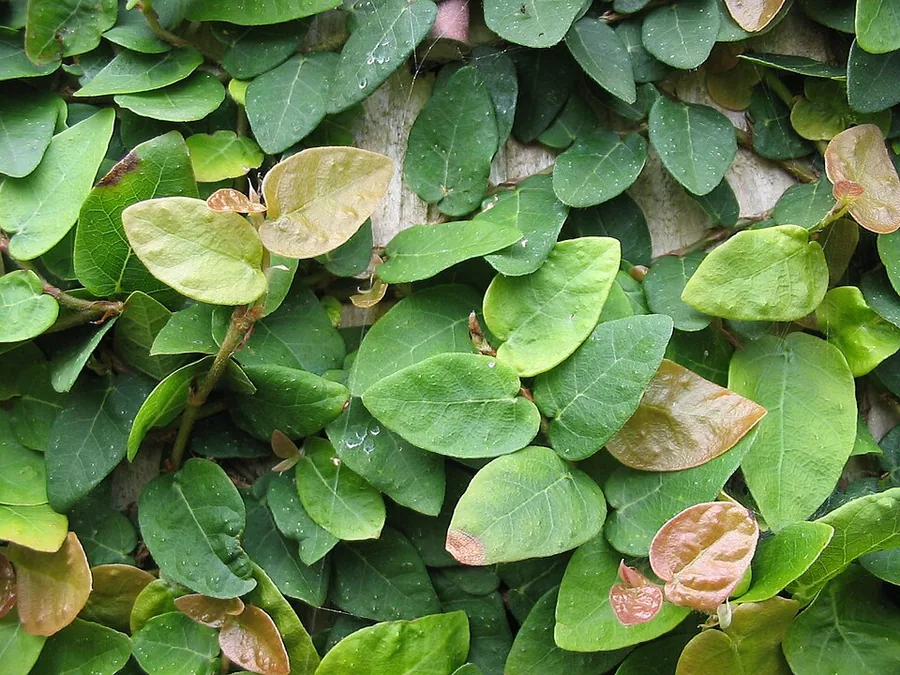
Creeping fig is a small-leaved evergreen vine in the fig family, native to East Asia and grown the world over as a houseplant. The juvenile growth most people know is delicate and dense, with heart-shaped leaves no bigger than a thumbnail running along wiry stems. Give it a pole, a frame, or a wall and it climbs, gripping by adhesive aerial rootlets that let it scale almost any surface.
Indoors it stays a tidy, fast-growing trailer or climber that takes happily to a hanging pot, a moss pole, or a terrarium. The same vigor that makes it easy can run away from you, so a quick trim now and then keeps it in bounds. It tolerates lower light than most figs, which is part of why it earns an easy reputation.
Two things are worth knowing before you bring one home. The milky sap can irritate skin and isn't safe for pets, so handle it with gloves and keep it out of reach. And outdoors in mild climates it can turn invasive and damage walls, so it's best kept to a pot.
Care
The short version: bright indirect light, soil kept evenly moist but never soggy, warm rooms, and high humidity, with a trim whenever the vine outgrows its space.
Light
Give creeping fig bright indirect light for the best growth. It puts up with medium light, part shade, and even full shade better than most figs, so a spot away from a window still works. Keep it out of harsh direct sun, which scorches the small leaves.
Water
Water through the growing season to keep the mix moist but never soggy, letting the top inch or so dry before the next drink, which usually lands every 5 to 10 days. Ease off from fall into late winter as growth slows. Soggy roots are the fastest way to kill it, so drainage matters more than a strict schedule.
Soil
Plant in a soil-based potting mix rich in organic matter that still drains freely. The roots want moisture they can reach without sitting in water, so a mix that holds some damp but lets the excess run through is ideal.
Temperature
Keep it in the warm range it likes, roughly 61°F to 75°F (16°C to 24°C). Steady indoor warmth suits it well, so just keep it clear of cold drafts and chilly windows in winter.
Humidity
This fig wants high humidity and shows its displeasure with crispy, dropping leaves in dry rooms. Group it with other plants, set it over a pebble tray, or run a humidifier, especially when the heating is on.
Feeding
Feed monthly through spring and summer with a balanced general-purpose houseplant fertilizer while the plant is in active growth. Stop feeding once growth slows in fall and winter, when the plant isn't using it.
Pruning
Expect to prune, because this is a vigorous vine that grows fast. Trim wayward or leggy stems whenever you like to keep it tidy and the right size, and cut back any growth creeping where you don't want it. Regular trimming is normal care here, not a rescue.
Repotting
Move it up a pot size every 1 to 2 years in spring as it fills its container. Roots circling the pot or pushing out the drainage holes, water running straight through, and stalled growth all say it's time. Step up just one size so the fresh mix doesn't stay wet around a small root ball.
Size & spacing
Trained on a support indoors it can reach 8 to 15 feet (2.4 to 4.5 m) over time, with a spread of about 3 to 6 feet (91 to 183 cm). Most growers keep it far shorter with regular pruning, and a pot naturally holds it in check.
Troubleshooting
Creeping fig is forgiving, but it tells you fast when the air or the watering is off. Most trouble shows on the leaves, so read the foliage and act before a few crispy edges turn into bare stems.
Leaves browning at the edges and dropping
Creeping fig sheds leaves when the mix dries out too far or the air around it turns dry. The small leaves crisp up, curl, and fall, often starting near the bottom. Keep the soil evenly moist through the growing season and lift the humidity with a pebble tray, a humidifier, or a cluster of nearby plants.
Fix:
- Water regularly during the growing season to keep the mix evenly moist but not soggy
- Raise humidity by grouping plants, using a pebble tray, or a humidifier
Fine webbing and dull, speckled leaves
Hot, dry air invites spider mites, and creeping fig is a favorite target. You'll spot faint webbing and tiny moving dots on the leaf undersides while the foliage turns dull and stippled. Rinse the leaves, push the humidity up, and treat with insecticidal soap or horticultural oil, repeating until the mites are gone.
Fix:
- Rinse foliage and increase humidity
- Treat with insecticidal soap or horticultural oil, repeating as needed
Toxicity
This is not a plant to leave within reach of pets or small children. The stems and leaves carry a milky sap with ficin and furocoumarins that irritates the mouth and gut and stings bare skin. Nothing here is meant to be eaten, and you should wear gloves whenever you prune or train it.
Toxic to
Cats · Dogs · Horses · Rabbits · Livestock · Birds · People
Cats Mild
A cat that chews the leaves or stems gets a mouthful of the milky sap, which irritates the mouth and gut. Drooling and vomiting are the usual result, and the sap can leave the skin red and sore where it touches.
Dogs Mild
Dogs react the same way cats do, with an irritated mouth, an upset stomach, and sometimes vomiting after a nibble. The sap can also redden the skin on contact.
Horses Mild
The same latex bothers horses, bringing on mouth and stomach irritation if they browse the foliage.
Rabbits Caution
There's no safety record for rabbits and this fig, and the irritating sap gives no reason to risk it. Keep the plant out of reach and don't offer it as a green.
Livestock Caution
Grazing animals aren't known to seek it out, but the latex that troubles other mammals would likely irritate them too. Best to keep it away from where they feed.
Birds Caution
Little is documented about creeping fig and birds, so treat it as off limits rather than safe and keep pet birds clear of the foliage and sap.
People Caution
The sap is a skin irritant and can trigger contact dermatitis, so wear gloves when you prune or train it. This isn't a plant to eat, and the sap should be kept off bare skin and out of the eyes.
Wear gloves when handling or pruning, as the milky latex can cause skin (contact) dermatitis.
Helpline numbers

United States
ASPCA Animal Poison Control: (888) 426-4435 (fee applies)
Poison Control: (800) 222-1222



Canada
Poison Centres: 1-844-764-7669
Varieties
Most creeping figs sold are the plain species, but a few cultivars stand out for leaf shape or color. These are the ones you're likely to run across.
'Minima'
A slow, mat-forming dwarf with small quilted leaves that suits terrariums and trails neatly over the lip of a pot.
'Variegata'
Wiry stems carry small heart-shaped leaves edged in broad creamy white.
'Quercifolia'
Its tiny leaves are lobed like miniature oak leaves, which makes it a good fit for containers and terrariums.
'Curly'
The leaves curl and crinkle, each marked with a variegated stripe running down the center.
How to propagate
Few houseplants are easier to multiply. The juvenile stems root almost on contact, so you can grow new plants from cuttings or by layering a stem still attached to the parent.
Stem cuttingsEasy
Spring through summer during active growth · A few weeks to root
Take cuttings from the juvenile growth in spring or summer while the plant is growing. This stage roots so willingly that you can skip the rooting hormone, and a cutting strikes in a few weeks.
LayeringEasy
Spring through summer · Several weeks to root where stems touch the medium
Creeping fig layers itself, since the trailing stems throw out aerial rootlets wherever they touch a surface. Pin a stem onto moist medium in spring or summer and it roots along its length over several weeks, giving you a new plant to cut free.
Myths
Creeping fig gives you edible figs like the common fig tree.
It does fruit, but only mature outdoor plants set the pear-shaped figs, and they're bland and not worth picking. Indoors the plant almost never flowers, let alone fruits. Grow this fig for its foliage, not a harvest.