Ornamental · Poaceae
Pink Muhly Grass
Muhlenbergia capillaris
Give it full sun and lean, dry ground, and pink muhly grass turns to a cloud of rose-pink haze every fall.
Full sun
Every 7–14 days
USDA 6–10
2–3 ft · 0.6–0.9 m
Overview
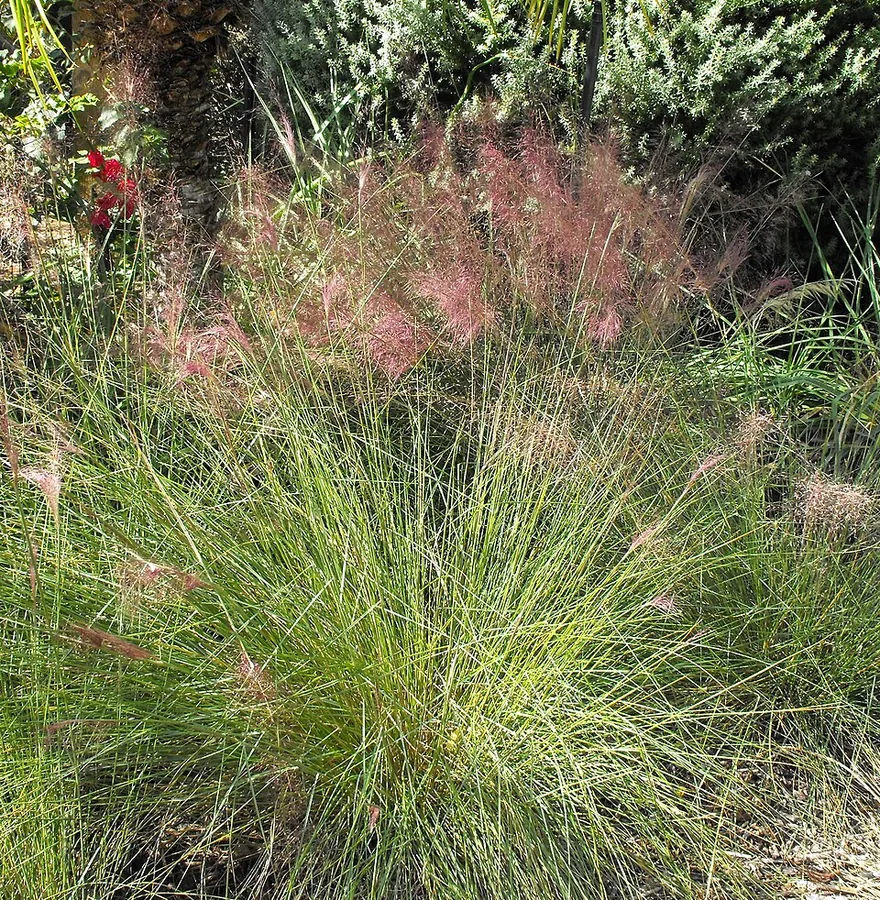
Pink muhly grass is a clump-forming native of the eastern and southern United States, grown for one spectacular trick. For most of the year it sits quietly as a fountain of fine green blades, then in fall it throws up an airy cloud of rose-pink plumes that catches the low light and seems to glow. It belongs to the grass family and asks for almost nothing in return.
What makes it such an easy plant is how little it wants. It handles heat, salt, and long dry spells once its roots are down, and it shrugs off the pests and diseases that trouble fussier ornamentals. The catch is that it earns its keep only in the right spot: full sun and lean, fast-draining soil. Rich, wet ground turns the whole thing soft and floppy.
Use it in a mass and the fall display reads from across the yard, a drift of pink that holds for weeks before fading to tan for winter. The clump stays put rather than running, so it won't take over a bed, and a single cut-back in late winter is most of the work a season asks of you.
Care
The short version: full sun, lean and well-drained soil, and very little water once it's established. Skip the fertilizer, leave it standing through winter, and cut it back hard in late winter before new growth starts.
Light
Give it full sun, 6 or more hours a day. Sun is what drives the dense, upright clump and the heavy pink bloom, and it's the single biggest factor in how good the plant looks. In shade the stems weaken, the plumes thin out, and the whole clump splays open.
Water
Water it regularly through the first season to settle the roots, and after that it barely needs you. Mature plants are highly drought tolerant and get by on rainfall alone in most spots. The real danger is the other way around, since wet, soggy ground rots the crown.
Soil
It wants lean, dry, well-drained soil, the kind of sandy or rocky ground that defeats fussier plants. A pH anywhere from 5.5 to 8.0 is fine, and it even takes clay so long as the drainage is sharp. Skip the rich, amended beds, which only make it floppy.
Temperature
This is a hardy, adaptable grass, comfortable across a wide swing from roughly -9°F to 104°F (-23°C to 40°C). It takes summer heat without flinching and survives hard winters down to zone 6.
Humidity
Ordinary outdoor humidity suits it fine, with no number to fuss over. What matters far more is good drainage and air around the crown, since the one thing it can't abide is staying wet.
Feeding
Don't feed it. This native actually performs best in lean, low-fertility soil, and a dose of fertilizer backfires by pushing soft, leafy growth and fewer blooms. Lean treatment is what keeps it upright and flowering.
Pruning
There's just one job a year. Cut the whole clump back to about 6 to 8 inches (15 to 20 cm) in late winter or early spring, before the new blades push up. Leave the old foliage standing through winter for cold protection and looks.
Repotting
It rarely needs dividing or potting on. Over many years an old clump may die out in the center, leaving a bare ring with fading vigor and fewer plumes, and that's the cue to lift and split it rather than repot.
Size & spacing
Plants reach about 2 to 3 feet (61 to 91 cm) tall and just as wide. Space them roughly that far apart, around 2 to 3 feet (61 to 91 cm), so each clump fills out into its rounded form with room to breathe.
When to plant
Pink muhly grass runs on a warm-season clock, greening up in spring and saving its show for fall. Sow seed indoors in late winter to early spring and set plants out after the last frost, and the pink plumes arrive from September into November.
Northern hemisphere
Southern hemisphere
Typical months for a temperate climate: start earlier in warm zones, later where spring frosts linger.
- Sow: Late winter to early spring
- Plant: Spring after last frost
- Harvest: September to November
Hardiness
USDA hardiness zones: 6–10
Temperature: down to -23°C
Troubleshooting
This is a tough grass, so trouble is rare and almost always comes down to the wrong spot rather than a disease. The clues show up in the bloom, the crown, or the base of the stems. Match what you see below, then fix the conditions behind it.
The plant rots or fades in soggy ground
This is root and crown rot, and it traces straight back to wet, heavy soil that never dries out. The crown turns mushy and the clump thins from the middle. Give it sharp drainage in sandy or rocky soil, plant on a raised mound if your ground runs to clay, and let the soil dry between waterings.
Fix:
- Plant in well-drained sandy or rocky soil, or amend heavy soil and plant on a raised mound or berm
- Reduce irrigation; allow soil to dry between waterings
- Remove dead rotted portions and replant healthy divisions in a drier, well-drained site
White cottony clusters at the base of a stressed plant
Those waxy white tufts at the leaf bases and crown are muhly grass mealybug, the one pest that troubles this otherwise tough grass. A heavy load leaves the plant stunted and off-color. Cut back and bin the infested foliage in late winter, hold off on the fertilizer that flushes the soft growth they favor, and let natural predators do the rest.
Fix:
- Cut back and remove heavily infested foliage in late winter
- Encourage natural predators and avoid excess fertilizer that flushes soft growth
Few or no pink plumes, and the clump flops open
A muhly grass that won't put on its fall show is almost always sitting in too much shade or soil that's too rich. Shade weakens the stems and starves the bloom, while fertile, frequently watered ground pushes lush leaves at the expense of plumes and splays the clump apart. Move it into at least 6 hours of direct sun, stop feeding, and ease off the water so it grows lean and upright.
Fix:
- Relocate or plant in full sun (6 or more hours of direct sun) for the best plume color, density, and upright form
- Stop fertilizing and reduce watering; grow in lean, dry, well-drained soil
- Cut back in late winter so vigorous new growth emerges in the right conditions
Toxicity
Good news for households with pets: pink muhly grass is safe across the board. It carries no toxins for cats, dogs, horses, rabbits, livestock, or people, and it isn't on the ASPCA's list of harmful plants. The only thing worth a mention is the heavy fall pollen, which can bother allergy-prone people.
Safe for
People · Cats · Dogs · Horses · Rabbits · Livestock · Birds
Cats None
Safe for cats, with no toxic compounds in the leaves or plumes. A cat that grazes a big mouthful might bring it back up, the way grass often does, but that's all.
Dogs None
Nothing here harms a dog. The worst you'll see from a curious chewer is the occasional bout of vomiting that any grass can cause.
Horses None
Horses can graze near it without worry, since the grass carries no toxins.
Rabbits None
Rabbits can nibble the foliage safely; it's a plain, harmless grass.
Livestock None
Cattle, goats, and sheep face no danger from this native grass and may graze it freely.
Birds None
Birds come to no harm around it, and many pick at the seed heads through fall and winter.
People None
Harmless to handle and plant. The one thing to note is the heavy fall pollen, which can stir up seasonal allergies in sensitive people.
Not poisonous, but pets that nibble large amounts of grass may vomit, and the abundant fall pollen can aggravate seasonal allergies in sensitive people.
Varieties
Most gardeners grow the straight species for its pink fall haze, but a few selections and close relatives are worth knowing.
White Cloud
A selection that trades the usual pink for white to cream plumes and shrugs off tar spot better than the species.
Pink Flamingos
A taller natural hybrid of M. capillaris and M. lindheimeri that reaches 3 to 4 feet with bright pink plumes aging to silvery-gray.
Lindheimer's muhly (Muhlenbergia lindheimeri)
A related, larger species native to central Texas, a 2 to 5 foot silvery-plumed clumping bunchgrass often planted as a tall specimen.
Bamboo muhly (Muhlenbergia dumosa)
A related species with arching, semi-woody bamboo-like stems and lacy pale-green foliage that forms a fountain 5 feet tall and wide.
How to propagate
Pink muhly grass is easy to multiply, whether you split a clump you already have or start fresh from seed.
DivisionEasy
Spring · One growing season
The simplest way to make more is to divide an established clump in early spring. Lift the whole crown, split it into pieces, and replant. Each division settles in over a single growing season and comes back as a full plant.
SeedEasy
Spring (sow indoors late winter to early spring)
Seed is easy too, and it won't take over the bed, since this grass spreads by clump rather than running rhizomes. Sow indoors in late winter to early spring and set the seedlings out after frost. Give them one to two growing seasons to reach blooming size.
Myths
Muhly grass needs rich, fertilized, frequently watered soil to bloom well.
The opposite is true. It flowers best and holds itself upright in full sun and lean, dry, well-drained soil, while rich, wet, fertilized ground gives you floppy leafy growth with few plumes and invites root rot. Treat it mean and it blooms its best.
Sources
- USDA NRCS PLANTS Database
- NC State Extension Gardener Plant Toolbox
- Missouri Botanical Garden
- University of Florida IFAS Gardening Solutions
- Texas A&M AgriLife Extension (Texas Superstar)
- NC State Extension Gardener Newsletter
- ASPCA Animal Poison Control
- NC State Extension Gardener Plant Toolbox
- NC State Extension Gardener Plant Toolbox