Ornamental · Poaceae
Creeping Bentgrass
Agrostis stolonifera
A fine, carpet-like turf that looks like a putting green and demands the care of one.
Full sun
Every 1–3 days
USDA 3–7
0–1 in · 0–2 cm
Overview
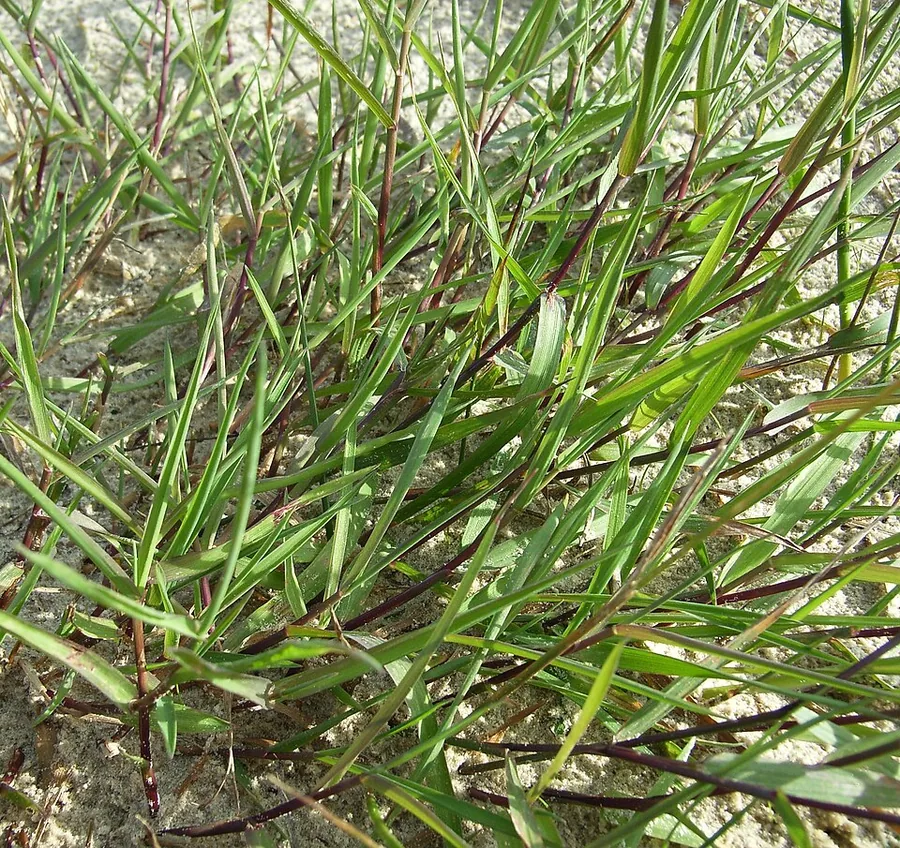
Creeping bentgrass is the fine, low grass behind the smooth surface of golf greens. It belongs to the cool-season grasses and spreads sideways by surface stolons, knitting into a dense, soft carpet that takes a very close cut. Left unmown it sends up airy purple to lavender seed heads in midsummer.
What sets it apart is the upkeep. This is a demanding grass that wants close, frequent mowing, cool moist soil, and steady attention, and it falls apart fast without them. Mow it high or skip a cut and it goes puffy, builds thatch, and thins out, which is why it suits a managed green far better than a backyard.
The same vigor that makes a tight green makes it a problem elsewhere. Its creeping stolons let it escape into other lawns, where it shows up as flat, light-green patches that are tough to dig out and tough to kill without taking the surrounding grass with them.
Care
The short version: full sun, cool and constantly moist soil, very close and frequent mowing, a light steady feed, and a watchful eye for fungal disease in warm humid weather.
Light
Bentgrass wants full sun. It tolerates no real shade, and a green that sits in shade thins, weakens, and grows far more disease-prone.
Water
Keep the soil cool and constantly moist, watering roughly every 1 to 3 days and more in heat. This is a thirsty grass with little drought tolerance, so it suffers quickly in a dry summer spell.
Soil
Give it fertile, moist, well-drained loam or silt on the slightly acidic side, around a pH of 5.5 to 6.5. It puts up with a high water table and even brief flooding better than most turf.
Temperature
As a cool-season grass it runs hardy and tough, taking cold down to about -40°F (-40°C) while topping out near 86°F (30°C). Summer heat is its real enemy, since high temperatures stress the plant and open the door to disease.
Humidity
It thrives in high humidity but pays for it, because damp, still air is exactly what fungal turf diseases want. Good airflow across the turf matters as much as the moisture itself.
Feeding
Feed lightly and steadily through the growing season with a balanced turf nitrogen, roughly 2 to 3 lbs of nitrogen per 1000 sq ft a year, alongside regular topdressing. Too much nitrogen only fuels disease.
Pruning
Mow it very close and often, down to about 1/8 to 1/4 inch on a green, ideally with a reel mower. Cut it high or let it go between mowings and it turns puffy, mats, and scalps the next time you drop the blade.
Repotting
none
Size & spacing
The grass itself stands barely 0 to 1 inch (0 to 2 cm) tall under a close cut, but a single plant creeps outward by stolons to cover 1 to 3 feet (30 to 91 cm). That sideways spread is how it fills in a stand, and how it escapes into ground you never planted.
When to plant
Creeping bentgrass is a cool-season grass, so it goes in when the weather favors cool, moist establishment. Sow seed or lay sod and stolons in late summer to early fall, or in spring, and look for the airy seed heads in midsummer if any of it is left unmown.
Northern hemisphere
Southern hemisphere
Typical months for a temperate climate: start earlier in warm zones, later where spring frosts linger.
- Plant: Seed or sod/stolons in late summer to early fall, or spring, when cool-season conditions favor establishment
- Harvest: Midsummer (purple to lavender panicles when left unmowed)
Hardiness
USDA hardiness zones: 3–7
Temperature: down to -40°C
Troubleshooting
Bentgrass tells you fast when its needs go unmet, usually through thinning turf, disease patches, or unwanted spread into other grass. Read the early signs below and step in before a patch turns into a problem.
Circular dead or discolored patches in hot, humid weather
Bentgrass is a magnet for fungal turf diseases, including dollar spot, brown patch, Pythium blight, anthracnose, take-all patch, and snow mold. Heat, humidity, and lingering leaf wetness on closely mown grass set them off fast. Name the disease first, then improve airflow, water early in the day, ease off the nitrogen, and treat with a labeled fungicide when the risk is high.
Fix:
- Identify the specific disease before treating
- Improve air movement and avoid prolonged leaf wetness
- Avoid excess nitrogen and irrigate early in the day
- Apply appropriate labeled fungicides during high-risk periods
Turf thins out no matter how hard you work it
Creeping bentgrass simply needs greens-level care to stay dense, so an ordinary lawn routine lets it weaken and thin. Mow it high or skip a cut and it turns puffy, builds thatch, and scalps the next time the blade drops. Commit to frequent close mowing, steady moisture, and regular aeration, or grow a different cool-season grass.
Fix:
- Commit to frequent close mowing with a reel mower
- Irrigate to keep the soil cool and moist
- Topdress and core-aerate regularly to manage thatch and mat
- Maintain a steady light fertility program
Fine light-green patches creeping into a regular lawn
Those flat, fine-textured patches are creeping bentgrass invading as a weed, spreading outward by surface stolons through bluegrass, ryegrass, and fescue. No herbicide pulls it out selectively, so dig small patches with all their roots and stolons, or solarize and reseed. Larger areas need a non-selective herbicide and a full renovation.
Fix:
- Dig out small patches, removing all shallow roots and stolons, then reseed
- Solarize affected areas with clear plastic before reseeding
- For larger areas, use a non-selective herbicide on the patch and renovate, since no herbicide selectively removes bentgrass from cool-season lawns
Toxicity
Good news for households with pets and children: creeping bentgrass is not poisonous. It is an ordinary cool-season turfgrass with no toxic compounds, and the only real nuisance is the grass pollen it sheds in spring and summer.
Safe for
People · Cats · Dogs · Horses · Rabbits · Livestock · Birds
Cats None
Safe to be around. A cat that grazes on the blades might cough up a little grass, but nothing in the plant will poison it.
Dogs None
No toxins here, so a dog can romp and chew the turf without harm. The odd bout of vomiting after eating grass is normal and not a sign of poisoning.
Horses Safe
Harmless to graze. This is a fine cool-season grass with no poisonous compounds.
Rabbits Safe
Perfectly safe for rabbits to nibble as part of normal grazing.
Livestock Safe
Cattle, goats, and sheep can graze it without any risk, though its low close-cropped growth offers little bulk.
Birds Safe
No danger to birds, whether they peck at the seed or shelter in the turf.
People Safe
Not poisonous to handle or be near. The only real bother is grass pollen, which can stir up hay fever in spring and summer.
Grass pollen can trigger seasonal allergies, and pets that nibble grass may vomit, but the plant itself is not poisonous.
Varieties
Most bentgrass falls into a few named cultivars and a couple of close relatives. These are the ones you are most likely to meet on a green or read about in a trial.
Penncross
An older standard cultivar that grows more open than newer ones and gives up ground more easily to dollar spot and annual bluegrass.
Penn A-1
An improved cultivar that knits into a tighter, denser turf than Penncross.
L-93
A widely planted improved cultivar prized for its density and putting-green performance.
Colonial bentgrass (Agrostis capillaris)
A related, finer-textured species that spreads far less aggressively than creeping bentgrass.
Velvet bentgrass (Agrostis canina)
A related, very fine bentgrass with excellent dollar spot tolerance that struggles to persist over the long haul in trials.
How to propagate
You can establish creeping bentgrass two ways, either from seed or vegetatively from the stolons that let it creep. Both root readily in cool, moist conditions.
SeedModerate
Late summer to early fall, or spring · Several weeks to a few months for a dense stand
Most stands start from very tiny seed, sown in late summer to early fall or in spring while conditions stay cool. The seed needs steady moisture to germinate and fill in, and a dense carpet takes anywhere from several weeks to a few months to grow in.
DivisionEasy
Cool, moist parts of the growing season · Several weeks to root and spread
You can also start it vegetatively from sod or stolons during the cool, moist stretches of the season. The pieces root readily and spread fast, taking root and creeping out within a few weeks.
Myths
Bentgrass makes a great home lawn because it gives you a putting-green look.
Bentgrass earns that look only with daily greens-level care: close mowing, heavy irrigation, topdressing, aeration, and serious disease control. That is far more than a home lawn can sustain. In most cool-season yards it shows up as an unwanted invader, not a turf you would choose to grow.