
Introduction
The name locust tree points to two different trees, not one. Black locust and honey locust both wear that label, so if you have been trying to name the one in your yard, you are in the right place. These two are not close relatives at all. They split on flowers, thorns, seed pods, and whether their parts can hurt you or feed you.
Both have spread far past where they began. Black locust started in the Appalachians and the Ozarks, yet it now grows in every state in the lower 48. Growers even carried it across the ocean to Europe around 1636, and it took hold there too. I have pulled black locust suckers from a fence row in the morning. That same afternoon, I sat in honey locust shade two lots over. That kind of overlap is why so many people meet a locust and want a name for it.
A quick search scatters the answers. You find how to name the tree on one page, its safety on another, and its wood value nowhere close. This guide keeps it all in one spot, starting with locust tree identification in plain words. Then come the uses, the safety facts, and the care steps. Each point leans on forestry and university sources you can trust. It even covers the nitrogen these trees pull from the air to grow fast.
Here is the path ahead. First you will learn to tell black locust and honey locust apart, then meet the popular varieties. After that comes wood and soil benefits, wildlife value, how to slow their invasive spread, and how to grow your own. Both trees are legumes that fix their own nitrogen from the air, and both grow fast to moderate. That is why they turn up in yards, old mine sites, and fence rows alike.
Black vs Honey Locust
Both trees sit in the pea family. That shared root is part of why black locust vs honey locust trips up so many people. Each one grows pinnately compound leaves. Small leaflets line up in rows along a single stem. Honey locust takes it a step further. On this tree the leaves are bipinnately compound, so they split into small leaflets that look like ferns. That leaf split is a fast tell for locust tree identification up close.
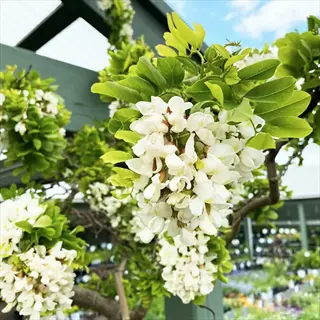
The clearest tell shows up in late spring. In May, a black locust drips with fragrant white flowers. You may also see this tree sold as Robinia pseudoacacia. The honey locust, sold as Gleditsia triacanthos, has small green flowers you can barely see. So a locust tree full of white blooms in May is almost always black locust. The table below lines up every other difference side by side.
The locust tree bark gives you a solid backup check. This one works when the tree is not in bloom. Black locust bark looks like dark braided or twisted rope. Deep grooves run up the trunk. Honey locust bark is flatter and grayer. Wild trees often carry branching thorns right on the trunk. Size settles any doubt that is left. Black locust tops out near 40 to 60 feet. On the best sites it can hit 100 feet. Honey locust climbs to 70 to 80 feet and can reach 140 feet.
Fragrant white flowers point to black locust. Long, twisted 6 to 16 inch pods or branching trunk thorns point to honey locust.
Locust Tree Cultivars to Know
Nearly every locust you can buy at a nursery traces back to just 2 wild species. So the thorns, pods, flowers, and leaves still split along the same black locust versus honey locust line. That split gives you a simple way to shortlist ornamental locust cultivars by what you want most in the yard. Honey locust picks hand you clean shade with little cleanup. Black locust picks earn their place with flowers, twisted form, or bold leaf color.
The main draw of the honey locust group is a good thornless honey locust that drops no long trunk spines and almost no pods. Growers leaned on that clean habit to replace dying elms across many towns. Breeders also get help from a handy quirk of the species. About 60% of seedlings grown from thornless honey locust seed come out thornless on their own, which makes tidy cultivars easier to grow true.
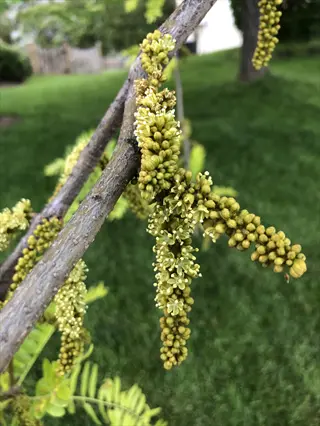
Sunburst Honey Locust
- Species: A honey locust cultivar (Gleditsia triacanthos) chosen for bright, glowing new foliage rather than for flowers or fruit.
- Look: New leaves emerge golden yellow at the branch tips and mature to green, giving the canopy a lit-from-within, two-tone effect.
- Mess factor: It is thornless and nearly seedless, so it drops few pods and no large trunk thorns, which suits patios and lawns.
- Best use: A filtered-shade specimen or lawn tree where homeowners want light dappled shade that grass can still grow beneath.
- Size: A medium shade tree in the honey locust range, smaller and rounder than the tall forest form of the wild species.
- Consider: The fine, ferny leaflets break down fast in autumn, so raking is light compared with big-leaved shade trees.
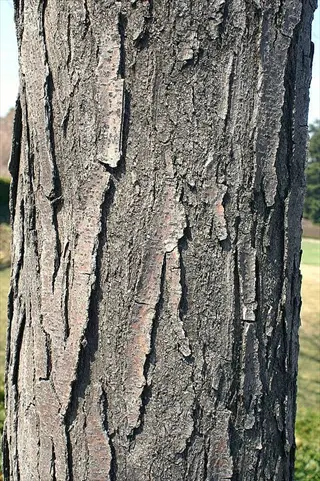
Shademaster Honey Locust
- Species: A vigorous thornless honey locust cultivar bred for a strong, upright frame and reliable street-tree performance.
- Look: An ascending, vase-like branch structure with deep green, fern-like foliage that casts even, filtered shade.
- Mess factor: Thornless and nearly seedless, so it avoids the long trunk thorns and heavy pod litter of wild honey locust.
- Best use: Driveways, streets, and lawns where a tough, clean, fast-establishing shade tree is the goal.
- Size: One of the larger landscape honey locusts, developing a tall, spreading crown at maturity.
- Consider: Like most honey locusts it tolerates salt, drought, and urban soils, which is why it is a common municipal pick.
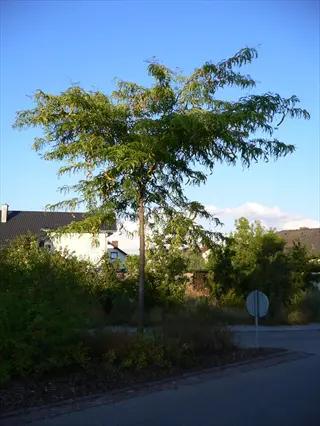
Skyline Honey Locust
- Species: A thornless, nearly seedless honey locust cultivar with a distinctly pyramidal, symmetrical outline.
- Look: A broadly pyramidal crown with a strong central leader and golden-yellow fall color from its ferny leaflets.
- Mess factor: Bred to shed the thorns and heavy pods of the wild tree, keeping cleanup and hazards to a minimum.
- Best use: Formal lawns and boulevards where a neat, uniform shade-tree shape matters.
- Size: A large shade tree at maturity, taller than it is wide when young before spreading with age.
- Consider: Its filtered canopy lets lawn grass thrive underneath, unlike the dense shade of maples or oaks.
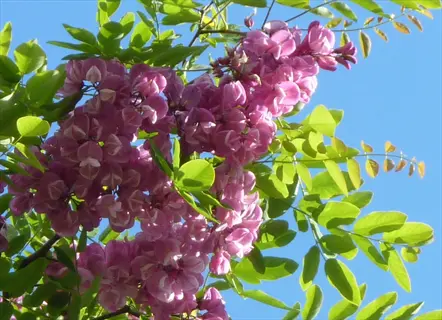
Purple Robe Black Locust
- Species: A black locust cultivar (Robinia pseudoacacia) grown for showy flowers rather than shade or timber.
- Look: Dense, drooping clusters of fragrant pink to rose-purple pea flowers in late spring, with bronze-tinted new leaves.
- Thorns: As a black locust it carries only the small paired spines typical of the species, not large branching thorns.
- Best use: A flowering accent or pollinator tree where the late-spring bloom display is the main attraction.
- Size: A medium tree that stays within the lower black locust height range, fitting mid-sized yards.
- Consider: Like other black locusts it can sucker from the roots, so give it room away from tidy borders.
Twisty Baby Black Locust
- Species: A dwarf, contorted black locust cultivar, also sold as Lace Lady, grown as a living sculpture.
- Look: Curling, corkscrew branches and twisted leaves that stand out most in winter once the leaves drop.
- Thorns: It keeps the small paired spines of black locust, so handle young shoots with a little care.
- Best use: A focal-point specimen for small gardens, containers, or courtyards where its twisting form is on display.
- Size: Much smaller than the wild species, staying a compact large shrub or small tree.
- Consider: Flowering is sparse compared with Purple Robe, since this cultivar is grown for form, not bloom.
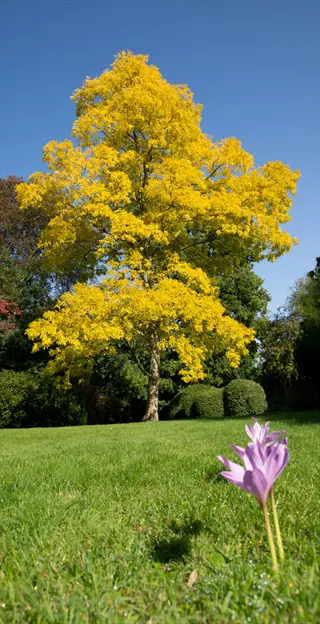
Frisia Black Locust
- Species: A black locust cultivar selected for vivid golden-yellow foliage across the growing season.
- Look: Bright chartreuse-to-gold leaves that glow against darker backdrops and hold color better than many gold-leaved trees.
- Thorns: Bears the usual small paired black locust spines rather than the honey locust's branching thorns.
- Best use: A color accent tree where the goal is a splash of gold foliage rather than heavy shade.
- Size: A medium tree in the black locust range, best given space to show its color from a distance.
- Consider: Leaf color is strongest in full sun; in shade the gold fades toward green.
Match the tree to the job before you dig the hole. Reach for the Sunburst honey locust when you want glowing golden new growth above a patio. Choose the tough Shademaster honeylocust when you need a big, fast street tree that shrugs off salt and drought. Pick the Purple Robe locust when the flower show in late spring beats shade as your goal. Save Twisty Baby or Frisia for spots where quirky form and gold leaves are the whole point.
Wood, Firewood and Soil Benefits
Black locust wood earns its name out in the weather, not in a lab. It is the most rot resistant wood you can grow across the Northeast. That is why farmers reach for it first when a post has to last. An untreated one can sit in wet ground for decades. It just holds.
Untreated black locust fence posts often outlast the pressure treated boards you buy at the store. The tree makes its own weatherproofing deep in the grain, so it never needs chemicals to fight off decay. Dense, heavy wood shrugs off both rot and bugs. That is rare in a fast growing tree.
The high-density wood is the most rot resistant wood we can grow in our climate, making it an ideal material for fenceposts, hope poles, outdoor furniture, decks, and other projects that require weatherproof materials.
The tree does more than resist rot. Black locust pulls off a neat trick called nitrogen fixation. It feeds itself nitrogen straight from the air. That built in fertilizer is why a young tree can shoot up 3 to 4 feet, about 1 meter, in one season. Crews once planted it across old strip mines to rebuild soil that mining had stripped bare.
That same dense wood makes black locust firewood among the hottest you can burn. It throws serious heat and burns clean, so one cord carries you a long way through winter. The tree feeds bees too. Nearly 20% of Hungary's forests are black locust, the base of a whole commercial honey trade. Honey locust wood is dense and durable in the ground as well. But you almost never see it for sale, since the tree stays far less common.
Wildlife, Honey and Forage
Plant either locust and you feed wildlife well. The two do it in very different ways, and each earns the name pollinator tree. Honey locust drops sweet pods, and you can watch deer and grazing animals feed on the drop all winter. Black locust works up high, where you see white flowers pour nectar for your bees.
The black locust nectar flow is short but heavy, and it gives you one of the most famous honeys on the planet. If you keep bees, you learn to chase this bloom the way orchard growers chase spring. You end up with a light, mild locust honey that the USDA even calls choice.
Locust Honey From Black Locust
- Bloom: Black locust opens masses of fragrant white flowers from late April to early June, a major nectar and pollen flow for honeybees.
- Honey quality: The USDA Forest Service describes the resulting honey as choice, prized for its light color and mild flavor.
- Scale: Nearly 20% of Hungary's forests are black locust, underpinning a large commercial honey industry built on this single tree.
- Timing: Because the flow is short and intense, beekeepers often move hives to catch the black locust bloom at its peak.
Honey Locust Pods As Forage
- Size: Honey locust drops long, twisted pods 6 to 16 inches (15 to 41 cm) long, filled with sweet, pulpy tissue between the seeds.
- Nutrition: The beans run up to 12% to 13% protein and the pods up to 42% carbohydrate, making them a genuine energy source.
- Who eats them: Cattle, hogs, deer, squirrels, rabbits, and bobwhite all feed on the fallen pods, especially in late fall and winter.
- Value: This is why honey locust earns its name, since the sweet pulp, not any bee product, gives the tree its honey label.
Black Locust Leaves As Fodder
- Feed value: Black locust foliage is nutritionally similar to alfalfa, so ruminants such as cattle and goats can browse it as rough forage.
- Self-limiting: Other ruminants reportedly limit how much they eat, which reduces the risk of overconsumption in mixed pasture.
- Caution: The same leaves are toxic to horses, so this forage use applies to ruminants and wildlife, never to equines.
- Silvopasture: Because it fixes nitrogen and casts light shade, black locust is used in silvopasture to shelter and enrich grazing land.
Cover, Roots And Habitat
- Erosion control: Black locust roots are shallow and wide-spreading, excellent for binding soil on banks and reclaimed ground.
- Spread: Its radial root spread runs about 1 to 1.5 times the tree's height, quickly stitching disturbed sites together.
- Pioneer role: As a fast pioneer legume, it colonizes bare ground and improves soil so slower native trees can follow.
- Bees and beyond: Beyond honeybees, the late-spring flowers draw native pollinators, adding value on reclaimed and edge habitats.
Honey locust runs the story in reverse. Long, sweet pods pack real energy, and this honey locust pods forage feeds your cattle, deer, squirrels, and rabbits once the pods drop in late fall. Walk your land in winter and you see the full locust tree wildlife value at work, from the bees at the flowers to the deer at the fallen pods.
Black locust leaves are toxic to horses even though they feed some ruminants. Keep horses away from black locust browse and prunings.
Invasive Spread and Control
A row of shoots came up across the lawn one spring, each about knee height, all near the old shed. They pushed under the back fence in a straight line from a black locust in the neighbor's yard. I mowed them flat. Two weeks later they were back, and thicker. I dug one up and found it riding a fat root that ran straight from that tree. Every pass of the mower woke up more of them. They stopped for good after I cut the stumps low and painted them with triclopyr, not just mowed.
That is how the tree spreads. It leans on root suckering and stump sprouting far more than seed. The roots reach 1 to 1.5 times the tree's height out from the trunk, so shoots surface well past the canopy, often far from where you first spot the trunk. Cut the top or burn it, and you make things worse. Damage sets off a fresh wave of sprouts, and new suckers tend to show up in the 4th or 5th year.
Where you live changes the whole picture. Black locust is native to the Appalachians and the Ozarks, and there it belongs. Move outside that range and it turns into a pest. New England and several Midwestern states treat it as invasive, and some brand it a noxious weed. So the black locust invasive label depends on your region, not on the tree itself.
So how to control black locust without feeding the roots? The same suckering vigor has a good side. It makes this tree great for erosion control and land reclamation. In your yard, that same trait works against you. You will not mow it into defeat. The steps below cut off the roots' fuel and treat your stumps at the same time.
Verify the tree is black locust, then mark the parent trunk and the full ring of suckers, which can reach well past the canopy edge.
Never just cut or burn, since that spurs more sprouts. Fell the trunk and treat the fresh stump right away so the roots take up the herbicide.
Apply triclopyr to cut stumps or as a basal bark treatment, because research finds it more effective than glyphosate on black locust.
Watch for new root suckers over several seasons and spot treat them, since the underground root system can keep sending up shoots.
The species is widely cultivated, but often becomes invasive due to high seed production and prolific root sprouts.
Growing Locust Trees
The Sunburst honey locust whip went into a clay slope out front, and my shovel fought the ground the whole way. I mixed two bags of compost into that sticky, sodden hole so the young roots would not sit in wet clay all winter. Ten years later I still watch it from the kitchen window, gold leaves catching the morning sun.
The short answer to how to grow locust tree stock is full sun, open room, and soil that drains. Both black locust and honey locust are very intolerant of shade, so a locust is a full sun tree through and through. Plant yours in open sky, not a shady corner behind the house. A young black locust grows fast in good light, and you can watch it add 3 to 4 feet in a single season.
Soil comes next. Black locust does best on well-drained soil that stays rich, moist, and loamy, and it handles limestone ground with ease. Its roots cope with a wide pH band, from 4.6 up to 8.2, so most soil in your yard suits it fine. Honey locust asks for even less. It shrugs off drought and stays cold hardy down to about -20 to -30°F (-29 to -34°C).
Spacing matters more with black locust than with most trees. Its roots sucker and spread, sending up new shoots feet from the trunk, so keep it well away from foundations, walkways, and tidy beds. Good locust tree care also means light pruning while the tree is young. Cut out crossing or weak limbs in late winter to build one strong trunk, because locust wood turns brittle with age.
Give black locust space away from foundations and beds because of its suckering roots, and pick thornless, seedless cultivars near patios and lawns.
This is why so many gardeners skip the wild tree for a tamer cultivar. Black locust suckers and seeds itself so much that a sterile substitute wins out. A thornless shade tree like a Shademaster or Sunburst honey locust makes a cleaner pick near a patio. You trade the white flowers and rot proof wood for a tidy canopy that stays put. For a front lawn, that trade is worth it.
5 Common Myths
Black locust and honey locust are just two names for the same tree.
They belong to different genera: black locust is Robinia pseudoacacia and honey locust is Gleditsia triacanthos, differing in flowers, thorns, pods, and toxicity.
Every locust tree has dangerous thorns, so none belong near a house or patio.
Most landscape honey locusts are thornless cultivars, and black locust carries only small paired spines rather than large branching thorns.
Locust wood rots fast like other quick-growing pioneer trees, so it is nearly useless outdoors.
Black locust is among the most rot-resistant woods grown in North America and can last for decades as untreated fence posts.
Honey locust pods must be poisonous because black locust parts are toxic.
Honey locust pod pulp is sweet and eaten by livestock and wildlife; it is black locust bark and seeds, not honey locust pods, that are toxic.
The locust tree and the swarming locust insect are the same living thing.
The tree is a flowering legume in the pea family, while a locust is a grasshopper; the tree merely borrowed the insect's name for its pods.
Conclusion
The name locust tree points to two trees that share almost nothing beyond that word. Once you know whether you're looking at black locust or honey locust, every choice after that falls into place. Tell them apart first, and the wood, the flowers, the thorns, and the pods all start to make sense.
Black locust earns its keep with wood that resists rot better than any tree you can grow in a cold climate. It stands for years as fence posts and outdoor furniture. Its roots pull nitrogen from the air and feed the soil, which is why it grows so fast and heals worn out land. Honey locust does a different job, dropping long sweet pods that feed livestock and wildlife through fall. The catch with black locust is its habit of suckering hard, sending up dense new shoots once you cut or damage it.
The bottom line is simple. Plant black locust on open land where you want fragrant flowers, good honey, and durable wood, and where its spreading won't crowd your neighbors. Pick a thornless honey locust cultivar when you want clean shade in a yard, without thorns underfoot or fruit to rake up.
Both trees still earn a place for building soil and casting shade, even where black locust falls under local rules. Next time you pass a locust along a fence line or a city street, slow down. Look at the bark, the thorns, and the pods. You'll know which one stands in front of you, and that's the whole point.
Glossary
- Bipinnately compound leaf
- A leaf whose leaflets are themselves divided again, giving a fine, fern-like appearance.
- Cultivar
- A plant variety selected and named through cultivation for specific traits such as thornless growth or golden leaves.
- Legume
- A plant in the pea family that often partners with bacteria to pull nitrogen from the air into its roots.
- Nitrogen fixation
- A process in which certain plants, aided by soil bacteria in their roots, turn nitrogen from the air into a form that enriches the soil.
- Pinnately compound leaf
- A leaf made of many small leaflets arranged in rows along a single central stalk.
- Pioneer species
- A fast-growing plant that is among the first to colonize bare or disturbed ground.
- Root suckering
- New shoots that sprout directly from a tree's roots, forming a cluster of clones around the parent tree.
- Silvopasture
- A land-use system that combines trees with pasture and grazing livestock on the same ground.
External Sources
Frequently Asked Questions
Is a locust tree poisonous to humans?
Yes for black locust. Its bark, leaves, and seeds are toxic if eaten, though honey locust pod pulp is not.
Do locust trees have thorns?
It depends on the species and cultivar:
- Black locust has small paired spines at the leaf bases
- Wild honey locust has long, branching trunk thorns
- Most planted honey locusts are thornless cultivars
What happens if you get poked by a locust tree thorn?
A locust thorn puncture is often deep and can be slow to heal, so clean it well and watch for signs of infection.
What are the problems with locust trees?
The most common drawbacks are:
- Aggressive root suckering and invasive spread
- Toxic bark and seeds on black locust
- Locust borer damage and brittle limbs
- Large thorns on wild honey locust
What is the lifespan of a locust tree?
Black locust is short-lived, often under a century, while honey locust can live to about 125 years.
What is another name for a locust tree?
Common alternate names include:
- False acacia and yellow locust for black locust
- Sweet locust and thorny locust for honey locust
- The Latin names Robinia pseudoacacia and Gleditsia triacanthos
Is a locust tree related to the locust insect?
No. The locust tree is a flowering legume, and it simply borrowed the name of the swarming locust insect.
How fast do locust trees grow?
Young black locust grows fast, about 3 to 4 feet (1 meter) per year, then slows sharply after about 30 years.
Is black locust good firewood?
Yes. Black locust is among the best firewoods, burning hot and long with excellent coals once fully seasoned.
Can you eat honey locust pods?
Honey locust pod pulp is sweet and eaten by wildlife and livestock. Black locust pods, by contrast, are not edible.