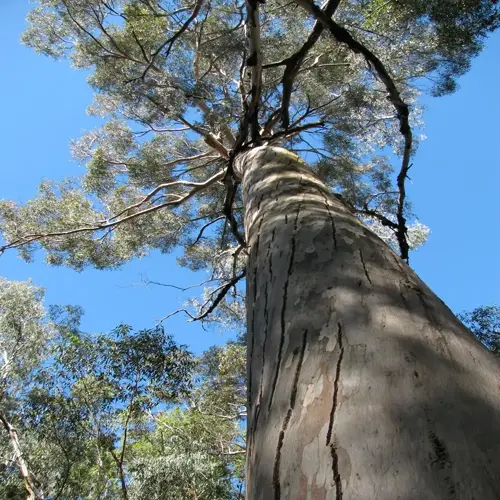

Locust trees grow fast while they are young. The locust tree growth rate runs about 3 to 4 feet (1 meter) a year on a young black locust, then drops off hard after about 30 years. That early black locust growth rate beats most other trees you could plant. So you get real height in the first ten years, not a long wait for a bare pole to fill out. A tree you set as a knee-high whip can throw useful shade before your kids finish grade school.
The Sunburst honey locust by my front walk now shades the whole front window on hot afternoons. It went in as a thin bare whip you could bend with one hand. Each spring it climbed faster than any other tree in the yard. The red maple I set the same week still stands at half its height. The lacy gold leaves fill in by mid-May. They hold a soft, dappled shade over the porch until the first cold snap drops them in fall.
Two different trees share the locust name, and both move fast. Black locust, the one those growth numbers describe, is the champion sprinter and the nitrogen fixer. Honey locust, like my Sunburst, grows fast too and gives that same open, dappled shade. But it leans on rich soil and steady water instead of fixing its own feed. If you want the fastest growth on poor ground, black locust is the pick.
Black locust pulls this off with a trick down in its roots. It fixes its own nitrogen straight from the air through nodules on its root hairs. That means you can plant it in thin, rocky, worn-out soil where other trees would stall. The built-in fuel drives the fast early burst you see in the first two decades. But the growth rate drops off after about 30 years as the tree matures early. The USDA Silvics record shows the same curve for the species: a quick climb, then a long, slow crawl. The tree reaches most of its full height young.
The field numbers back up what I watched happen in my own yard. Cornell puts young growth at 3 to 4 feet each season. UConn measures 4 feet or more a year on strong young trees. Here is the quick picture for your own yard.
The locust tree growth rate is a two-stage story, so do not expect that speed to last forever. A locust sprints out of the gate, then eases off once it hits maturity. Most of the height you get shows up in the first 20 to 30 years. The tree you see at three decades is close to the tree you keep. The wood also grows dense and tough as it ages, which is why old locust makes such long-lasting fence posts. The early rush is the payoff. The slow, steady old age is the tradeoff.
That early speed makes locust a fast growing shade tree for a yard that needs cover soon. It also earns its keep as a windbreak along an open field. And it works as a repair crew for rough, eroded, or strip-mined ground where little else takes hold. Its roots knit loose soil together and add nitrogen as they go. Seed production starts young, around age 6, so a mature tree can seed and sucker its way into a small grove if you let it.
- Use it for: Quick shade, a windbreak, or greening up rough, worn-out ground where little else grows.
- Plan the pace: Expect fast height for the first two decades, then a long, slow stretch once the tree passes 30.
- Give roots room: Fast growth pairs with strong suckering, so keep the tree well clear of patios, pipes, and the septic field.
- Set it at least 20 feet from the house so new shoots and roots have space to spread.
Read the full article: Locust Tree: Honey vs Black Locust Guide