
Introduction
The larkspur flower wears two faces at once. It is the beloved July birth flower of cottage gardens, prized for its tall blue and purple spikes. It is also one of the most costly poisonous plants on western rangelands across the United States. Few garden flowers carry that kind of split personality, and that is why larkspur is worth a closer look.
Botanists have counted more than 500 Delphinium species around the world. North America alone is home to 60 native larkspur species. The same larkspur flower that looks stunning in a vase can turn deadly out in a pasture. Cattle deaths from it can climb as high as 15% in the worst weeks, and ranchers lose millions of dollars every year. So this guide treats both sides of the plant as real.
I have grown larkspur from my own seed packets. I have also read the rangeland safety studies. So you get four things here in one place. First comes the larkspur meaning behind each flower color, along with the July folklore and old myths tied to the plant. Then you get plain, tested steps for growing larkspur from seed in your own beds. After that, you will see how larkspur and delphinium differ, plant by plant, so you buy the right one.
You will also get a straight answer to the question is larkspur poisonous. It rests on cited toxicology, not a vague warning. That matters whether you plan to gift a July bouquet or keep curious pets and kids away from the seeds. Larkspur pulls at two needs at once, a gift and a safety question. This guide serves both, and it starts with what the flower means.
What Larkspur Flowers Mean
The larkspur flower meaning runs deeper than its tall summer spikes. Penn State Extension ties the bloom to floriography. That is the old Victorian language of flowers. In it, larkspur stands for a beautiful spirit, swiftness, and strong bonds of love.
The larkspur meaning also shifts with each color. Floriography gave every shade its own note, so a blue larkspur and a purple larkspur say two different things in one bouquet. Pick the wrong one and your message changes. The larkspur color meanings below break down what each hue tells the person who gets it.
Blue Larkspur
- Meaning: Blue larkspur traditionally stands for dignity and grace, which is why it reads as the most formal and composed color in the range.
- Best for: It suits messages of respect and quiet admiration, making it a fitting choice for mentors, elders, or a graceful thank-you.
- Note: Blue is the signature larkspur shade most people picture first, and it is the color that dominates classic cottage-garden plantings.
Purple Larkspur
- Meaning: Purple larkspur carries the message of first love, giving it a tender, slightly nostalgic feeling in the language of flowers.
- Best for: It works for early romance and sweet, sincere affection rather than long-established commitment or passion.
- Note: Purple and lavender tones are among the most common larkspur colors, so this meaning travels easily in a mixed summer bouquet.
Pink Larkspur
- Meaning: Pink larkspur is linked to contrariness or fickleness, a playful, teasing note rather than a serious or heavy one.
- Best for: It fits a lighthearted friendship or a gently flirtatious gesture where a wink matters more than a promise.
- Note: The softer symbolism makes pink a favorite for cheerful, casual arrangements instead of formal occasions.
White Larkspur
- Meaning: White larkspur signals a happy nature, so it reads as bright, open, and joyful in traditional floriography.
- Best for: It suits celebrations, new beginnings, and any message meant to feel clean, positive, and uncomplicated.
- Note: White larkspur also brightens mixed plantings and cut arrangements, lifting the deeper blues and purples around it.
Larkspur is symbolic of a beautiful spirit, swiftness and generally of positivity and strong bonds of love.
That warm larkspur symbolism also carries a note of lighthearted youth, which suits its role as the July birth flower. A blue stem reads as formal and graceful. A pink one keeps things light. So one bloom can fit a quiet thank-you or a cheerful hello, based on the shade you choose.
Larkspur Legends and Folklore
The oldest larkspur legend comes from ancient Greece. There, the bloom is said to have sprung from the blood of Ajax, a fallen hero of the Trojan War. After a bitter contest over a dead friend's armor went against him, Ajax fell on a sword and died. Blue flowers rose from the stained ground, and the tale spread from there. You will meet that story in almost every larkspur mythology you read today.
You can trace the larkspur name origin in two directions. Penn State Extension links the genus name Delphinium to the Greek word delphis, which means dolphin. The name follows the shape of the closed flower bud. The common name points somewhere else, to the backward spur that looks like the long claw of a lark. Whichever name you prefer, larkspur folklore spread far past Greece and picked up fresh meaning in each culture it touched.
The Blood of Ajax
- Story: In Greek legend, larkspur is said to have sprung from the spilled blood of the hero Ajax after the events of the Trojan War.
- Why it lasts: This origin tale is the single most repeated larkspur myth, tying a delicate garden flower to an epic story of grief and honor.
- Read on: The full version of this legend, and how the markings were read as Ajax's initials, is covered in the dedicated larkspur myth FAQ.
A Name from the Dolphin
- Origin: Penn State Extension notes the genus name Delphinium comes from the Greek delphis, meaning dolphin, after the shape of the unopened flower bud.
- The other name: The common name larkspur comes instead from the flower's backward spur, said to resemble the long claw of a lark.
- Takeaway: Two names, two images, one plant, which is a large part of why larkspur and delphinium are so often confused.
Roman and Neptune Lore
- Story: Roman folklore attached its own legends to the flower, including tales linking larkspur to the sea god Neptune and to protective charms.
- Theme: Across these versions the flower repeatedly stands for protection and good fortune rather than danger, despite its real toxicity.
- Spread: Similar protective folklore appears across medieval Europe, where larkspur was hung or scattered to ward off misfortune.
The Pawnee Dream Woman
- Story: A Pawnee legend tells of a Dream Woman whose descent to earth is connected to the blue of the larkspur flower.
- Meaning: The tale ties the vivid blue color to the sky and to a story of longing, giving the flower a gentler, more wistful character.
- Value: Legends like this show that larkspur folklore reaches well beyond the familiar Greek myth into many cultures.
A Remedy for Lice
- Historical use: Utah State University Extension records that American Indians crushed larkspur and applied it to their hair to control lice and other insects.
- Why it worked: The same alkaloids that make larkspur poisonous also act on insects, which is what gave the crushed plant its pest-controlling effect.
- Caution: This is a historical note, not a recommendation, since every part of larkspur is toxic and should never be used on skin today.
These tales pull the flower in very different directions. Roman lore tied it to Neptune and to charms for protection. A Pawnee legend linked the deep blue color to a Dream Woman who came down from the sky. Native peoples even crushed the plant and rubbed the paste through the hair to fight lice and other insects. Grow one small blue bloom and you hold grief, protection, longing, and a rough old remedy all at once.
Larkspur vs Delphinium
Walk into any nursery and you will hear shoppers swap the names larkspur and delphinium as if they name one plant. The confusion makes sense. The two look like close cousins and share the same family tree. So the whole larkspur vs delphinium question comes down to a few clear traits once you know where to look.
Here is the plain botany. Annual larkspur goes by the name Consolida, the easy plant you grow fresh from seed each year. A perennial delphinium comes back for three years or so in your garden before it fades. Both come from the same plant family, the buttercup group known as Ranunculaceae. The delphinium genus alone holds more than 500 species. You can see why the two get mixed up.
- Usually an annual grown fresh from seed each year, finishing its whole life cycle in one season.
- Finer, lacier, more feathery foliage that gives the plant a soft, airy look.
- Easygoing and beginner friendly, thriving from seed sown directly where it will grow.
- Generally shorter, often 1 to 3 feet (0.3 to 0.9 m) tall in the garden.
- Belongs to the genus Consolida, the botanical home of true annual larkspur.
- Usually a short-lived perennial that returns for a few years before needing replacement.
- Denser, showier flower spikes with larger individual blossoms packed along the stem.
- More demanding, often needing staking, richer soil, and steady care to look its best.
- Can grow taller and more statuesque, making a bold vertical accent in a border.
- Belongs to the genus Delphinium in the same buttercup family, Ranunculaceae.
So the real difference between larkspur and delphinium comes down to the leaves and the spikes. Larkspur wears finer, lacier foliage with a soft, feathery look. Delphinium answers with denser spikes and larger blossoms packed up the stem. Picture larkspur as the carefree annual cousin you sow and leave alone. Delphinium is the showier perennial that needs richer soil and steady staking to shine.
How to Grow Larkspur
One afternoon in late fall I scattered Giant Imperial larkspur seed across the bare soil in the sunny strip by my back picket fence. My zone 6 cottage garden was going quiet for winter, so I raked the seed in and walked away. By early summer, tall blue and pink spikes stood all down that fence line. I cut armloads for the kitchen table.
Once you know how to grow larkspur, you will find it takes less work than most cottage flowers this tall. Garden larkspur grows in USDA zones 3 to 9 and reaches 1 to 3 feet tall, or 0.3 to 0.9 m. It wants full sun of at least 6 hours and loose, well drained soil on the alkaline side, up to a pH of 8.0. Get your site right and the rest of larkspur care is mostly patience.
Timing beats everything else when growing larkspur from seed. Garden larkspur is a cool season annual, and its seed sprouts best after a stretch of cold. So sow larkspur from seed in late fall or very early spring, and skip a late sowing that never gets that chill. Because larkspur hates having its roots moved, scatter the seed right where you want your plants to stand.
Pick a site with full sun of at least 6 hours and well-drained, slightly alkaline soil, since larkspur dislikes soggy ground and shade.
Scatter seed where plants will grow in late fall or very early spring; the cool period improves germination and larkspur hates being transplanted.
Once seedlings are a few inches tall, thin them so each plant has room, which encourages sturdier stems and better airflow.
Give about 1 to 1.5 inches (2.5 to 4 cm) of water per week during active growth, keeping moisture consistent but never waterlogged.
Support the taller spikes before they flop, then deadhead spent flowers to keep the plant blooming longer through the season.
Larkspur resents root disturbance, so sow seed directly where the plants will grow rather than starting them in pots and transplanting. Direct-sown larkspur almost always establishes more reliably.
Once your seedlings take off, give them about 1 to 1.5 inches (2.5 to 4 cm) of water each week. Thin the crowd so air moves between the stems. Stake the tall spikes early, before a summer storm bends them flat. Snip the spent flowers as they fade, and the plant pushes out fresh spikes for weeks. For when those first blooms open, check the timing question in the FAQ below.
Larkspur Colors and Types
From my kitchen window at dusk, the blue larkspur glows like cobalt against the white pickets of my back fence. In my zone 6 garden these Giant Imperial spikes catch the last light and hold it. The blue reads from clear across the yard. Of all the larkspur colors, this is the shade that stops me every evening.
Both larkspur and its close cousin delphinium bloom in four core shades. You get blue, purple or lavender, pink, and white. Garden types send these colors up erect spikes that stand 1 to 3 feet (0.3 to 0.9 m) tall. That is high enough to anchor the middle or back of a border, and the short palette makes the colors easy to mix.
For annual color, Giant Imperial mixes are the classic choice. One seed packet packs blue, purple larkspur, pink, and white into a single bed. If you want spikes that come back each year, perennial delphinium series like New Millennium give the same bold look. Out in western mountain meadows, wild tall larkspur dwarfs them all and climbs 3 to 8 feet (0.9 to 2.4 m). These larkspur varieties also earn their keep beyond color. They make fine cut flowers that dry well, and the nectar spur on each bloom pulls in hummingbirds and butterflies.
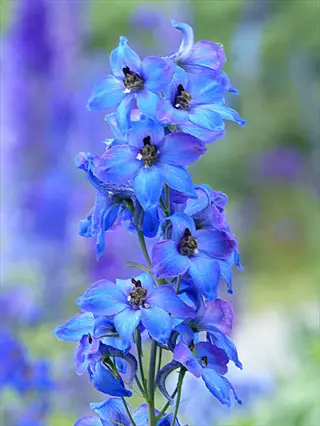
Blue Larkspur
- Look: Deep cobalt-to-sky-blue spikes are the signature larkspur image, and blue is the color most people picture when they hear the name.
- Meaning: In floriography blue larkspur stands for dignity and grace, giving it a calm, formal presence in the border.
- Height: Garden types reach about 1 to 3 feet (0.3 to 0.9 m), standing tall enough to read from across a bed.
- Use: Blue larkspur anchors cottage plantings and cuts beautifully, holding its color well when dried for arrangements.
- Pairing: It contrasts sharply against white fences, pale roses, and silver foliage, which makes the blue look even more vivid.
- Note: Because blue is common in both annual larkspur and perennial delphinium, it is the shade most likely to blur the two.
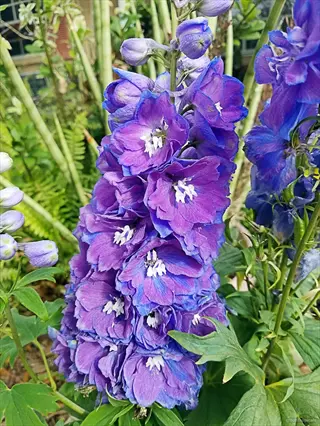
Purple and Lavender Larkspur
- Look: Rich violet through soft lavender spikes give a warmer, more romantic feel than the cooler blues.
- Meaning: Purple larkspur carries the message of first love, adding a tender note to any mixed bouquet.
- Height: Like other garden larkspur, purple forms typically stand 1 to 3 feet (0.3 to 0.9 m) tall on erect stems.
- Use: Lavender shades blend easily with pinks and blues, making purple a flexible bridge color in a planting scheme.
- Pairing: It sits happily beside pink roses, catmint, and other soft cottage-garden companions.
- Note: Purple and lavender are among the most widely available larkspur colors, so they are easy to source as seed.
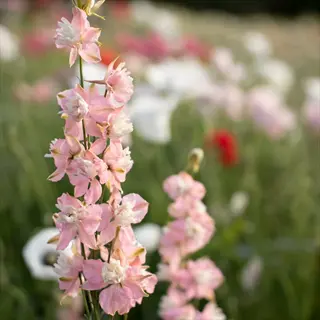
Pink Larkspur
- Look: Shades from pale blush to bright rose give pink larkspur a cheerful, informal character.
- Meaning: Traditional floriography links pink larkspur to playful contrariness or fickleness rather than serious romance.
- Height: Pink garden forms grow to a similar 1 to 3 feet (0.3 to 0.9 m), fitting neatly into the middle of a border.
- Use: Pink is a favorite for lighthearted, casual arrangements and for softening bolder blues and purples.
- Pairing: It works well with white and silver, keeping a bed looking fresh and airy through summer.
- Note: Pink often appears within mixed larkspur seed packets, so it is easy to grow alongside other colors.
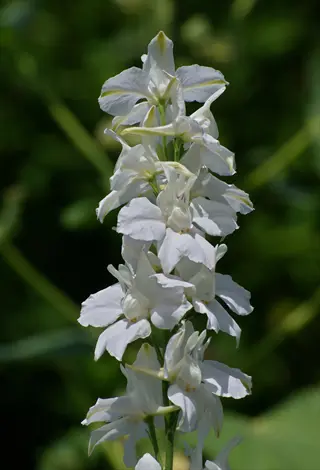
White Larkspur
- Look: Clean white spikes bring brightness and contrast, standing out especially well in the evening garden.
- Meaning: White larkspur signals a happy nature, reading as fresh, open, and celebratory.
- Height: White forms match the usual garden range of 1 to 3 feet (0.3 to 0.9 m) on upright stalks.
- Use: White lifts and separates the deeper colors around it and shines in moon-garden and wedding plantings.
- Pairing: It flatters nearly every companion, from blue larkspur to green foliage and pastel roses.
- Note: A ribbon of white through a mixed larkspur planting keeps the display from looking too heavy or dark.
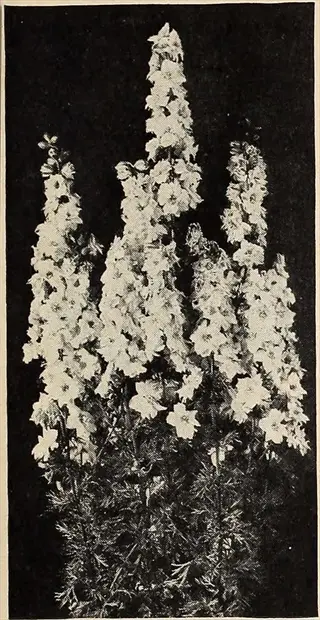
Giant Imperial and Tall Types
- Look: Giant Imperial larkspur is a classic tall annual mix, sending up long, densely packed flower spikes in many colors.
- Range: These annual mixes cover blue, purple, pink, and white, letting one seed packet fill a bed with variety.
- Height: Tall garden strains reach the upper end of the range, while wild mountain larkspur can climb 3 to 8 feet (0.9 to 2.4 m).
- Perennials: For a lasting version, perennial delphinium series such as New Millennium offer similar bold spikes year after year.
- Use: Tall types make dramatic cut flowers and strong vertical accents at the back of a border.
- Care: The taller the spike, the more likely it needs staking, so support these forms before summer storms arrive.
Is Larkspur Poisonous?
Yes. Larkspur is poisonous, and every part of the plant holds toxins. New growth and the seeds carry the most, so a child or pet who chews a seed pod faces the biggest risk. If you have wondered is larkspur poisonous, the honest answer is that the whole plant can harm people, pets, and grazing animals.
The danger comes from the plant's own chemistry. Scientists have found more than 40 diterpenoid alkaloids in larkspur. The most dangerous one is a toxin called methyllycaconitine, and it does the most harm of them all. Garden larkspur also holds delphinine and ajacine. These larkspur alkaloids fill the leaves, stems, flowers, and seeds, so no part is safe to eat.
Here is how larkspur toxicity works inside the body. The alkaloids block the signal that runs from nerve to muscle, so the muscles stop firing. An animal grows weak, then collapses and bloats. Death can follow within hours when the breathing muscles quit. That is why you keep pets and livestock well away from it.
The method of toxicity has been identified as neuro-muscular paralysis, leading to respiratory failure, bloat and often death.
Cattle face the worst of it. Larkspur poisoning cattle costs ranchers millions of dollars each year, and losses can run as high as 15% of an exposed herd. The risk peaks during a window of about 5 weeks that starts at the flower stage and ends after the seed pods shatter. Spraying plants with herbicide makes them taste better to cattle but leaves them just as toxic, so keep a hard eye on treated pastures if you run cattle.
5 Common Myths
Larkspur and delphinium are two completely different, unrelated plants that just happen to look somewhat alike in the garden.
They belong to the same buttercup family; larkspur is the common name shared by annual Consolida and perennial Delphinium species.
Larkspur is only mildly irritating, so it is perfectly safe to plant and grow around curious pets and young children.
All parts are highly poisonous, especially new growth and seeds, so keep the plants and cut stems away from pets and children.
Only cattle are ever harmed by larkspur, so the plant poses no real danger at all to horses, dogs, or people.
Cattle are the most susceptible, but larkspur is also toxic to humans, dogs, cats, and horses; sheep are more resistant, not immune.
Larkspur is a fussy, difficult flower that only expert gardeners with a greenhouse can ever grow successfully from seed.
Garden larkspur is an easygoing cool-season annual that grows readily from seed sown directly in full sun and well-drained soil.
Larkspur is most dangerous to livestock in early spring, so grazing cattle after the flowers appear is completely risk-free.
Risk actually peaks during a roughly five-week window from flowering until the pods shatter, when cattle eat larkspur most readily.
Conclusion
This guide pulled four threads together around a single plant. You saw what the larkspur flower stands for as July's birthday bloom. You met the myths behind its name, the steps for growing it, and the plain facts about its poison. Held side by side, those threads tell you a fuller story than any one of them alone. Few plants ask you to hold beauty and danger in the same hand.
The larkspur meaning stays warm even as the science turns serious. This is the flower of dignity and first love, a gift you give with grace built right in. Yet every part of the plant is toxic. On western rangelands, cattle deaths from it can run as high as 15%. That gap between a soft symbol and a real risk is why this flower deserves your respect.
So is larkspur poisonous? Yes, in every leaf, stem, and seed. But it is also a beloved cottage garden flower that pulls in hummingbirds and holds up for a week in your vase. Both things are true at the same time. Knowing both sides is what makes you confident with this plant, not scared of it.
Enjoy the tall blue spires, but respect what they carry. Growing larkspur well means full sun, good drainage, and a bit of care to keep the seeds and new shoots away from pets and children who might taste them. A raised bed or a fenced corner works well for homes with curious pets. If you still wonder about its many names, when it blooms, or how to keep dogs and cats safe, the questions below give you focused answers.
Glossary
- Consolida
- The plant genus of true annual larkspur, grown fresh from seed each year.
- Deadheading
- Removing spent flowers so a plant keeps blooming instead of setting seed.
- Delphinium
- The plant genus of usually perennial larkspur, with denser, showier flower spikes.
- Diterpenoid alkaloids
- The family of natural toxic compounds in larkspur, with more than forty identified in the genus.
- Floriography
- The traditional Victorian language of flowers, where each bloom and color carries a coded message.
- Methyllycaconitine
- The main toxic MSAL-type alkaloid in larkspur and the one chiefly responsible for poisoning cattle.
- Nectar spur
- The backward-pointing tube behind a larkspur flower that holds nectar and gives the plant its name.
- Ranunculaceae
- The buttercup family of flowering plants, which includes both larkspur and delphinium.
External Sources
Frequently Asked Questions
What is another name for larkspur?
Other names for larkspur include:
- Delphinium
- Staggerweed
- Knight's spur
- Lark's heel
- Duncecap larkspur, a tall species
Is larkspur a perennial or an annual?
Both: annual larkspur (Consolida) is grown from seed each year, while delphinium species are usually short-lived perennials.
Why is it called larkspur?
It is named for the flower's backward-pointing spur, which resembles the long hind claw, or spur, of a lark.
What is the birth flower for July?
July has two birth flowers, larkspur and the water lily, with larkspur the more familiar of the pair.
What is the myth behind larkspur flowers?
In Greek myth, larkspur is said to have sprung from the blood of the hero Ajax after the Trojan War.
What month does larkspur bloom?
Garden larkspur blooms from late spring through mid-summer, while tall mountain larkspur flowers in July and August.
Is it okay to touch larkspur?
Brief contact is low risk, but all parts are poisonous if eaten, so wear gloves when cutting and wash your hands.
How poisonous is larkspur?
Highly poisonous. Larkspur can cause serious illness or death in people and livestock:
- Burning mouth and throat numbness
- Vomiting and diarrhea
- Muscle weakness and spasms
- Respiratory paralysis in severe cases
What toxin is in larkspur?
Larkspur contains more than forty diterpenoid alkaloids, led by the toxic MSAL-type alkaloid methyllycaconitine, plus delphinine and ajacine.
How poisonous is larkspur to dogs?
Very. Larkspur is toxic to dogs; all parts can cause vomiting, weakness, and in severe cases collapse, so seek a vet promptly.