
Introduction
You can spot a beech tree from clear across an open stretch of woods, and you only need the bark. The trunk stays smooth and pale gray for its whole life, from short saplings to towering giants. Most trees turn rough and furrowed as they age, but the beech never does. That clean, almost muscular bark is its calling card. This one tree shapes whole forests on two continents, from the hardwood hills of North America to the ancient woods of Europe.
A beech is built to last. These trees live 300 to 400 years, and a few in Pennsylvania have pushed past 366. A grown beech stands 60 to 80 ft (18 to 24 m) tall and spreads almost as wide. It takes its time getting there. Beech are slow growers, so yours will add height at a patient pace across many decades.
Two very different trees share this name. In the woods of North America you will meet American beech. Gardeners may know it as Fagus grandifolia. In Europe you will find European beech. Its Latin name is Fagus sylvatica. The two look and act like close cousins, and the genus Fagus is the thread that ties them. Your search may point to one tree or the other, and this guide holds room for both.
So here is what you get. First you will learn to tell a beech apart by its bark, its buds, and its leaves with their single row of teeth. Then you get the practical care: how to plant a beech tree and keep it strong for years. Near the end waits the hard news. A new leaf disease is sweeping through beech woods across the eastern states, and its early signs are easy to miss. This guide combines both trees, their care, and these diseases in one place, backed by current research you can trust.
Types of Beech Trees
The copper beech hedge along my driveway glows a deep reddish purple every summer, and drivers still slow for a second look. I planted a European beech with purple leaves instead of the plain green kind for one reason, the color. Fifteen summers on, it still stops people. A green hedge makes a fine wall, but it never turns heads like this dark one does in July.
Beech trees split into two main species before you reach the ornamental garden forms. American beech is the only beech native to North America. You find it in the wild across the eastern United States and into Canada. European beech, also called common beech, is the classic tree for hedges and parkland. Both grow large. A mature beech stands 60 to 80 ft (18 to 24 m) tall and 40 to 80 ft (12 to 24 m) wide. A few top 100 ft (30 m) when you give them room and good soil.
Almost every other beech you meet is a cultivar of European beech. Breeders select these for leaf color or branch shape, not because they are separate species. Copper beech and purple beech give you dark purple leaves all season long. Weeping beech sweeps its long branches down toward the lawn. Tricolor beech blends purple, pink, and cream in a single leaf. The form you choose shapes the look as much as the species does. The trees below are the ones you will plant in your yard or spot on a walk.
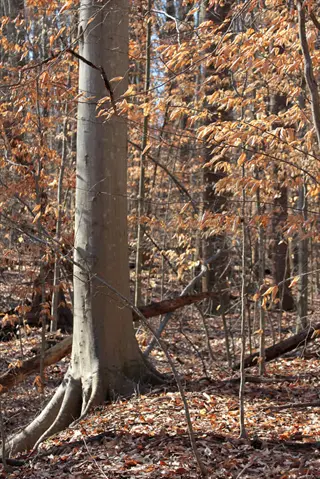
American Beech (Fagus grandifolia)
- Native range: The only beech native to North America, growing across the eastern United States and into southeastern Canada.
- Bark and form: Wears the classic smooth silver-gray bark with a broad, dense, low-branching crown that casts heavy shade.
- Size: Typically reaches 60 to 80 ft (18 to 24 m) tall and 40 to 80 ft (12 to 24 m) wide over many slow decades.
- Leaves: Carries oval, coarsely single-toothed leaves that often hang on in a papery tan through much of the winter.
- Wildlife: Produces small triangular beechnuts that feed bears, deer, turkeys, and many birds in good mast years.
- Habit: Spreads readily by root suckers, so a single tree can slowly form a whole grove of genetically identical clones.
European Beech (Fagus sylvatica)
- Native range: Native across much of Europe and long nicknamed the queen of British trees for its stately presence.
- Bark and form: Shows the same smooth gray bark as American beech but often a taller, more uniform, dome-shaped canopy.
- Size: Commonly grows 60 to 80 ft (18 to 24 m) tall in the open, with a wide, spreading crown at full maturity.
- Hedging: The classic choice for formal hedges, since it tolerates hard clipping and holds coppery leaves through winter.
- Leaves: Bears glossy, wavy-edged oval leaves with a fringe of fine hairs when they first flush in spring.
- Cultivars: Parent of most ornamental beeches, including the purple, weeping, and tricolor forms grown in gardens.
Copper and Purple Beech
- Type: Purple-leaved cultivars of European beech, sold as copper beech or purple beech depending on the depth of leaf color.
- Color: Leaves emerge deep red to purple in spring and hold a dark bronze tone right through the growing season.
- Use: Planted as dramatic specimen trees and as bold, dark hedges that contrast with the greens of the rest of a garden.
- Size: Reach the same 60 to 80 ft (18 to 24 m) height as green European beech unless kept trimmed as a hedge.
- Light: Develop the richest leaf color in full sun, turning greener and duller when grown in heavy shade.
- Origin: Selected forms propagated by grafting so the purple color stays true, since seedlings vary widely in shade.
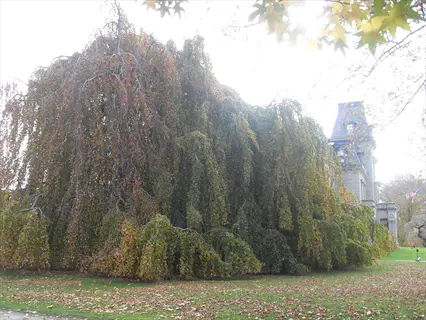
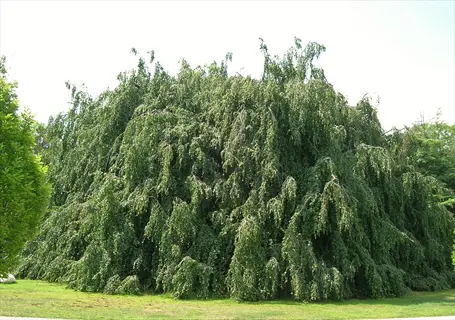
Weeping Beech
- Type: A cascading cultivar of European beech with long branches that arch and sweep down toward the ground.
- Form: Creates a living dome or tent, and the lowest branches can root where they touch bare soil.
- Use: Grown as a striking focal point in large lawns and parks rather than as a clipped hedge.
- Size: Can still reach 40 to 60 ft (12 to 18 m) tall, so it needs plenty of open room to spread out.
- Foliage: Available in both green and purple-leaved weeping forms for different color effects in the landscape.
- Care: Needs the same acidic, moist, well-drained soil as other beech and dislikes wet, compacted ground.
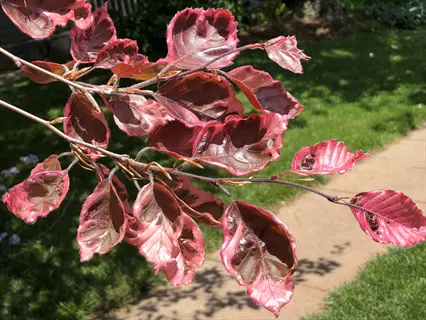
Tricolor Beech
- Type: A slower, smaller cultivar of European beech grown mainly for its striking variegated foliage.
- Color: Leaves are purple with irregular pink and creamy-white margins that stand out across the landscape.
- Size: Usually stays more compact, often around 24 to 40 ft (7 to 12 m), which suits it to smaller yards.
- Light: Needs shelter from harsh afternoon sun, which can scorch the pale leaf edges in hot, exposed spots.
- Use: Works best as a specimen tree set where its unusual coloring can be seen and enjoyed up close.
- Care: Shares beech's dislike of soggy or compacted soil and rewards a sheltered, free-draining site.
How to Identify a Beech Tree
The papery tan leaves of the old American beech in the back corner of my yard rattle against my kitchen window all winter. The nearby oaks stand bare. Those dry leaves cling on for months, a habit called marcescence, and young beech and low branches show it best. A shrubby little beech still full of pale tan leaves in deep winter gives itself away.
Most beech tree identification starts with the bark, and for good reason. Beech keeps thin, smooth bark in a soft gray, and it stays smooth even on very old, wide trunks. Few large forest trees do this, so you can often name a beech from across a field. The single-toothed leaves back it up, each oval blade pointed at the tip with even, simple teeth along a wavy edge.
In winter, drop your eyes to the buds. Beech carries long, slender cigar-shaped buds that sit at an angle, sharp as little spears. They show up best in late winter, just before the leaves flush. Two trees fool people here: hornbeam and birch. Hornbeam bark looks fluted and muscled, not smooth, while birch leaves carry double teeth instead of single ones. Smooth, unfluted bark and simple single teeth rule both out fast.
Smooth Gray Bark
- Look for: Thin, smooth bark in a soft silver-gray that stays smooth and unfurrowed even on very old, large trunks.
- Why it helps: Few large forest trees keep bark this smooth, which makes a beech easy to spot from a fair distance.
- Caution: The thin bark scars permanently, so carved initials and other wounds can open the tree to infection.
Single-Toothed Oval Leaves
- Look for: Oval leaves with a pointed tip and evenly spaced single teeth along a crisp, slightly wavy margin.
- Texture: Leaves feel thin and papery, with a fringe of fine hairs on European beech when they first unfurl.
- Compare: Single teeth separate beech from the double-toothed leaves of birch and the more folded leaf of hornbeam.
Cigar-Shaped Buds
- Look for: Long, slender, sharply pointed buds held at an angle, often described as cigar-shaped or spear-shaped.
- When: These buds are easiest to notice in late winter, just before the new leaves flush out in spring.
- Why it helps: The distinctive bud shape is one of the surest ways to confirm a bare beech in the winter.
Winter Leaves and Marcescence
- Look for: Young trees and lower branches that keep dry, pale tan leaves clinging on through much of the winter.
- Term: This leaf-holding habit is called marcescence, and it is a classic trait of both beech and oak.
- Why it helps: A shrubby young tree still full of tan leaves in the middle of winter is very often a beech.
Triangular Beechnuts
- Look for: Small three-sided nuts held in a soft, bristly husk that splits open in autumn to drop the seed.
- Timing: Large nut crops, called mast, come every two to eight years rather than reliably every single year.
- Wildlife: Empty husks and cracked cases scattered under a tree are a good sign that beech grows overhead.
In winter, check the bark and buds together: smooth gray bark with long, cigar-shaped buds means beech, while fluted, muscle-like bark points to hornbeam instead.
Planting and Growing Beech
One cold spring I worked down the driveway, heeling in a row of bare root copper beech whips. I firmed the soil around each thin stem and drove in a stake to hold it. Most of the line took hold and pushed out fresh green leaves by midsummer. The single whip I set in the low, wet end of the row sulked for a whole season. Its twig stood bare while the rest of the hedge filled in.
Good beech tree care starts with the site, not the tree. Beech want acidic, moist, well-drained soil and a spot in full sun to part shade, and they are hardy across USDA zones 3a to 9b. They cannot stand wet or compacted ground, and they rank among the least flood tolerant hardwoods you can plant. Give them a raised spot with good drainage and they settle in fast. Sit them in a soggy hollow and they fight you from the start.
Timing matters when planting beech. Bare root trees and hedging whips go in best while they sleep, from late autumn to early spring. For a beech hedge, set your whips about 45 to 60 cm (18 to 24 in) apart so they knit into a solid green wall. Water each one well, then ring it with a loose mulch to lock in moisture and hold back the weeds around your young trees.
Pick a sunny or lightly shaded spot with acidic, moist, well-drained soil, well away from wet hollows and compacted ground.
Clear competing weeds and loosen the planting area so young roots can spread, mixing in leaf mold or compost on poor soil.
Set the tree so the root collar sits level with the soil surface, then backfill and firm gently to close any air pockets.
Soak the roots well after planting and spread a loose mulch ring, keeping the mulch back from the trunk to avoid rot.
Stake tall or exposed young trees for the first seasons and guard the soft bark and stems from deer and rodents.
Water through dry spells for the first two or three years and top up the mulch each spring while the tree establishes.
Young beech ask for patience more than anything else. Keep the soil damp through dry spells for the first two or three years. Top up the mulch ring each spring while the roots spread out and grip. Guard your tree's soft bark from deer and rodents, since one hard winter of gnawing can set it back for years.
A full-size beech will overwhelm a small urban lot and hates soggy ground, so match the tree to a large, free-draining site or pick a compact cultivar instead.
Beech Trees and Wildlife
Fall is when a beech tree earns its keep. Walk into a beech grove in autumn and you land in a busy feeding station. Its beechnuts feed the black bears, deer, wild turkeys, foxes, squirrels, and woodpeckers you share these woods with. Blue jays love them too. A heavy nut crop, called a mast year, comes every 2 to 8 years.
That mast year kicks off a simple chain you can watch play out. More nuts feed more bears, deer, and jays. Those animals then scatter and bury the nuts across the forest floor. A share of them sprout into the next generation of beech trees you will walk past years from now.
Beech shapes the forest as much as it feeds it. It ranks among the most shade-tolerant trees in the East. It is a true climax species that can grow in deep shade for years. Once it reaches the top, it holds that spot for 300 to 400 years. In beech-maple forests it teams up with sugar maple, and stand under one on a summer day and you feel how little light gets through.
Beech also clones itself. Through root suckering, one tree can send up 700 to 900 sprouts per acre in a thick, undisturbed stand. Many share that single parent's roots. So the grove you are standing in may be one tree wearing many trunks. Those same nuts once fed passenger pigeons in flocks so thick they darkened the sky, before the bird went extinct.
Beech trees develop suckers from their vast system of surface roots, and entire beech groves have often grown from the roots of a single tree.
Uses, Beechnuts, and Folklore
Few trees pull their weight as many ways as beech. The pale, dense beech wood shows up in your kitchen as cutting boards, spoons, and chair frames. Overhead, the beechnuts have fed people and fattened pigs for hundreds of years.
Those small triangular nuts count as edible beech nuts, but only in small amounts. You can eat the meats raw or roasted, and they taste sweet, close to a hazelnut. A big raw handful, though, will turn your stomach.
Timber and Wood
- Uses: Beech wood is hard, pale, and even-grained, long favored for furniture, flooring, tool handles, and turned items.
- Kitchen: It is a common choice for chopping boards and utensils because it is dense and takes a smooth, clean finish.
- Flavor: Beech is also burned or used as chips to smoke foods and, traditionally, to help fine and flavor some beers.
Beechnuts as Food
- Edibility: The small triangular nutmeats are edible in small quantities, either raw or lightly roasted to improve flavor.
- Foraging: Gather the nuts in autumn once the bristly husks split, then peel the thin shell away from the inner meat.
- History: Beechmast has long fattened pigs and, in hard times, been ground as an emergency flour or brewed as a coffee substitute.
Wildlife and Woodland Value
- Food: Beyond people, the nuts feed a long list of mammals and birds right through autumn and into winter.
- Shade: The dense canopy casts heavy shade that shapes the woodland floor and the plants able to grow beneath it.
- Habitat: Old beech with deadwood and hollow cavities shelter fungi, insects, and hole-nesting birds for many years.
Symbolism and Folklore
- Meaning: European beech goes by the nickname queen of British trees and carries old ties to knowledge and femininity.
- Language: The link between beech and book reflects early writing surfaces cut from the wood and bark of the tree.
- Lore: Folklore tied beech to a Celtic deity called Fagus and treated it as a tree of prosperity and learning.
Beech carries meaning as well as timber. In old lore, beech symbolism links the tree to wisdom and to women. People have long called European beech the queen of British trees. The word beech even shares an old root with the word book. That link reflects a time when people cut early writing into beech wood and bark. Folklore tied the tree to a Celtic figure named Fagus and treated it as a sign of learning and plenty.
Eat beechnuts only in small amounts and preferably roasted, since the raw nuts contain a saponic glycoside that can upset your stomach if you eat a large handful.
Beech Diseases and Threats
Two threats now shape the future of every beech tree you will find in eastern forests, and they arrived more than a century apart. The older one is beech bark disease, which takes two culprits working as a team to bring a tree down. The newer one moves faster and worries scientists even more.
Beech bark disease starts with the beech scale, a tiny insect that pierces the bark and opens the door for Neonectria fungi. Walk through a forest hit for decades and you will find only about 1% of trees free of the disease. That small share carries real hope. Scientists found that one gene controls this resistance. So a few tough trees already grow in the wild, and they can seed the next generation.
Beech leaf disease works in a way you can track season by season. A tiny worm called Litylenchus crenatae mccannii infects the buds through winter. Those buds then fail to leaf out come spring. Branch by branch the tree thins from the inside, and this canopy dieback leaves whole crowns bare. First found near Lake Erie in 2012, the disease had reached 13 states plus Ontario by 2023.
No proven cure exists yet for beech leaf disease. Partners at the USDA report some promise from a turf fertilizer called PolyPhosphite 30. But it treats a single tree, not a whole forest. The clock is short for young trees, since infected saplings can die within about 5 years. That speed is what alarms the experts who track its path.
The rate of spread and new detections is very concerning. The advancement of symptoms within tree stands is extremely high. In only a few years, infections will progress from mild symptoms to mortality of the understory.
5 Common Myths
Beech trees grow quickly and will fill a large space within just a few years of first planting them.
Beech are slow-growing trees. They add height gradually over decades and can take many years to reach their full mature size.
Beechnuts are toxic and should never be eaten by people under any circumstances at all.
Beech nutmeats are edible in small amounts, raw or cooked. They only tend to cause stomach irritation when eaten in large quantities.
A grove of beech trees is always made up of many separate, completely unrelated individual trees.
Beech spread by root suckers, so an entire grove can be one clone that grew from a single parent tree's surface roots.
Beech bark disease and beech leaf disease are the same problem caused by the same single organism.
They are different. Bark disease involves a scale insect and Neonectria fungi, while leaf disease is caused by a microscopic nematode.
Once beech leaf disease appears, spraying a standard treatment will quickly and reliably cure the affected tree.
There is no proven cure for beech leaf disease. PolyPhosphite 30 shows only some promise, and large forests cannot be treated tree by tree.
Conclusion
The beech tree rewards patience more than almost any tree you can plant. It grows slow, lives 300 to 400 years, and reaches 60 to 80 ft (18 to 24 m) once mature. Good beech tree care stays simple at heart: acidic soil that drains well, steady moisture, and room to spread. Get those right and the tree does the rest over decades.
Two named diseases now shadow that long life. Beech bark disease has worked through northern forests for over a century. Beech leaf disease, caused by a tiny worm, spreads faster and can kill young saplings within about 5 years. Neither one changes what a healthy beech gives you. It still offers deep shade, beechnuts for deer, bears, and turkeys, and a silver trunk that lasts its whole life.
There is real reason for hope. About 1% of American beech stay free of beech bark disease, even in forests hit hard for generations. That small share carries natural resistance, and researchers now use it as a starting point to breed stronger trees for the future.
So learn to spot a beech by its slim pointed buds and toothed leaves. Plant one with thought if you have the space and the acidic soil it wants. Then keep an eye on the beech trees near you, and watch for the dark leaf bands that flag trouble early. These trees have stood for centuries, and with steady attention they can stand for many more.
Glossary
- Beech bark disease
- A tree disease caused by a beech scale insect together with Neonectria fungi, which kill patches of bark.
- Beech leaf disease
- A newer disease caused by a nematode that infects beech buds, causing dark leaf striping, canopy loss, and death.
- Climax species
- A long-lived tree that dominates a mature, stable forest once faster pioneer trees have faded.
- Cultivar
- A plant variety selected and propagated by people for specific traits, like the purple leaves of a copper beech.
- Marcescence
- The habit of a tree holding onto dead, dry leaves through winter instead of dropping them in autumn.
- Mast
- A large, periodic crop of tree nuts, such as the beechnuts beech trees produce heavily only every few years.
- Nematode
- A microscopic worm; the one behind beech leaf disease, Litylenchus crenatae mccannii, feeds inside beech buds and leaves.
- Root suckering
- The growth of new shoots directly from a tree's surface roots, which can turn one beech into a whole grove of clones.
External Sources
Frequently Asked Questions
What is the lifespan of a beech tree?
Beech are long-lived trees that commonly reach 300 to 400 years, with some individuals recorded past 366 years.
How fast does a beech tree grow?
Beech are slow-growing trees that add height gradually over many decades rather than in a few quick seasons.
Can humans eat beech nuts?
Yes, beech nutmeats are edible in small amounts, ideally roasted, since raw nuts can irritate the stomach in quantity.
What is the difference between American beech and European beech?
The main difference is native range: American beech grows in North America and European beech in Europe, with subtle leaf and use differences.
Where do beech trees grow?
Beech grow across eastern North America and much of Europe, favoring cool, moist, well-drained soils in hardiness zones 3 to 9.
Why is it called a beech tree?
The name beech shares an old root with the word book, dating to a time when early writing was cut into beech wood and bark.
What tree is similar to a beech tree?
The usual look-alikes are:
- Hornbeam, which has fluted, muscle-like bark
- Birch, which has double-toothed leaves and peeling bark
- Blue beech, which is actually a hornbeam, not a true beech
What is beech wood used for?
Beech is a hard, pale, even-grained wood used for furniture, flooring, tool handles, kitchen items, and smoking food.
Is a beech tree good for a yard?
Beech can be excellent in a large yard with room to spread and free-draining soil, but they are a poor fit for small or wet lots.
Why do beech trees keep their leaves in winter?
Young beech and lower branches hold dry, tan leaves through winter in a natural habit called marcescence.