
Introduction
You can spot a eucalyptus tree long before you touch it. The aromatic leaves give it away, along with ribbons of bark that peel and curl off the trunk. This is one of the largest tree groups on Earth. Its members grow at a pace that shocks most gardeners. Crush a leaf in your hand and the sharp, clean scent tells you what you hold.
The group holds more than 700 species. All belong to the myrtle family, and all trace back to Australia. The eucalyptus, also called the gum tree, grows in more plantations than any other hardwood on Earth. Today you can find eucalyptus species in almost every part of the world. Growers plant it for timber, oil, and shade. Many just want a fast-growing tree, and it delivers.
Sun, soil, and water are the easy part. This guide digs into the rest. You will learn about the fire risk that shapes where you plant. You will see how roots and leaves choke out the plants below them. We also cover the real danger to pets and people, plus the science behind eucalyptus oil.
What you plant shapes your results more than any rule here. A eucalyptus tree can be a towering blue gum that clears 100 feet. It can also be a compact silver dollar you keep in a pot. So species and climate drive the whole plan. That range explains the love and hate this tree stirs up in spots like California. Ahead we cover identification, the main types, size, and growth. Then come planting and care, safe placement near buildings, and ecology. We start with how to know a eucalyptus on sight.
What Is a Eucalyptus Tree
Two features give a eucalyptus tree away before you check anything else. The first is the peeling eucalyptus bark that sheds in long ribbons and leaves a smooth, pale trunk underneath. The second is the blue-green foliage, often dusted with a silvery, waxy film. You may also hear the tree called a gum tree, a nod to the sticky sap that seeps from cuts in the bark.
The eucalyptus belongs to the myrtle family, or Myrtaceae. The genus holds more than 700 species, and they all come from Australia. Almost all of them stay green year round. The eucalyptus leaves you find also shift shape as the tree ages. Young leaves are round and hug the stem. The older ones you spot up high grow long and curve like a blade. Crush one between your fingers and you get that sharp, clean scent from tiny oil glands packed across the surface.
Aromatic Blue-Green Leaves
- Shape: Juvenile leaves are usually rounded and clasp the stem, while mature leaves grow longer, narrower, and often curve like a sickle blade.
- Scent: Tiny oil glands across the leaf release a sharp, menthol-like fragrance the moment you crush or brush against the foliage.
- Color: Many species carry a waxy blue-green or silvery coating that gives cut stems their popular decorative, frosted appearance.
Peeling, Colorful Bark
- Habit: Bark sheds in long ribbons or flakes, revealing a smooth trunk that can be cream, tan, gray, or streaked with several colors.
- Streamers: The hanging strips are a signature look, but as later sections explain, they also make the tree far more flammable.
- Variation: Some species keep rough, fibrous bark low on the trunk, so bark texture is a useful clue for telling species apart.
Petal-Less Cap Flowers
- Structure: Eucalyptus flowers have no petals; a woody cap called the operculum, or calyptus, pops off to release a burst of fluffy stamens.
- Color: The stamens create the fluffy bloom in white, cream, yellow, pink, or red, depending on the species and cultivar.
- Pollinators: These nectar-rich flowers draw bees and other pollinators, which is one reason the trees are valued for honey production.
Woody Capsule Fruit
- Form: After flowering, the tree forms hard, woody seed capsules, often called gum nuts, that hold many tiny seeds inside.
- Release: In several species the capsules stay closed until heat or drying triggers them to open and scatter the seed.
- Identification: The distinctive cup or bell shape of these capsules is one of the most reliable ways to confirm a eucalyptus.
Fast Growth From a Lignotuber
- Speed: Eucalyptus is a notably fast grower, and many species can add several feet of height in a single favorable season.
- Resprouting: A swollen woody base called a lignotuber stores buds and energy, letting many species resprout vigorously after being cut or burned.
- Form: Growth habit ranges from towering single-trunk timber trees to compact, multi-stemmed shrubs kept small by pruning.
The flowers explain the name. Look at a eucalyptus bloom and you see no petals at all. Instead, a woody cap called the operculum, or calyptus, sits over the bud. It pops off to release a burst of fluffy stamens. That little cap is where the genus gets its name. Down at the base, many species build a swollen woody knob known as a lignotuber. It stores buds and energy, so your tree can push out fresh shoots after fire or a hard cut.
Not sure it is a eucalyptus? Crush a leaf between your fingers. A clean, menthol-like resin scent, paired with peeling bark and a smooth trunk underneath, is a reliable field test.
Popular Eucalyptus Types to Grow
A silver dollar I potted last spring sits on the patio outside my kitchen window. Its round leaves, the color of blue coins, catch the low morning sun. Just 6 feet away, my own cider gum grows in open ground and has cleared the fence in 2 seasons. Same genus, same dusty blue foliage, yet one stays a neat pot plant while the other climbs toward tree size.
That split runs through the whole genus. When you sort the types of eucalyptus below, lead with 3 questions: how big the tree gets, how much cold it survives, and how the leaves look. Those points matter far more than the name on the plant tag. Get them right and your tree fits the space for decades.
For a pot or a small yard, stay with a silver dollar or a cider gum you pollard each spring. A snow gum also stays modest and gives you sculptural bark that holds color through winter. For real acreage, the giants take over. A blue gum can reach 180 feet, and a rainbow eucalyptus needs a warm tropical spot with no frost. Match the tree to the space you have, then check your winter lows before you buy.
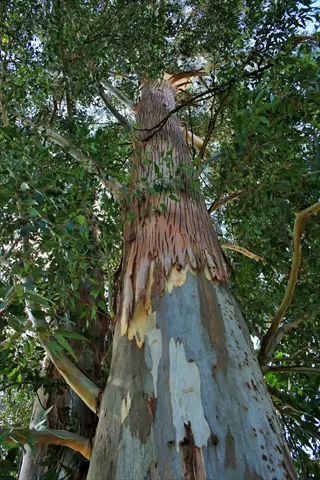
Blue Gum (Eucalyptus globulus)
- Size: This is the classic timber giant, reaching 30 to 55 metres (98 to 180 feet), so it needs a large, open site.
- Climate: It thrives in mild, frost-light coastal regions and was the species introduced to California in 1856, where it naturalized.
- Foliage: Young plants show rounded silver-blue leaves, while mature trees carry long, glossy, sickle-shaped adult foliage rich in aromatic oil.
- Bark: The trunk sheds bark in long streamers to reveal a smooth, pale surface, a hallmark of the species.
- Use: Widely grown for timber, pulpwood, windbreaks, and oil, it is the eucalyptus most people picture first.
- Caution: Its size, thirst, and flammability make careful siting essential, so it is best kept well away from buildings.
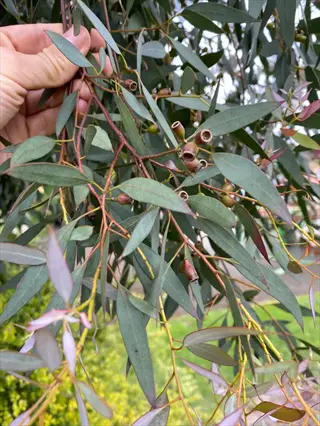
Cider Gum (Eucalyptus gunnii)
- Hardiness: Cider gum is among the more cold-tolerant species, which makes it the favorite eucalyptus for cooler temperate gardens.
- Size: Left alone it becomes a large tree, but regular pollarding keeps it as a compact, shrubby feature with rounded juvenile leaves.
- Foliage: Its silvery, coin-like young leaves are a florist favorite, prized for wreaths, bouquets, and long-lasting cut arrangements.
- Growth: Like most eucalyptus it grows quickly, so gardeners often coppice or pollard it each spring to control its size.
- Site: It wants full sun and free-draining soil and dislikes sitting in cold, waterlogged ground over winter.
- Cold note: In very cold zones it may die back to the ground, then resprout from the base in spring.
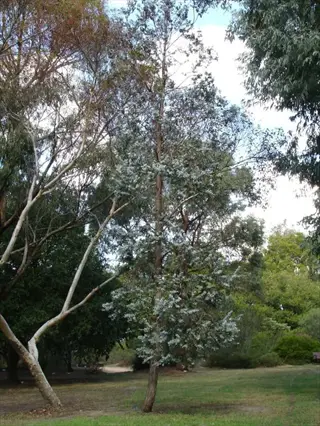
Silver Dollar (Eucalyptus cinerea)
- Foliage: Named for its round, silver-blue leaves that resemble coins, this species is grown for its striking decorative foliage.
- Size: It can become a modest tree outdoors but is often grown as a container plant or cut back hard for foliage.
- Indoor use: Its manageable size and fragrant leaves make it one of the more popular choices for patios and bright indoor spots.
- Leaves: Individual leaves last about a year before dropping and being replaced, so some leaf drop is normal and not alarming.
- Scent: The crushed foliage gives off the classic clean, menthol-like eucalyptus aroma many people associate with the plant.
- Care: It needs bright light, fast-draining soil, and careful watering, since soggy roots quickly cause trouble in pots.
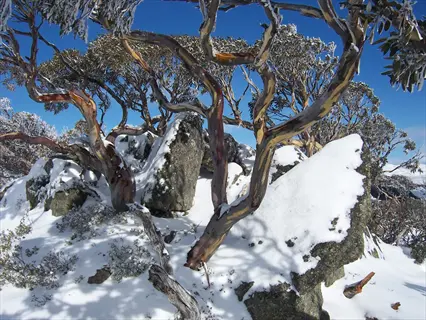
Snow Gum (Eucalyptus pauciflora)
- Hardiness: Snow gum, especially the alpine subspecies, is one of the toughest eucalyptus for cold and exposed sites.
- Bark: Its main attraction is the sculptural trunk, which peels into patches of white, gray, green, and warm gold.
- Size: It is a smaller, more manageable tree than blue gum, which suits it to many home gardens.
- Form: Trees often develop a beautiful twisting, multi-stemmed shape that gives strong year-round structure to a planting.
- Foliage: Adult leaves are leathery, gray-green, and aromatic, holding their color through winter as an evergreen.
- Site: It handles wind and cold better than most, but still needs full sun and soil that drains freely.
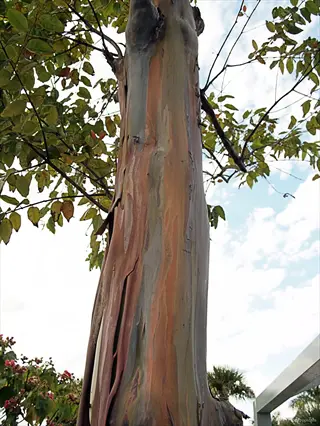
Rainbow Eucalyptus (Eucalyptus deglupta)
- Bark: This tropical species is famous for bark that peels to reveal streaks of green, orange, blue, and purple.
- Climate: Unlike most eucalyptus it needs a frost-free, humid tropical or subtropical climate and will not tolerate hard freezes.
- Size: In the tropics it grows into a very large tree, so it needs plenty of space and warmth.
- Interest: It is grown as an ornamental, since the multicolored trunk is its main attraction.
- Growth: Given heat and moisture it grows rapidly, quickly developing the colorful bark that makes it a photographer's favorite.
- Limitation: Outside truly tropical regions it can only be grown under glass, which limits it for most home gardeners.
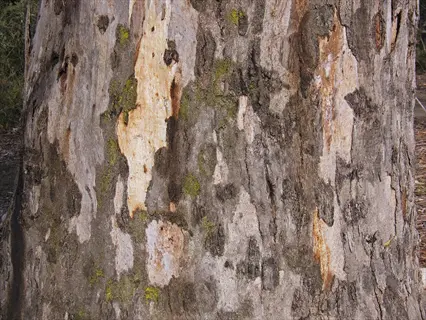
River Red Gum (Eucalyptus camaldulensis)
- Range: Red gum is one of the most widespread eucalyptus, well adapted to hot, dry regions and seasonal waterways.
- Size: It matures into a broad, spreading tree, so like blue gum it is a species for large, open landscapes only.
- Toughness: It tolerates heat, drought, and periodic flooding, which makes it a common choice for tough sites and shelterbelts.
- Wood: Its dense, durable timber has long been valued for heavy construction, fence posts, and firewood.
- Wildlife: Mature trees develop hollows over time that provide important nesting and roosting sites for birds and other wildlife.
- Caution: It can drop heavy limbs without warning, so it should never be planted close to homes, paths, or parking.
The pattern holds across all 6 profiles. Size and hardiness pick the tree for you, not the color of the bark. A silver dollar or a pollarded cider gum will live well in a pot on your patio. A blue gum or a red gum needs open ground and a wide safety gap. Choose for your climate and your space first, and the rest of the care falls into place.
How Big and Fast It Grows
How big does a eucalyptus tree get? The answer splits into two parts. There is how tall it ends up, and how fast it climbs to get there. Eucalyptus height swings hard from one species to the next, so a single number would just mislead you. A blue gum reaches a mature size of 30 to 55 metres, or 98 to 180 feet. Exceptional trees in the California fog belt have topped 61 metres, close to 200 feet. And its cousin the mountain ash is the tallest flowering plant on Earth.
My cider gum now stands well above the back fence and throws shade across half the lawn by noon. Eight years back I planted it as a knee-high whip thin enough to snap between two fingers. It cleared the fence in three summers and kept right on climbing. The neighbors started asking what I had been feeding it.
So how fast does eucalyptus grow? Faster than almost anything else you can plant. A young eucalyptus does most of its growing up front, then eases off. The eucalyptus growth rate runs steepest in the first 5 to 10 years, when a thin whip turns into a real tree. Because this fast-growing tree puts on its height early, you should plan for full size from day one. Do not tuck one ten feet from the house and hope it stays polite.
Eucalyptus front-loads its growth. Research finds that roughly 60% to 70% of a tree's final height is reached by about age ten, so plan for full mature size from the day you plant.
Planting and Care Guide
Good eucalyptus care comes down to three things this tree will not bend on. Give it full sun of 6 hours or more, set it in well-draining soil, and go easy on the water once it settles in. Get those right and your young tree takes off, since eucalyptus turns drought tolerant once its roots reach down. It is a tough plant. Most species stay happy in USDA hardiness zones 8 to 11. The steps below show you how to plant eucalyptus and keep its size in check.
One cool early spring morning I was out by the back fence, saw in hand, pollarding my cider gum down to its low framework. Sap ran and a sharp menthol scent lifted off every cut stem. This one is my Eucalyptus gunnii, and I planted it years back against that post. Every year I cut it hard to the same knuckle of old wood. By midsummer it threw up a burst of fresh shoots in round, silver juvenile foliage. Left alone, it would clear your roofline in a few seasons.
Choose a site with full sun and room for the mature size, well away from homes, since the tree grows fast and large.
Set a young, pot-grown plant at the same depth it grew in the pot, in soil that drains freely; eucalyptus hates sitting in cold, waterlogged ground.
Water through the first year or two so the roots settle in; after that most species are very drought tolerant and need little extra water.
Cut back in spring to control size and keep rounded juvenile foliage; pollarding to a low framework or coppicing to the ground both work well.
Apply a loose mulch to hold moisture and keep feeding light, since eucalyptus grows fast on its own without heavy feeding.
Overwatering and heavy clay kill more young eucalyptus than cold does. Prioritize sharp drainage, and once the tree is established, let it rely on its natural drought tolerance.
Size control is the real trick with this tree, and it is simpler than you think. Pruning eucalyptus in spring keeps the shape tidy, but the two boldest cuts do the heavy lifting. Pollarding drops it to a low trunk. Coppicing cuts the whole plant to the ground, so it resprouts as a shrub with many stems. In zone 7 and colder, winter often does this job for you, killing the top while the roots push up fresh growth. If you garden in a cold region, you can treat some species almost like a shrub you cut back each year.
Fire Risk and Safe Placement
The eucalyptus tree pays for its beauty with one serious flaw. NC State Extension rates it as extreme for how fast it burns. The eucalyptus fire risk is not something you can prune away. Almost every part of this tree seems built to burn, so where you plant it matters as much as sun or soil.
What makes eucalyptus flammable comes down to three things stacked on top of each other. The leaves are full of oils, the same oils you smell when you crush a leaf in your hand, and they catch fast and burn hot. Above them hang long ribbons of peeling bark that dry out and light with ease. Below sit years of shed bark and dead leaves, piled into deep litter that builds a heavy fuel load.
Here is where it turns dangerous. The USDA Forest Service found that these bark ribbons carry fire up into the tree crown. They can even fling it ahead of the main fire. A ground fire becomes a crown fire in minutes, and one tree turns into a real fire hazard for every roof near your home. This is the chain of ignition you want to break with smart placement.
- Distance: Plant at least 30 feet (9 metres) from your house, garage, deck, and other structures, and farther in high wildfire-risk regions.
- Clear litter: Rake up shed bark, dropped leaves, and dead branches regularly, since this oily litter is easy to ignite and builds a heavy fuel load.
- Mind the canopy: Keep branches away from rooflines, chimneys, and power lines so hanging bark streamers cannot carry flames into the tree crown.
- Separate fuels: Avoid planting eucalyptus in dense groups next to fences, sheds, or other shrubs that could form a continuous path for fire.
- Choose wisely: In wildfire-prone areas, consider a smaller, pruned species or skip eucalyptus entirely in favor of a less flammable tree.
The single most useful rule is planting distance. Keep any eucalyptus at least 30 feet (9 metres) from your house, garage, and deck, and push it farther in high wildfire regions. Rake the ground beneath it often too, since bare soil holds far less fuel than a bed of dry bark and dead leaves.
Tasmanian bluegum is highly flammable and should not be planted near homes and other structures.
One hard truth makes all of this worse. Fire rarely kills a grown eucalyptus. It resprouts from lignotubers, woody swellings at the root, and from hidden buds along the trunk. That toughness is why the tree spread across the hills after the 1991 Oakland Hills Fire. It is also why so many California towns now pull it back from their homes.
Ecology, Water and Wildlife
Few trees split opinion like the eucalyptus tree. Walk into an old grove and you meet bare, open ground where almost nothing green grows. The leaves and roots leak chemicals into the soil, and these stop any plant you add from taking hold. We call this eucalyptus allelopathy, and it is why your borders stay bare in the shade below.
So is the tree a villain or a gift? The honest answer is both, and it depends on where you plant it. Old warnings about eucalyptus water use cast it as a water thief that drains your ground dry. New research has started to question that label. You will hear experts fight over whether the eucalyptus invasive tag is fair. Federal foresters say it seldom spreads far. State parks warn it crowds out the native plants you want to protect.
Why Little Grows Underneath
- Chemistry: The leaves release terpenes and phenolic acids, and fog dripping from the canopy inhibits the growth of annual grass seedlings below.
- Roots and litter: Both the roots and the thick layer of shed leaves add naturally occurring chemicals that suppress competing plants, a process called allelopathy.
- Effect: The result is the bare, open ground gardeners often notice beneath established eucalyptus, which makes underplanting genuinely difficult.
The Water Reputation, Re-Examined
- Reputation: Eucalyptus has long carried a water-thief reputation for heavy groundwater use, one reason it was once planted to help drain swampy ground.
- Efficiency: Yet blue gum does well on only 530 millimetres (21 inches) of rain in coastal California because frequent fog compensates for the lack of rainfall.
- New research: Researchers are now re-examining how much water the trees really use, so treat the old water-thief label as a debated point rather than settled fact.
Real Value to Wildlife
- Monarchs: Eucalyptus groves provide critical overwintering habitat for migratory monarch butterflies and nesting sites for migratory birds.
- Pollinators: The nectar-rich flowers feed bees and other pollinators, and the trees are a well-known source of eucalyptus honey.
- Birds: Even where the tree is considered non-native, its flowers and foliage offer food and foraging habitat for many native birds.
Native, Non-Native, or Invasive
- Context matters: Whether eucalyptus counts as invasive depends on place; federal foresters note bluegum rarely spreads far beyond plantations, while park and state sources stress habitat encroachment.
- California story: First planted in California in 1853, the tree boomed from 1907 to 1913, then fell from favor as attitudes shifted toward viewing it as non-native.
- Turning point: After the 1991 Oakland Hills Fire, many parks began removing blue gums, cementing the tree's lasting love-hate reputation in the state.
None of this cancels out the good the tree does. Its groves shelter the monarch butterfly through winter. The flowers feed bees that make the prized eucalyptus honey you may have tasted. That real eucalyptus wildlife value is why the removal debate stays messy. These trees have shaped the California coast for 170 years. Growers planted the first ones in 1853 and cheered a boom from 1907 to 1913. Cutting of blue gums picked up after the 1991 Oakland Hills Fire. Where you stand, more than the tree itself, decides whether you read it as a pest or a prize.
The leaves and roots of eucalyptus trees inhibit other plants to grow under them due to naturally occuring chemicals.
5 Common Myths
Eucalyptus trees can spontaneously burst into flames on a hot day, igniting all on their own with no outside spark at all.
They do not self-combust. Eucalyptus is highly flammable and ignites easily from an outside spark, but reports of spontaneous combustion are untrue.
Eucalyptus grows so large and so fast that it is always a poor, unmanageable choice for any ordinary backyard garden.
Regular pollarding or coppicing keeps many species compact, and smaller cultivars grow happily in containers and modest gardens.
Eucalyptus is a harmless, decorative plant, so its leaves and essential oil are perfectly safe around curious pets and young children.
All parts are toxic to cats, dogs, and horses, and the concentrated oil is extremely poisonous if it is eaten.
Nothing grows underneath a eucalyptus tree simply because its dense canopy blocks out nearly all of the available sunlight.
Its leaves and roots release terpenes and phenolic acids that chemically suppress nearby plants, a natural process known as allelopathy.
Every eucalyptus is a tender tropical tree that cannot survive anywhere that experiences real winter frost or freezing temperatures.
Hardy species such as cider gum tolerate cold well, though in zone 7 and colder plants often die back to the ground.
Conclusion
You have seen how much one eucalyptus tree can shift the feel of a garden. It might be a small silver dollar in a pot or a towering blue gum that shades the whole yard. The real reward comes when you match the species to your space and climate. Pick a hardy snow gum for a cold plot, or a vigorous blue gum for open ground. The tree does most of the work for you. Get that first choice right and the rest falls into place with far less effort.
This is a huge family, with more than 700 species spread across one fast-growing genus. Most of them grow wild in Australia and nowhere else on earth. Their leaves are packed with aromatic oil, which gives the whole group its clean, sharp scent. That beauty comes with two traits you cannot ignore. The wood and leaves are highly flammable, and the oil is toxic to pets and people if eaten.
The plain bottom line for eucalyptus care stays simple once you learn the basic rules. Give the tree full sun and soil that drains well, and it will grow with little fuss. Plant it well clear of your house and other buildings, since the bark and foliage burn fast. Keep the size in check with pollarding, cutting the main stems back hard each year to hold a tall tree at a manageable height.
Growing eucalyptus is a balanced trade between beauty and care. A gum tree gives you fragrant leaves, peeling bark, and shelter for monarch butterflies and nesting birds. In return it asks for smart, informed siting. Hold both truths at once and you keep the best of this fast-growing tree without the regret. The questions just below point you to more answers. They cover water needs, lifespan, uses, safety, and wildlife value. Read on if any doubts still linger about your own gum tree.
Glossary
- 1,8-cineole (eucalyptol)
- The main aromatic compound in eucalyptus oil, responsible for its menthol-like scent and studied anti-inflammatory effects.
- Allelopathy
- When a plant releases natural chemicals that suppress the growth of other plants nearby, such as under a eucalyptus.
- Coppicing
- Cutting a tree down close to the ground so it resprouts with multiple new stems from the base.
- Epicormic buds
- Dormant buds hidden under the bark that sprout new shoots after fire or heavy pruning damages a tree.
- Lignotuber
- A swollen woody base that stores buds and energy, letting many eucalyptus resprout after being cut or burned.
- Operculum (calyptus)
- The little cap on a eucalyptus flower bud that falls off to release the stamens, and the source of the genus name.
- Phenolic acids
- Natural plant chemicals released by eucalyptus leaves that help inhibit the growth of grasses and other plants below.
- Pollarding
- Cutting a tree back to a low framework each year to control its size and keep fresh, often rounded, foliage.
External Sources
Frequently Asked Questions
Where do eucalyptus trees grow best?
Eucalyptus grows best in full sun, free-draining soil, and mild climates within USDA hardiness zones 8 to 11.
Do eucalyptus trees need a lot of water?
Once established, most eucalyptus are strongly drought tolerant and need little extra water, but young trees need regular watering.
How long does a eucalyptus tree live?
Lifespan varies widely by species; many are long-lived, and blue gums planted in California in the 1870s still stand today.
What are common problems with eucalyptus trees?
The most common eucalyptus problems include:
- Pests such as psyllids, lerps, borers, and leaf beetles
- Diseases like root rot, canker, and powdery mildew
- Leaf drop and brown tips from stress, cold, or overwatering
- Fast growth that quickly outgrows a small space
What are the 10 uses of eucalyptus?
Ten common uses of eucalyptus include:
- Firewood
- Timber and furniture
- Pulpwood and paper
- Flooring
- Essential oil
- Traditional medicine
- Windbreaks
- Honey
- Natural dye
- Didgeridoos
Is eucalyptus healthy to breathe in?
The aroma comes from 1,8-cineole, which laboratory studies link to anti-inflammatory effects, but concentrated oil should never be swallowed.
What animal only eats eucalyptus leaves?
The koala feeds almost entirely on eucalyptus leaves, which most animals avoid because of the strong, oily compounds.
What animals hate the smell of eucalyptus?
The strong oils repel many insects and deter some browsing animals, and grazing animals find eucalyptus seedlings unpalatable.
Are eucalyptus leaves toxic to touch?
Handling leaves and bark can cause contact dermatitis in sensitive people, but the real danger is swallowing the highly toxic oil.
Who should avoid eucalyptus?
Keep it away from cats, dogs, and horses, and people with sensitive skin or a risk of swallowing the oil should be cautious.