Tree · Arecaceae
Windmill Palm
Trachycarpus fortunei
Hardy down to single digits, the windmill palm gives a true tropical look to gardens far colder than most palms can stand.
Partial shade
USDA 7–10
8–40 ft · 2.4–12.2 m
Overview
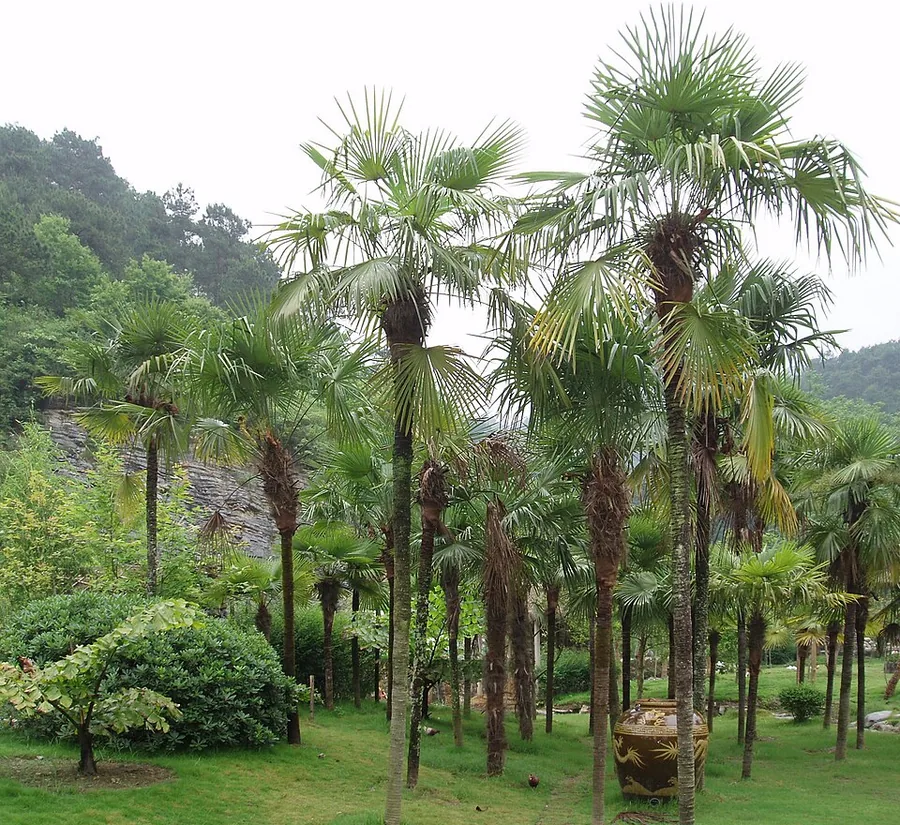
The windmill palm is the cold-hardy palm that lets gardeners outside the tropics grow a real fan palm. It comes from the mountains of central and eastern China, and that high-altitude home is why it shrugs off cold that would kill most palms, taking temperatures as low as 5°F (-15°C). The stiff, rounded fans spread out like the blades of a windmill, which is where the name comes from.
It grows on a single, slender trunk wrapped in coarse brown fiber, and it climbs slowly, often only a few inches a year. Given decades it can reach 8 to 40 feet (2.4 to 12 m), though most garden plants stay well short of that. It works as a hardy landscape tree in USDA zones 7 to 10, in a large container, or under glass in a cool conservatory.
This is the palm people mean to plant when they want the look without the fuss, and it asks little once it's settled in. Give it decent soil, steady moisture, and some shelter from harsh wind, and it carries on for years with almost no attention.
Care
The short version: part shade to full sun, rich and well-drained soil kept evenly moist but never waterlogged, a slow-release palm feed through the growing season, and shelter from cold, drying winds.
Light
The windmill palm does best in partial shade but takes full sun once it's established. Light to medium shade suits it, and a young plant especially appreciates being kept out of the harshest midday glare.
Water
Give it regular, ample water in soil that stays evenly moist but drains freely. An established palm handles a moderate dry spell, but it will not tolerate standing water or a high water table, which rots the roots.
Soil
Plant in rich, fertile, well-drained loam. A pH of 6.0 to 7.5 works fine, and the palm takes sand and a wide range of soils in stride. It even shrugs off moderate salt, which helps in coastal gardens.
Temperature
This is the hardiest trunked palm around, riding out cold to 5°F (-15°C) and heat up to 104°F (40°C). That range is what lets it live outdoors well beyond the usual palm country, though young plants still appreciate winter shelter.
Humidity
Ordinary outdoor humidity is all it needs, so there's no figure to hit. Shelter from cold, drying wind does far more for it than any humidity reading.
Feeding
Feed through the growing season, spring into early fall, with a slow-release palm fertilizer that carries micronutrients like manganese, magnesium, and iron. Palms run short on nitrogen, potassium, magnesium, and manganese in sandy ground, so the right feed heads off the deficiencies that yellow the fronds.
Pruning
Keep pruning to a minimum. Take off only the fully dead, browned lower fronds and spent flower or fruit stalks, and never cut a healthy green frond. Loose trunk fiber can be tidied for looks, but the growing point at the crown must stay untouched.
Repotting
Move a container plant into a larger pot every 2 to 3 years or when it turns rootbound. Mature landscape specimens are never lifted, so this only applies while the palm is still in a pot.
Size & spacing
A windmill palm reaches 8 to 40 feet (2.4 to 12 m) tall over many years, with a crown spreading 4 to 6 feet (122 to 183 cm). Slow growth means it takes its time, so plan its spot for the long haul.
When to plant
The windmill palm is a slow, year-round grower rather than a plant with a planting season, so there's no sowing schedule to follow. What it does keep is a flowering and fruiting rhythm: yellow flowers open in early summer, and on female plants the dark drupes ripen from late summer into fall.
Northern hemisphere
Southern hemisphere
Typical months for a temperate climate: start earlier in warm zones, later where spring frosts linger.
- Harvest: Yellow flowers on drooping panicles in early summer (June to July); dark blue to nearly black drupe fruits ripen on female plants in late summer to fall.
Hardiness
USDA hardiness zones: 7–10
Temperature: down to -18°C
Troubleshooting
The windmill palm has few real problems, and most of what shows up is cosmetic or easy to head off. Watch the fronds and the soil drainage, since that's where the warning signs appear first. Match what you see below and act before a small issue settles in.
Wilting and crown decline even though the soil is soaking wet
When a palm wilts in soggy ground, the cause is root rot from waterlogged soil. Roots that sit in standing water or a high water table go soft, dark, and stop feeding the plant. Improve the drainage, ease off the watering, and never plant in a low spot that collects runoff.
Fix:
- Improve drainage and reduce supplemental watering
- Avoid planting in low spots that collect water
Sticky fronds with sooty black film and small bumps
Scale insects or palm aphids are feeding on the fronds. They leave a sticky honeydew that turns into a black sooty mold, and you'll spot the pests themselves as tiny armored bumps or soft colonies on the leaf surfaces and undersides. Wipe them out with horticultural oil or insecticidal soap, and cut away any frond that's badly overrun.
Fix:
- Treat with horticultural oil or insecticidal soap
- Remove heavily infested fronds
Yellow, frizzled fronds showing up on the newest growth
This is a nutrient deficiency, usually manganese, potassium, or magnesium, and it shows first as discolored, distorted fronds. Sandy soils run short on these minerals fastest. Feed a slow-release palm fertilizer that carries micronutrients, and keep it on a steady schedule rather than fixing it with one heavy dose.
Fix:
- Apply a slow-release palm fertilizer containing micronutrients
- Correct deficiency on a regular schedule rather than a single dose
Fronds tearing and shredding along the leaf segments
This is wind damage, not disease. Cold, drying gusts whip the wide fans until they split along the natural folds, which looks rough but rarely hurts the plant. Move a potted palm to a sheltered corner or set up a windbreak, and trim only the worst or fully dead fronds.
Fix:
- Provide a windbreak or relocate to a more sheltered position
- Trim only the most badly damaged or fully dead fronds
Toxicity
Good news for households with animals: the windmill palm is non-toxic across the board. It's a true palm, not the poisonous sago palm it's so often confused with, so there's no cycasin or any other toxin to worry about for pets, livestock, or children.
Safe for
People · Cats · Dogs · Horses · Rabbits · Livestock · Birds
Cats None
Safe around cats. The ASPCA lists the windmill palm as non-toxic, so a curious cat batting at the fronds has nothing to fear.
Dogs None
No risk to dogs. It carries the ASPCA non-toxic listing, and a dog that chews a frond won't be poisoned by it.
Horses None
NC State Extension reports the windmill palm as non-toxic to horses, so it's a safe plant to have around the paddock.
Rabbits Safe
Nothing in this true palm is known to harm rabbits, so a stray nibble is no cause for worry.
Livestock Safe
Cattle, goats, and sheep can graze near it without trouble, since the plant holds no toxins that affect them.
Birds Safe
Birds are fine around it. The fronds and ripe fruit pose no poisoning risk to backyard or pet birds.
People Safe
Safe for people, including children. This is the true palm, not the toxic sago palm it's often mistaken for, so a handled frond is harmless.
Often confused with the highly toxic sago palm (Cycas revoluta); the true windmill palm is a different, non-toxic plant.
Varieties
Only a couple of named windmill palms turn up in gardens, and both are picked for a specific reason rather than for show.
Trachycarpus fortunei var. wagnerianus ('Waggie')
Its stiffer, smaller, more compact leaves shrug off wind far better than the standard species, which makes it the one to plant in an exposed spot.
Trachycarpus fortunei 'Nanus'
A dwarf form that stays notably shorter than the standard windmill palm, handy where height is at a premium.
How to propagate
There's just one way to make more windmill palms, and it calls for patience more than skill.
SeedModerate
Sow fresh, cleaned ripe seed in spring at its own depth in a moist, free-draining medium. · Seed germinates in roughly 1 to 3 months; several years are needed to develop a visible trunk.
Seed is the only way to multiply a windmill palm, and you need both a male and a female plant for the seed to be viable. Sow fresh, cleaned seed in spring at its own depth in moist, free-draining mix, and it sprouts in 1 to 3 months. Patience is the catch, since it takes several years to put up a trunk you can see. This is a solitary, single-trunked palm, so it never throws offsets or pups, and it won't root from a cutting.
Myths
The windmill palm is the same as the sago palm and just as poisonous.
They aren't even close relatives. The sago palm (Cycas revoluta) is a cycad and genuinely toxic, while the windmill palm is a true palm in the family Arecaceae. The ASPCA lists the windmill palm as non-toxic, so the two should never be lumped together.