Houseplant · Crassulaceae
String of Buttons
Crassula perforata
Give it bright light and a dry, gritty mix, and this stacked succulent climbs into neat little towers.
Bright indirect
50–77°F · 10–25°C
USDA 9–11
8–18 in · 20–45 cm
Overview
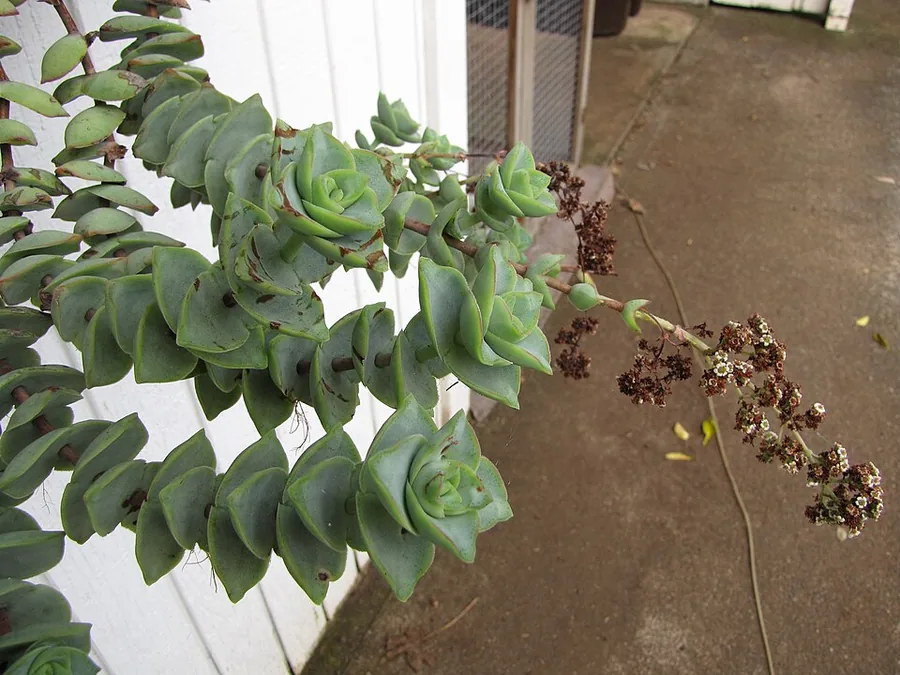
String of buttons is a trailing succulent named for the way its triangular leaves stack up the stem like beads on a string. It belongs to the Crassulaceae family, the same group as jade and stonecrop, and it stays a manageable size indoors at 8 to 18 inches (20 to 45 cm) tall. The stacked, geometric look is what draws people to it, and good light is what keeps that look tight.
It earns its reputation as an easy plant, asking for little beyond strong light and restraint with the watering can. The leaves bank their own water, so the soil should dry out fully before the next drink. In spring it sends up small star-shaped flowers in pale yellow to white, a quiet bonus on top of the foliage.
Grown well, the stems branch and trail and spread to about 12 to 24 inches (30 to 60 cm) across, spilling over the edge of a pot or hanging basket. Let the light drop and the stems stretch and lean, trading those neat towers for a loose, leggy sprawl.
Care
The short version: bright light, a gritty fast-draining mix, and water only once the soil has dried out completely. Keep it warm, ease off the water in winter, and it mostly looks after itself.
Light
Give it bright light, ideally bright indirect with a few hours of direct sun. It tolerates full sun once hardened off, but in dim corners the stems stretch and the tidy stacked shape falls apart.
Water
Let the soil dry out completely before you water again, since the leaves store their own supply. Water sparingly through winter dormancy. This plant rots fast in soggy soil, so when in doubt, wait.
Soil
Plant it in a gritty cactus or succulent mix that drains in seconds rather than minutes. A slightly acidic pH around 6.0 to 6.5 suits it, and the grit is what keeps the roots from sitting wet.
Temperature
Keep it in the comfortable range of 50°F to 77°F (10°C to 25°C). It is not frost-hardy, so move it somewhere warm before the cold sets in.
Humidity
Low household humidity is exactly what this succulent wants, so there's no number to chase. Dry air and good airflow help keep rot at bay.
Feeding
Feed only in spring and summer while it's actively growing, using a diluted balanced or low-nitrogen succulent fertilizer. A light seasonal feed is plenty, and too much nitrogen brings soft, weak growth.
Pruning
Pinch or trim any leggy, stretched stems to push the plant to branch and stack more tightly. The pieces you remove root readily, so nothing goes to waste.
Repotting
Repot every 2 to 3 years or once the plant crowds its pot, doing it in spring. Watch for roots poking through the drainage holes, soil that dries unusually fast, or a top-heavy plant straining at the edges.
Size & spacing
Indoors it reaches about 8 to 18 inches (20 to 45 cm) tall and trails to roughly 12 to 24 inches (30 to 60 cm) wide. Give it room to spill, or let it hang so the stacked stems can drape.
Troubleshooting
Almost every problem with string of buttons traces back to light or water. Too little light stretches the stems, too much water rots the roots, and a sudden blast of sun scorches the leaves. Match what you see below and the fix is usually a small change in habit.
Yellow, mushy leaves and a soft base
Soft, see-through leaves and a dark, squishy stem base point to root rot from too much water in soil that drains too slowly. Stop watering and let everything dry out. If the base is already lost, unpot the plant, cut away the slimy brown roots, and repot the firm pieces in fresh gritty mix, or take cuttings from whatever growth is still healthy.
Fix:
- Stop watering and let soil dry fully
- Unpot, cut away rotted roots and stems, and repot healthy portions in fresh gritty mix
- Take cuttings from firm growth if the base is lost
Stems stretching out and losing their stacked shape
This is etiolation, the plant reaching for light that isn't there. The new growth comes in pale and elongated, and the whole stem leans toward the nearest window. Move it somewhere much brighter, then prune the stretched stems and root the cuttings to start a tight, stacked plant again.
Fix:
- Move to a brighter spot with several hours of direct or very bright indirect light
- Prune stretched stems and root the cuttings to restart compact growth
Brown or reddish scorch marks on the leaves
These patches are sunburn, and they show up when a plant meets strong direct sun before it has hardened off. The damage lands on the surfaces facing the light, often right after a move outdoors or to a hot window. Shift it back to bright indirect light, pull the worst leaves, and reintroduce full sun slowly over a week or two.
Fix:
- Move to bright indirect light and remove badly damaged leaves
- Reintroduce direct sun gradually over one to two weeks
Toxicity
Good news for pet owners: string of buttons is generally considered non-toxic and safe around the household. A curious cat, dog, or rabbit that takes a bite shouldn't suffer for it. The leaves are still an ornamental succulent rather than food, so there's no reason to encourage snacking, but you don't need to keep this one out of reach.
Safe for
People · Cats · Dogs · Horses · Rabbits · Livestock · Birds
Cats None
String of buttons is considered safe around cats, so a curious nibble shouldn't cause any harm.
Dogs None
Dogs can share a room with this succulent without any worry. It isn't known to cause poisoning if a leaf gets chewed.
Horses None
No toxic effects are linked to horses with this plant.
Rabbits None
A rabbit that tastes a stem won't come to any harm, since the plant carries no known toxins for them.
Livestock None
Grazing animals such as goats and sheep aren't affected by string of buttons.
Birds None
The plant poses no recognized danger to pet birds.
People None
There's nothing toxic here for people, though the leaves are an ornamental succulent rather than something to eat.
Helpline numbers

United States
ASPCA Animal Poison Control: (888) 426-4435 (fee applies)

United Kingdom
Animal PoisonLine: 01202 509000 (fee applies)

Australia
Animal Poisons Helpline: 1300 869 738
Varieties
Most plants you'll find are the plain green species, but there is one named selection worth knowing.
Crassula perforata 'Variegata'
Its leaves carry creamy-yellow to pinkish variegation and blush pink along the margins when the light is bright.
How to propagate
String of buttons multiplies with almost no fuss, and a single plant gives you all the cuttings you need to fill more pots or share with friends.
Stem cuttingsEasy
Spring through summer during active growth · 2 to 4 weeks to root
Stem cuttings are the easy way to make more of this plant. Snip a stem segment during spring or summer, let the cut end callus over for a day or two, then set it on or in gritty mix. New roots take hold in about 2 to 4 weeks.
Leaf cuttingsModerate
Spring through summer · 4 to 8 weeks to root and sprout
You can also start from a single leaf, though it asks for more patience. Pull a whole healthy leaf, let it callus, and lay it on dry succulent mix in spring or summer. Expect 4 to 8 weeks to root and sprout, and a lower success rate than stem cuttings.
Myths
String of buttons must be poisonous because it looks like other toxic succulents.
Crassula perforata is generally treated as non-toxic and safe around cats and dogs. Plenty of succulents do carry toxins, so the family's reputation is fair, but this one isn't among the dangerous ones. The leaves are best left as decoration rather than a snack, but a stray nibble is nothing to panic over.