Houseplant · Crassulaceae
Burro's Tail
Sedum morganianum
Give it bright light and dry feet, and this trailing succulent spills over the pot for years.
Full sun
Every 14–30 days
50–77°F · 10–25°C
USDA 10–11
Overview
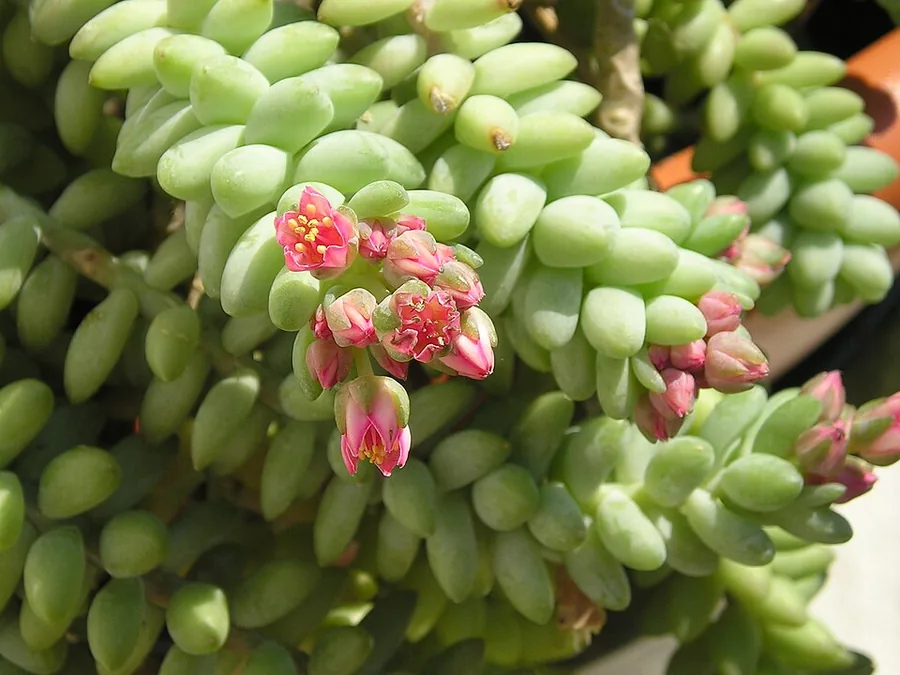
Burro's tail is a trailing succulent named for the thick, braided stems that hang like a tail over the edge of a pot. It comes from southern Mexico and Honduras, where it clings to rocky slopes, and that mountain background explains everything about how it likes to be grown. The plump blue-green leaves are packed with stored water, so the plant shrugs off the dry spells that would finish off a thirstier houseplant.
What makes it so striking is also what makes it a little fussy to live with. Those overlapping leaves are only loosely attached and shatter off at the lightest touch, which is why a hanging basket out of the daily traffic suits it best. Grown well, a single plant can trail to several feet, and in summer it may tip its stems with small pink to red flowers, though that show is rare indoors.
The good news is that it asks for almost nothing. Bright light, a fast-draining pot, and a long stretch between waterings keep it happy, and the biggest risk by far is kindness in the form of too much water. Treat it lean and leave it alone, and it rewards you for years.
Care
The short version: give it the brightest spot you have, plant it in a gritty cactus mix, and water only when the soil has nearly dried out, going even drier in winter to keep rot away.
Light
Burro's tail wants bright light to full sun, the brightest spot you can give it. A sunny windowsill keeps the stems tight and full, while a dim corner stretches them out thin and pale. If you move it into stronger sun, do it over a week or so to spare the leaves from scorching.
Water
Water sparingly and only once the mix has nearly dried out, which often works out to about once a month indoors. The fat leaves carry their own reserve, so when you're unsure, wait. Cut back even further in winter, since soggy soil in the cold is the fastest route to rot.
Soil
Plant it in a gritty, fast-draining cactus or succulent mix, ideally with extra perlite worked in. A pH anywhere from 6.0 to 7.5 suits it. What matters most is that water runs straight through rather than lingering around the roots.
Temperature
It's comfortable between 50°F and 77°F (10°C to 25°C), ordinary room range. It can take a brief dip toward 40°F (4°C), but bring it indoors before any frost, which it won't survive.
Humidity
This is a low-humidity plant that's right at home in dry indoor air, so there's no number to chase and no misting needed. Damp, stagnant air does it no favors and only invites rot.
Feeding
Feed it rarely, just once or twice across the spring-to-summer growing season, using a balanced or dilute liquid fertilizer. It grows lean by nature, and heavy feeding does more harm than good.
Pruning
It needs little to no pruning. Trim back any leggy or overlong stems just to tidy the plant, and work gently, because the stems are brittle and the leaves drop at a touch.
Repotting
Repot only when the plant has completely filled its pot, which won't be often. Telltale signs are roots crowding the container and growth that stalls or looks congested. Handle it as little as you can during the move to keep the leaves on.
Size & spacing
Trailing stems can reach 2 to 4 feet (60 to 120 cm) long, spreading 1 to 3 feet (30 to 90 cm) wide. A hanging basket gives those tails room to spill and keeps them clear of passing elbows.
Troubleshooting
Almost every problem with burro's tail traces back to one of two things: too much water or too little light. Read the early signs below and you can usually fix the cause before the plant suffers for it.
Soft, mushy stems and leaves turning translucent
This is rot, and it almost always comes from too much water sitting around the roots. Stop watering at once and let the soil dry right out, then cut away any soft, discolored stems before the damage spreads. If the base is gone, snip off the healthy tips and root them, and from now on use a gritty mix that drains fast and water far less in winter.
Fix:
- Stop watering and allow the soil to dry out
- Remove rotted portions and repot into gritty, fast-draining mix
- Propagate healthy stem tips if the base is lost
White cottony tufts wedged into the leaf joints
Those little cotton balls tucked into the leaf axils are mealybugs, sap-suckers that often leave a sticky film behind. Touch each one with a cotton swab dipped in rubbing alcohol, move the plant away from your others, and keep at it until none come back. Check any new succulent before it joins the shelf, and don't let plants sit wet or crowded.
Fix:
- Dab insects with a cotton swab dipped in alcohol
- Isolate the plant and repeat treatment until clear
Plump leaves dropping off the moment you touch the plant
Those fat leaves are only loosely attached, so a stray brush or a bumped pot sends them raining down. This is just how the plant is built, not a sign of trouble. Hang it somewhere out of the daily traffic, lift it by the pot rather than the stems, and press the fallen leaves into the soil where they root into new plants for free.
Fix:
- Place the plant where it will not be brushed against or knocked by passing traffic
- Handle by the pot rather than the stems
- Pot or scatter dropped leaves on soil, where they readily root into new plants
Stems stretching out with wide gaps between the leaves
Stretched, leggy growth with pale leaves is the plant reaching for light it isn't getting, a problem called etiolation. Move it to a brighter window with bright light to full sun, but make the switch over a week or two so the stems don't scorch. A sunny sill keeps the trailing stems tight and full.
Fix:
- Move to a brighter spot with bright light to full sun
- Acclimate gradually to stronger light to avoid scorching
Toxicity
Good news for a pet home: burro's tail is safe to keep around animals and children. The ASPCA lists it as non-toxic to cats, dogs, and horses, and there are no harmful compounds in the leaves. A curious nibble might cause a brief upset stomach, the way most plants do, but nothing worse.
Safe for
People · Cats · Dogs · Horses · Rabbits · Livestock · Birds
Cats None
The ASPCA lists this one as safe for cats. A curious nibble might bring on a little drooling or a brief upset stomach, but nothing worse.
Dogs None
Safe for dogs too, with no toxic compounds to worry about. A dog that chews a trailing stem may get mild, passing tummy trouble at most.
Horses None
The ASPCA also clears it for horses, so a grazing mouthful poses no real danger.
Rabbits Safe
No toxins here mean a rabbit won't be harmed by a taste, though the fleshy, water-heavy leaves are best kept as a rare treat rather than a regular green.
Livestock Safe
Goats, sheep, and cattle can sample it without coming to harm. As a houseplant it rarely crosses their path anyway.
Birds Safe
Pet birds are fine around it, and a pecked leaf carries no poison. The brittle stems will scatter long before much gets eaten.
People Safe
There's nothing toxic in it for people, so a child who tastes a dropped leaf is in no danger. It isn't grown for eating, so leave it on the windowsill.
Varieties
Burro's tail has one close relative worth knowing, a more compact form that's easier to handle and just as easy to grow.
Sedum morganianum 'Burrito' (baby burro's tail)
Carries shorter, rounder, more tightly packed leaves than the species and holds onto them far more stubbornly, which makes it the easier one to handle.
How to propagate
Few plants are this generous. Every leaf that falls and every trimmed stem can become a new plant, so you'll never be short of copies to pot up or pass along.
Stem cuttingsEasy
Growing season (spring to summer) · Several weeks to a few months to root well
Stem cuttings are the quickest way to a full new plant. Take healthy tips during the spring-to-summer growing season, let the cut ends callus over for a day or two, then lay them on or push them into a gritty mix. Roots take hold over several weeks to a few months, faster than starting from a single leaf.
Leaf cuttingsEasy
Growing season (spring to summer) · Several weeks to a few months, slower than stem cuttings
Every leaf that drops is a free plant waiting to happen. Lay the fallen leaves on the soil surface during the growing season and they sprout roots and tiny plantlets on their own. It works reliably, but expect it to run several weeks to a few months, slower than a stem cutting.
DivisionEasy
When repotting during the growing season · A few weeks to establish
Once a clump has packed its pot, you can split it when you repot in the growing season. Each section settles back in within a few weeks, giving you two plants from one with little fuss.
Myths
Burro's tail is poisonous to cats and dogs and unsafe to keep around pets.
The ASPCA lists Sedum morganianum as non-toxic to dogs, cats, and horses, so it earns a spot in a pet home. A nibble might cause mild stomach upset, the same as eating most any houseplant, but nothing dangerous.
The plant needs frequent watering to keep its plump leaves from shriveling.
It's a drought-tolerant succulent that stores water in those fat leaves and wants the soil to nearly dry out between drinks. Too much water is what kills it, rotting the roots and stems, so when in doubt, wait.