Houseplant · Crassulaceae
Mexican Snowball
Echeveria elegans
Give it bright sun and dry roots, and the Mexican snowball holds a tight silver rosette for years.
Full sun
50–77°F · 10–25°C
USDA 9–11
2–4 in · 5–10 cm
Overview
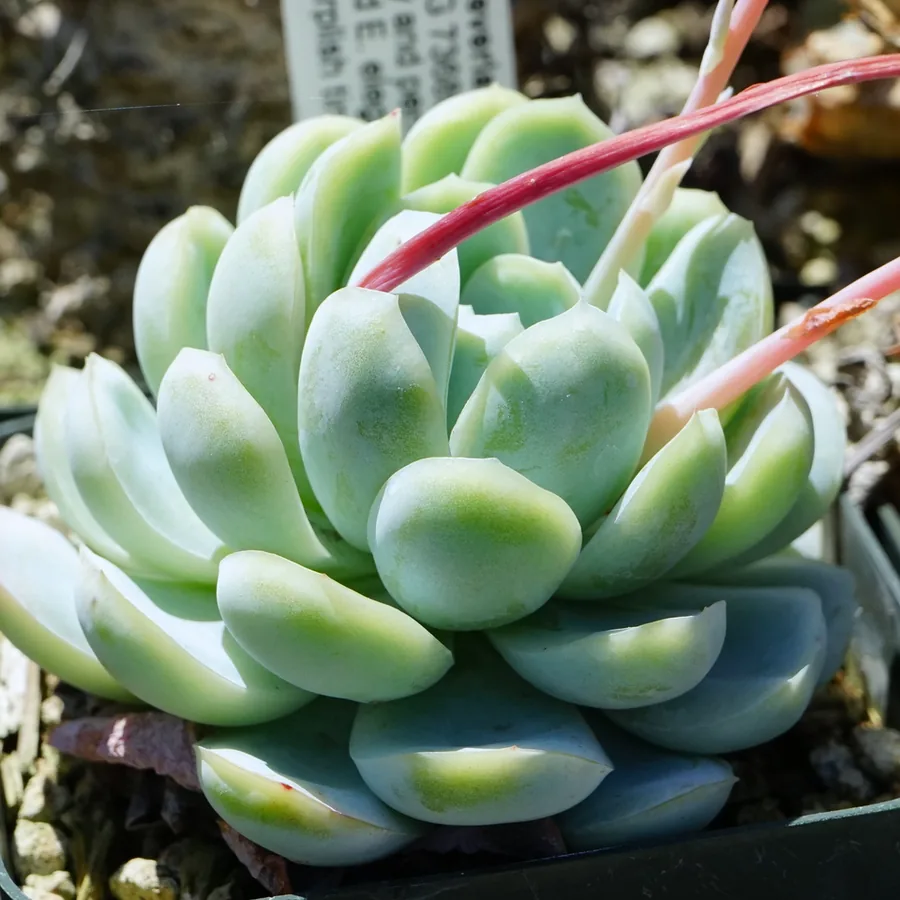
The Mexican snowball is a small succulent that forms a tight rosette of pale, blue-green leaves dusted with a silvery bloom. It comes from the rocky highlands of Mexico, which tells you most of what it wants: sharp drainage, plenty of light, and very little fuss. At 2 to 4 inches (5 to 10 cm) tall and spreading to about 20 inches (50 cm) across, it stays compact enough for a sunny windowsill.
It earns its keep by being hard to kill in the right spot. Growth is slow, the plant is a perennial, and over time it clumps as it pushes out offsets around the base. Indoors it needs the brightest window you can give it, and in spring it can send up a slender stalk of small bell-shaped flowers above the rosette.
Almost every problem traces back to one thing: water. This is a plant built to go dry, so the quickest way to lose it is to keep the soil damp. Get the watering right and give it strong light, and the frosted rosette stays tight and full with barely any care.
Care
The short version: give it the brightest light you have, plant it in gritty fast-draining mix, and water only once the soil has dried out completely.
Light
Give it full sun or the brightest spot you can manage, and it will hold a tight, compact rosette. It tolerates bright indirect light, but anything dimmer and the plant stretches and pales. Indoors in winter, a grow light keeps the shape from loosening.
Water
Let the soil dry out completely between waterings, then soak it and let it drain. Cut back hard in winter when growth stalls. Always water at the base rather than into the rosette, because water trapped among the leaves is a fast track to rot.
Soil
Plant it in a gritty cactus or succulent mix that drains fast and never stays soggy. A pH from 6.0 to 7.0 suits it well. The single most important thing is drainage, so use a pot with a hole and skip any dense, water-holding potting soil.
Temperature
It's happiest between 50°F and 77°F (10°C to 25°C). Ordinary room temperature works year-round, and it's not a plant that takes hard frost, so bring it in before the cold sets in.
Humidity
This succulent wants low humidity and dry foliage, which makes it an easy match for most homes. Skip the misting entirely, since damp air and wet leaves only invite rot.
Feeding
Feed lightly from spring through summer while it's actively growing, about once a month. Use a balanced fertilizer diluted to half strength or a low-nitrogen cactus feed. It needs very little, and overfeeding pushes soft, pest-prone growth.
Pruning
There's almost nothing to do here. Pull off the dried lower leaves and snip away spent flower stalks to keep it tidy. Detaching the offsets now and then keeps the clump neat and gives you new plants to grow on.
Repotting
Repot every 2 to 3 years, or sooner once offsets crowd the pot. Watch for roots poking through the drainage holes, soil that dries out unusually fast, or growth that has stalled. Move up to fresh gritty mix and a pot only a size larger.
Size & spacing
It stays small, reaching just 2 to 4 inches (5 to 10 cm) tall while spreading to about 10 to 20 inches (25 to 50 cm) across as it clumps. That low, wide habit makes it a natural for a shallow dish or a windowsill pot.
Troubleshooting
Trouble with this succulent almost always starts at the roots or with the light. Read the rosette and you can catch most issues early, before a soft base or a stretched stem becomes permanent. Match what you see below, then act while it still helps.
Mushy translucent leaves and a soft, blackening base
This is root and crown rot, and it comes from too much water sitting in soil that drains poorly. The lower leaves turn see-through and yellow, the stem goes soft, and the roots end up brown and mushy. Stop watering and let it dry out, then unpot it, cut away every rotted root and any soft tissue, and let the cuts callus before repotting into fresh gritty mix with drainage. If the base is gone, save the plant by re-rooting a healthy rosette top.
Fix:
- Stop watering and let the plant dry out
- Unpot, cut away rotted roots and tissue, and let cuts callus
- Repot into fresh gritty mix in a pot with drainage
- Re-root a healthy rosette top if the base is lost
White cottony tufts tucked between the leaves
Those fuzzy clusters are mealybugs, soft pests that hide in the leaf axils and at the center of the rosette and leave a sticky residue behind. Wipe them off with a cotton swab dipped in 70 percent isopropyl alcohol, then move the plant away from your other succulents so they can't spread. Keep at it every few days until the rosette stays clean, and treat the soil too if you suspect root mealybugs.
Fix:
- Wipe off pests with a cotton swab dipped in 70 percent isopropyl alcohol
- Isolate the plant from other succulents
- Repeat treatment every few days until clear
- Treat soil if root mealybugs are suspected
Rosette stretching out with a bare, leaning stem
This is etiolation, the plant reaching for light it isn't getting. The tight silvery rosette opens up, the stem runs long, and the new leaves space out and lean toward the window. Move it to the brightest spot you have or full sun, step up the light slowly so it doesn't scorch, and behead and re-root the compact top if the stretch has gone too far.
Fix:
- Move to the brightest spot available or full sun
- Acclimate gradually to stronger light to avoid scorch
- Behead and re-root the compact top if severely stretched
Brown, bleached patches on the sun-facing leaves
This is sunburn, caused by a sudden jump to intense light before the plant could adjust. Dry, discolored marks show up on the side that faces the sun after a move outdoors or into a brighter window. Pull it back into slightly filtered light until new growth settles in. Leave the scarred leaves where they are, since they won't heal but still shield the rosette underneath.
Fix:
- Move to slightly filtered light until new growth adjusts
- Leave scarred leaves in place; they will not heal but protect the rosette
Toxicity
Good news for households with animals: the Mexican snowball is non-toxic and pet-safe. The ASPCA does not list Echeveria as poisonous, so a curious cat, dog, or nibbling pet faces nothing worse than a possible mild stomach upset from eating a plant that isn't food.
Safe for
People · Cats · Dogs · Horses · Rabbits · Livestock · Birds
Cats None
Safe around cats. The ASPCA does not list it as toxic, so a curious nibble won't poison them.
Dogs None
No toxic effects to worry about with dogs. A bite of a fleshy leaf might bring on a little stomach upset, as any non-food plant can, but nothing harmful.
Horses Safe
Not toxic to horses. There's nothing in the plant that causes poisoning if one grazes on a rosette.
Rabbits Safe
Rabbits are in no danger from it. The leaves carry no toxins, though the thick succulent flesh isn't a natural part of their diet.
Livestock Safe
Goats, sheep, and cattle can be around it without harm, since the plant holds no poisons that affect them.
Birds Safe
Safe near birds. A pecked leaf poses no toxic risk.
People Safe
Harmless to people. It isn't grown to eat, but handling it or an accidental taste does no harm.
Varieties
A few named forms of E. elegans turn up in collections, each a slightly different take on the pale rosette. These are the ones worth knowing.
Echeveria elegans var. kesselringiana
A compact form whose rosettes stay denser and smaller than those of the typical species.
Echeveria elegans 'Potosina'
Its leaves are plumper and more rounded, a richer blue-green that packs into a tighter rosette.
Echeveria elegans 'Albicans'
Frosted, notably whiter leaves give this one an especially pale, silvery rosette.
How to propagate
Few plants are as generous as this one. It hands you new plants for free, either from the pups it sprouts on its own or from a single leaf laid on soil.
Offsets & pupsEasy
Spring through summer · 2-4 weeks to root once detached
The easiest way to multiply this plant is to let it do the work. E. elegans throws off offsets, or pups, all around the parent through spring and summer. Separate a rooted pup, pot it up on its own, and it settles into a new plant within 2 to 4 weeks.
Leaf cuttingsEasy
Spring through summer · 4-8 weeks to form roots and a tiny rosette
Leaves work too, and they cost you nothing. In spring or summer, twist off a whole healthy leaf cleanly, let the broken end callus over, then lay it on gritty mix. Tiny plantlets push out from the base, taking 4 to 8 weeks to form roots and a small rosette of their own.
Myths
Echeveria is poisonous to cats and dogs.
The ASPCA does not list Echeveria, E. elegans included, as toxic, and it's a well-known pet-safe choice. A pet that eats a lot might get a mild stomach upset, the same as with any plant that isn't food, but there's no real poison here.
Succulents like Echeveria thrive in low light because they store water.
Stored water has nothing to do with light needs. E. elegans wants bright light or full sun to hold its tight rosette, and in a dim corner it etiolates and stretches into a loose, leggy shape.
Misting keeps succulents healthy.
E. elegans likes low humidity and dry leaves, so misting works against it. Water that pools in the rosette invites rot, which is the last thing this plant needs.