Houseplant · Aizoaceae
Split Rock
Pleiospilos nelii
A succulent that looks like a cracked pebble and asks for almost nothing but sun and a dry rest.
Full sun
50–86°F · 10–30°C
USDA 9–11
2–3 in · 5–8 cm
Overview
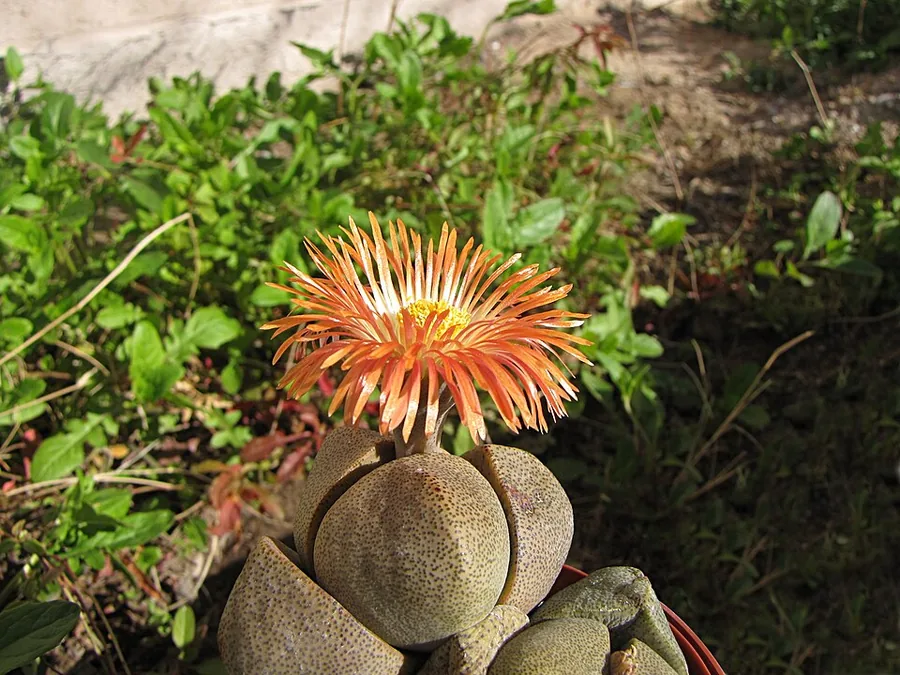
Split rock is a small South African succulent that disguises itself as a stone. It belongs to the mesemb group in the family Aizoaceae, and its fat, fissured leaves swell into a body the size of a large pebble. Sat in a gritty pot, it looks more like a piece of cracked granite than a living plant, which is exactly the camouflage it evolved in the wild.
The plant grows slowly and stays tiny, reaching only 2 to 3 inches (5 to 8 cm) tall. It works as a year-round houseplant on a bright sill, where it carries just one or two leaf pairs at a time. Each year a fresh pair pushes out from inside the old one, drawing the previous leaves down until only papery remains are left.
What makes split rock tricky isn't feeding or pruning, it's water. The plant runs on a strict cycle and needs a completely dry summer rest, and the quickest way to lose it is kindness with a watering can. Get the timing right and it will reward you with a bright daisy-like flower in late winter or spring.
Care
The short version: the brightest light you can give it, a sharply draining gritty mix, and water only during spring and autumn growth, never while it's dormant or renewing its leaves.
Light
Give split rock the brightest spot you have, ideally full sun on a south-facing sill. Strong light is what keeps the body tight and rock-like, and too little pulls it pale, tall, and out of shape.
Water
This is the whole game with split rock. Water only during active growth in spring and autumn, and only once the soil has dried out completely. Keep it bone dry through summer dormancy and the entire time a new leaf pair is emerging, because any water then makes the leaves burst and rot.
Soil
Plant it in a very gritty, sharply draining mineral or cactus mix that never stays soggy. A pH anywhere from 6.0 to 7.5 suits it, so the exact number matters far less than how fast the water runs through.
Temperature
It's comfortable between 50°F and 86°F (10°C to 30°C). Ordinary room warmth works year-round, though it appreciates a cooler, dry rest in summer.
Humidity
Low humidity is exactly what this desert plant wants, so there's no number to chase. Dry air suits it far better than the damp, still conditions that invite rot.
Feeding
Feed rarely, and only during the spring and autumn growth periods. A dilute, low-nitrogen cactus or succulent fertilizer is plenty, since too much feeding pushes soft growth this plant doesn't want.
Pruning
There's essentially nothing to prune, and you should never cut into the plant. Just let the old leaf pair shrivel and be reabsorbed by the new one, then gently peel away the papery remains once they're spent.
Repotting
Repot rarely, roughly every 2 to 3 years or only when it has outgrown its pot. Watch for roots poking out of the drainage holes or the plant heaving up out of the soil, both signs it's ready for a fresh gritty mix.
Size & spacing
Split rock stays tiny, reaching only 2 to 3 inches (5 to 8 cm) tall and spreading 3 to 4 inches (7 to 10 cm) across. One plant happily fills a small pot on its own.
Troubleshooting
Almost every split rock problem starts with water given at the wrong moment, and it shows up in the leaves. Learn to read whether the leaves are firm, mushy, or stacking up, and you can step in before rot sets in. Match what you see below, then act fast.
Leaves splitting open or turning soft and translucent
This is rot from too much water, and it almost always traces back to a drink given at the wrong time. The danger is highest during summer dormancy and while a new leaf pair is pushing out of the old one, when the plant wants no water at all. Stop watering, cut away any mushy tissue with a clean blade, and move the plant into a grittier, faster-draining mix.
Fix:
- Stop watering immediately
- Cut away rotted tissue with a clean blade
- Repot into a much grittier, faster-draining mix
- Allow the plant to dry out fully before any further water
Several stacked leaf pairs that refuse to shrivel
A healthy split rock carries just one or two leaf pairs at a time. When you see a stack of three or more, it means the plant has been watered or fed during leaf renewal, so the old pair never got drawn down. Withhold water and let the plant feed on the old leaves, then pick the normal dry cycle back up once the extras are reabsorbed.
Fix:
- Withhold water so the plant draws on the old pair
- Resume the normal dry-cycle once excess pairs are reabsorbed
Pale, stretched growth that loses its rock-like shape
When a split rock reaches and grows tall and pale, it is starved for light. The tight, stone-mimicking body only holds together under strong sun, and a dim windowsill pulls it out of shape. Move it to the brightest spot you have, somewhere with several hours of direct sun.
Fix:
- Move to the brightest available position with several hours of direct sun
Toxicity
Good news for a home with pets and children: split rock is not toxic. The ASPCA doesn't list it, and mesembs in its family carry no known poisons. The only mild risk is a passing stomach upset if a pet swallows a mouthful of the gritty, fibrous leaf.
Safe for
People · Cats · Dogs · Horses · Rabbits · Livestock · Birds
Cats None
Safe to share a home with a curious cat. A cat that chews a leaf might get a passing bout of mild stomach upset from the fibrous tissue, but nothing toxic is at work.
Dogs None
No poisoning risk for dogs. The worst a determined chewer faces is some short-lived loose stool or drooling from the gritty leaf, which settles on its own.
Horses None
Not a poisoning concern for horses. The tiny size of the plant means there's little for a horse to eat in the first place.
Rabbits None
Carries no toxins that would harm a rabbit. A nibbled leaf may pass with a little gas, since the dense succulent tissue isn't part of a normal diet.
Livestock None
Goats, sheep, and cattle face no toxic threat here. At most a grazing animal might get a mild, brief digestive grumble from the gritty mouthful.
Birds None
Safe around pet birds, with no documented poisoning. A bird that pecks at a leaf is in no danger beyond a possibly upset crop from the fibrous bite.
People None
Handling and growing it poses no toxic risk to adults or children. It isn't a food plant, though, so there's no reason to eat it.
Its sharp gritty soil and fibrous leaf tissue could cause minor mechanical or digestive upset if a pet chews and swallows large amounts.
Varieties
Only a couple of forms turn up in collections, and they differ mainly in color. These are the two worth knowing.
Pleiospilos nelii (species)
The wild form carries grey-green fissured leaves that swell into a near-round body looking just like a cracked stone.
Pleiospilos nelii 'Royal Flush'
This cultivar trades the usual grey-green for deep purple to reddish leaves while keeping the same split-stone shape.
How to propagate
Split rock multiplies slowly, but you can raise more from seed or split an established clump when you repot it.
SeedModerate
Sow in warm conditions during spring or autumn · Several months to over a year to reach a recognizable plant
Sow seed in spring or autumn while it's warm, scattering it on the surface of a gritty mix and keeping it lightly moist until it sprouts. After that, switch to the strict dry cycle. Be patient, because it takes several months to more than a year for a seedling to look like a real plant.
DivisionModerate
During active growth when repotting an established clump · Several weeks to a few months
Once a clump has spread, you can split it during active growth while you repot. Tease off an offset with a few roots attached, let the cut surfaces dry and callus, then pot it into a dry gritty mix. A division settles in within a few weeks to a couple of months.
Myths
Split rock is a kind of Lithops, or living stone.
The two are different genera, even though both belong to the mesemb group. Split rock is Pleiospilos, with far fatter and fewer leaves than a true Lithops, so the resemblance is only skin deep.
Water it on a regular schedule like any other succulent.
It runs on a strict cycle and demands a bone-dry summer dormancy. Routine, year-round watering makes the leaves burst and rot, which is the fastest way to kill the plant.