Houseplant · Aizoaceae
Lithops
Lithops
Tiny living stones that ask for almost no water and punish you the moment you give them too much.
Full sun
41–77°F · 5–25°C
USDA 10–11
1–2 in · 2–4 cm
Overview
Lithops look like a pair of smooth pebbles wedged into the soil, which is exactly the disguise they evolved in the dry grasslands of southern Africa. Each plant is just two fused, water-filled leaves with a window on top that lets light down inside. They stay small their whole lives, rarely more than 2 inches (5 cm) across, and they live for decades when left mostly alone.
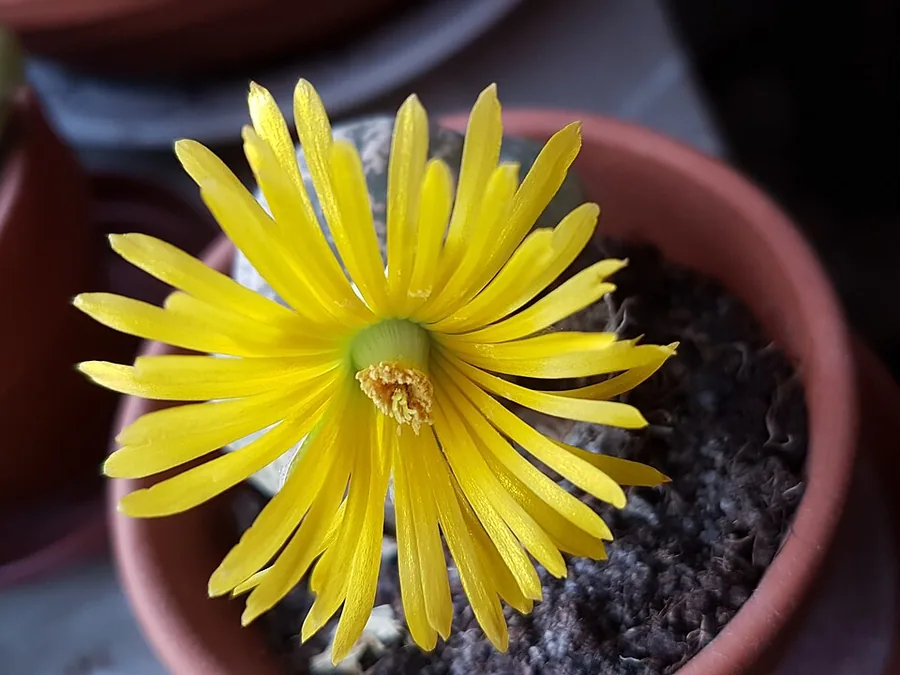
What sets them apart is the cycle they run through. Through the hot months they go dormant and want no water at all. Then a new leaf pair forms inside the old one, splits it open, and draws it dry, so the plant seems to renew itself from within. In late summer and autumn a single daisy-like flower, white or yellow, pushes up from the fissure between the leaves.
These are not difficult once you understand them, but they reward restraint over fuss. The whole craft is learning when to water and when to leave them bone dry. Get the timing right and a lithops is one of the toughest, longest-lived plants you can keep on a sunny sill.
Care
The short version: give them the brightest sun you have, pot them in sharply draining gritty mix, and water only during active growth in autumn and spring while keeping them completely dry through summer dormancy and the leaf split.
Light
Lithops need full sun or the brightest light you can give them, year-round. A south-facing window is ideal indoors. Skimp on light and the bodies stretch tall and pale instead of staying flat and compact.
Water
This is where most lithops are won or lost. Water only during active growth in autumn and spring, soaking the gritty soil and then letting it dry out completely before the next drink. Through summer dormancy and the leaf-renewal split, keep them bone dry, since water at the wrong moment rots them fast.
Soil
Plant in a very gritty, sharply drained mineral or cactus mix that water runs straight through. A pH anywhere from 6.0 to 7.5 suits them. The faster the soil dries, the safer the plant.
Temperature
They handle a wide range, from about 41°F to 77°F (5°C to 25°C). A cool, dry rest in winter is fine, but protect them from hard frost and from baking heat that would force them to drink when they shouldn't.
Humidity
These are desert plants and want low humidity with air that moves. There's no figure to chase here. Damp, stagnant air only invites the rot that kills them.
Feeding
Lithops barely need feeding. A dilute, low-nitrogen, high-potassium cactus fertilizer during the autumn and spring growth is plenty, and even that is optional. Too much food pushes soft, weak growth.
Pruning
There's nothing to cut. When the old leaf pair shrivels during renewal, let it dry and be absorbed on its own and resist the urge to peel or pull it off, which only sets the plant back.
Repotting
Repot only every 3 to 5 years, and only once the clump has crowded its pot or sent roots out the drainage holes. They like a snug container, so there's no rush to move them on.
Size & spacing
Each plant stays tiny, just 1 to 2 inches (2 to 5 cm) tall and about as wide, though it slowly forms a clump over years. A small, shallow pot holds several with room to spread.
Troubleshooting
Almost every lithops problem comes down to water and light, and most of it is preventable. The plant shows trouble in its body, going soft, stretched, or wrinkled, so learn to read those signs against where you are in its yearly cycle. Match what you see below before you reach for the watering can.
A soft, mushy body that looks glassy or collapses
This is rot, and it almost always traces back to water given at the wrong time. A plant kept wet through summer dormancy or during the leaf split, or one sitting in soil that holds water, starts to break down from the base up. Stop watering at once, cut away the rotted tissue with a clean blade, and replant into dry, gritty mix until firm growth returns.
Fix:
- Stop watering immediately
- Remove the plant and cut away any rotted tissue with a clean blade
- Repot into dry, gritty mineral mix and withhold water until firm growth resumes
A stretched, pale body growing tall instead of flat
When a plant reaches up and loses its squat shape, it is starved for light. The flat-topped, compact look only holds in strong sun. Move it to the brightest spot you have, but ease it into the change so the new exposure doesn't scorch the surface.
Fix:
- Move to the brightest available position
- Introduce stronger light gradually to avoid scorch
Old and new leaf pairs stacked up at once
A plant that clings to its old leaves while the new pair pushes through is showing the result of water during the leaf split. The fresh growth should draw everything it needs from the shrinking old pair, not from the soil. Hold back all water until the old leaves dry out fully and are absorbed.
Fix:
- Withhold all water until the old leaf pair fully dries and is absorbed
A wrinkled, shriveled body in autumn or spring
Wrinkling that shows up during active growth points to thirst, and a careful drink while the plant is growing will plump it back up. Timing is everything here. Shriveling through summer dormancy or while the new leaves are forming is normal and should be left alone.
Fix:
- Resume careful watering only if the plant is in active growth
Toxicity
Good news for anyone with pets or small children: lithops are non-toxic across the board. Cats, dogs, rabbits, birds, and people can all share a home with them safely. There are no harmful compounds in the leaves, so a stray nibble is nothing to worry about.
Safe for
People · Cats · Dogs · Horses · Rabbits · Livestock · Birds
Cats None
Safe around cats. A curious nibble won't poison them, though a mouthful of the gritty mix may bring on a brief bout of vomiting from the soil, not the plant.
Dogs None
No toxic compounds, so a dog that chews one comes to no harm. The squat little bodies rarely tempt them in the first place.
Horses Safe
Nothing in the plant is poisonous to horses, and its tiny size means there's little there to graze anyway.
Rabbits Safe
Rabbits can sample it without risk, since the fleshy leaves carry no harmful compounds.
Livestock Safe
Cattle, goats, and sheep face no toxic threat from it, and a windowsill succulent this small rarely crosses their path.
Birds Safe
Pet birds can peck at it freely. The plant holds no toxins that would trouble them.
People Safe
Harmless to people, including children. It isn't grown for eating, but a curious taste does no damage.
Varieties
The genus holds dozens of species, and growers prize them for the colors and surface patterns on their windowed tops. A few turn up again and again in collections.
Lithops aucampiae
One of the easier species to grow, with reddish-brown to coppery tops marked by darker, branching lines.
Lithops lesliei
A widely grown species recognized by its finely netted, rusty-brown windowed tops and yellow flowers.
Lithops optica 'Rubra'
A collector's favorite for its striking purple-red bodies.
Lithops karasmontana
Pale grey to pinkish bodies carry an intricate reddish pattern across the surface.
Lithops salicola
Grey-green tops with translucent windows that shrug off a touch more moisture than most of its relatives.
How to propagate
You can make more lithops from seed or by splitting an older clump, but neither is quick. Both ask for patience and a light touch with water.
SeedModerate
Sow in spring or early autumn onto gritty mix and keep warm and lightly moist until germination. · 2 to 3 years to reach mature flowering size
Most lithops are raised from seed, sown onto gritty mix in spring or early autumn and kept warm and lightly moist until they sprout. It's a patient gardener's project, since a seedling takes 2 to 3 years to reach mature flowering size and needs a careful hand with moisture the whole way.
DivisionModerate
Divide established multi-headed clumps at repotting during active growth. · Several months to root and re-establish
Older clumps with several heads can be split during active growth, usually when you repot. Cut between the heads while keeping roots on each piece, let the cut surfaces dry first, then pot them up, and give them several months to root and settle in.
Myths
Lithops are a type of cactus.
They are leaf succulents in the family Aizoaceae, and they share no close kinship with true cacti in the Cactaceae. The two groups simply landed on the same water-storing trick from different branches of the plant world.
Lithops need regular watering like a typical houseplant.
Treating them like a leafy windowsill plant is what kills most of them. They must stay completely dry through summer dormancy and the leaf-renewal split, and overwatering is the single most common cause of death.