Houseplant · Aizoaceae
Baby Toes
Fenestraria rhopalophylla
Give it bright light and almost no water, and this little cluster of window-tipped toes asks for nothing else.
Bright indirect
50–77°F · 10–25°C
USDA 9–11
1–3 in · 3–8 cm
Overview
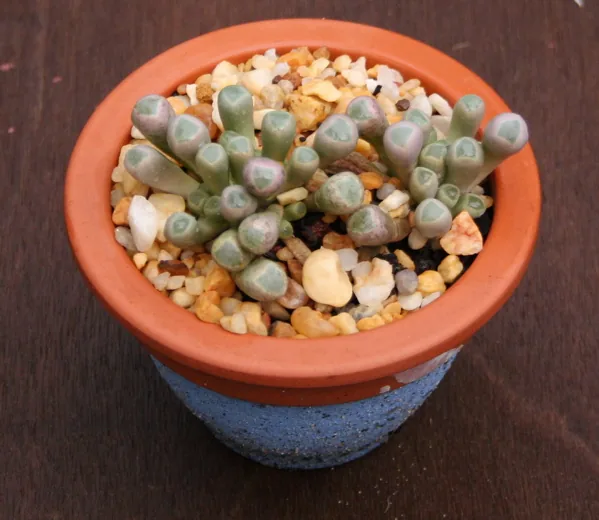
Baby toes is a small South African succulent that grows as a tight cluster of upright, club-shaped leaves, each one capped with a clear pane that looks like a tiny window. In the wild it lives half-buried in sand with only those windows showing above the surface, which lets light reach the leaf while the rest hides from the sun. Grown as a houseplant, it stays low and slow, never more than 1 to 3 inches (3 to 8 cm) tall.
It earns its name well. The fat, rounded leaf tips really do look like a bunch of pale toes pushing up out of the pot. In late summer to autumn a mature clump can throw up daisy-like yellow to white flowers on short stalks, almost as wide as the plant itself.
This is a plant that rewards a light touch. The one thing that kills it is kindness with the watering can, since the swollen leaves rot fast in damp soil. Get the gritty soil and the sparing water right and baby toes will sit happily on a bright sill for years.
Care
The short version: bright light, a sharply drained gritty mix, and very little water. Soak it now and then in the cooler months, keep it nearly dry through summer, and never let it sit in soggy soil.
Light
Baby toes wants bright light, ideally bright indirect with some gentle direct sun. It takes full sun once eased into it, but a plant kept too dark stretches and falls apart, losing the tight little cluster that gives it its name.
Water
This is where most plants are lost, so go light. Water sparingly and only in the cooler growing season, letting the gritty mix dry out fully between drinks, and keep the plant nearly dry through summer when it's resting. Too much water and the club leaves split, burst, or rot.
Soil
Plant it in a very gritty, sharply drained mineral or cactus mix that water runs straight through. A pH anywhere from 6.0 to 7.5 suits it fine. If the soil holds moisture for more than a day or two, cut in more grit or pumice.
Temperature
Ordinary room warmth works well, with a comfortable range of 50°F to 77°F (10°C to 25°C). It isn't frost-hardy, so keep it indoors or bring it in before the cold arrives.
Humidity
Low humidity is no trouble at all. This is a desert plant that prefers dry air, so there's no misting or pebble tray to bother with.
Feeding
Feed rarely, and only during active growth in the cooler months. A heavily diluted, low-nitrogen cactus or succulent fertilizer once in a while is plenty, since too much pushes soft, weak growth.
Pruning
There's no real pruning to do. Just pull or snip away any shriveled or rotted leaves now and then to keep the clusters looking tidy.
Repotting
Repot only every 2 to 3 years, or when a clump has clearly outgrown its pot and roots start poking from the drainage holes. Move it into fresh gritty mix and a slightly larger container, then hold off watering for a few days to let any disturbed roots settle.
Size & spacing
Baby toes stays tiny, reaching just 1 to 3 inches (3 to 8 cm) tall while spreading into a clump 4 to 8 inches (10 to 20 cm) across over time. Its small size makes it a natural for a shallow dish or a spot on a crowded windowsill.
Troubleshooting
Baby toes runs into few problems, and the ones it does have trace back to water or light. Soft, splitting leaves mean too much to drink; pale, stretching ones mean too little sun. Read those two signs and you've solved most of what can go wrong.
Swollen leaves that split, burst, or go soft
This is almost always overwatering, and it bites hardest in summer when the plant is resting and barely drinking. The fat club leaves take up more water than they can hold, so they crack or turn to mush. Stop watering, let the gritty mix dry out completely, pull off any rotted leaves, and move the plant somewhere brighter with better airflow.
Fix:
- Stop watering immediately and let the mix dry out completely
- Remove rotted leaves
- Move to a brighter, well-ventilated spot
- Repot into a grittier mineral mix if soil holds water
Pale, stretched leaves leaning toward the window
Reaching, washed-out leaves that lean toward the glass mean the plant is starved for light. The tight little cluster pulls apart and loses its shape. Move it to a brighter spot, but step up the light over a week or two so the leaves don't scorch.
Fix:
- Move to a brighter location with strong indirect or gentle direct light
- Acclimate gradually to stronger light to avoid scorching
Toxicity
Good news for pet owners and parents: baby toes is non-toxic and safe to be around. The ASPCA does not list Fenestraria among its toxic plants, so a stray nibble from a cat, dog, or child won't poison anyone. The most you'll see from a big mouthful of the watery leaves is a passing upset stomach.
Safe for
People · Cats · Dogs · Horses · Rabbits · Livestock · Birds
Cats Safe
Baby toes is safe for cats, and a curious nibble won't poison one. A cat that bolts a mouthful of the fleshy leaves might drool or have a brief upset stomach, the same as with any odd plant material.
Dogs Safe
Dogs can share a room with this plant without any risk of poisoning. The worst a determined chewer faces is a bit of loose stool from the watery leaf flesh, which passes on its own.
Horses Safe
There's nothing in baby toes that harms a horse. The plant is far too small to tempt grazing anyway, so it poses no real concern in a stable or paddock.
Rabbits Safe
Rabbits can crop the leaves with no toxic effect. The juicy flesh holds a lot of water, so a rabbit that eats a large helping might get loose droppings, but nothing more.
Livestock Safe
Cattle, goats, and sheep face no poisoning from this succulent. It carries none of the toxins found in dangerous range plants, and its tiny size keeps it off the menu in any case.
Birds Safe
Pet birds and backyard poultry are in no danger around baby toes. A bird that pecks at a leaf will get a harmless taste of plant sap and little else.
People Safe
Baby toes is not poisonous to people, including small children. It isn't grown to eat, but a leaf put in the mouth by a curious toddler does no harm beyond a possible mild stomach ache.
Varieties
Baby toes is sold as one main form, with the difference coming down to flower color.
Fenestraria rhopalophylla subsp. aurantiaca
This is the form you'll usually find for sale, and it opens bright yellow to orange flowers rather than the white blooms of the typical subspecies.
How to propagate
Making more baby toes is easy if you already have a clump, and slower but doable from seed.
Offsets & pupsEasy
Cooler growing season · 4 to 8 weeks to root
The easy route is to divide an established clump during the cooler growing season. Tease apart a cluster, let any torn or cut surfaces dry and callus over for a day or two so they don't rot, then settle the pieces into a gritty mix. New roots take hold in 4 to 8 weeks.
SeedModerate
Cooler growing season · Several weeks to germinate, months to size up
Seed is slower and asks for more patience. Scatter it on the surface of a gritty mix in the cooler season, keep it lightly moist and warm, and seedlings break ground over several weeks. From there it's months of careful, sparing watering before they bulk up into recognizable plants.
Myths
The leaf windows mean the plant wants deep shade indoors.
Those clear panes on the leaf tips evolved for the opposite reason. In the wild the plant sits buried in sand with only the windows showing, and they funnel light down to the leaf so it can keep working underground. Grown in a pot, baby toes still needs plenty of bright light to hold its tight, compact shape.