Vegetable · Fabaceae
Runner Bean
Phaseolus coccineus
Give it full sun, a tall support, and steady water, and the runner bean climbs fast and crops until frost.
Full sun
Every 3–7 days
50–77°F · 10–25°C
65–75 days
Overview
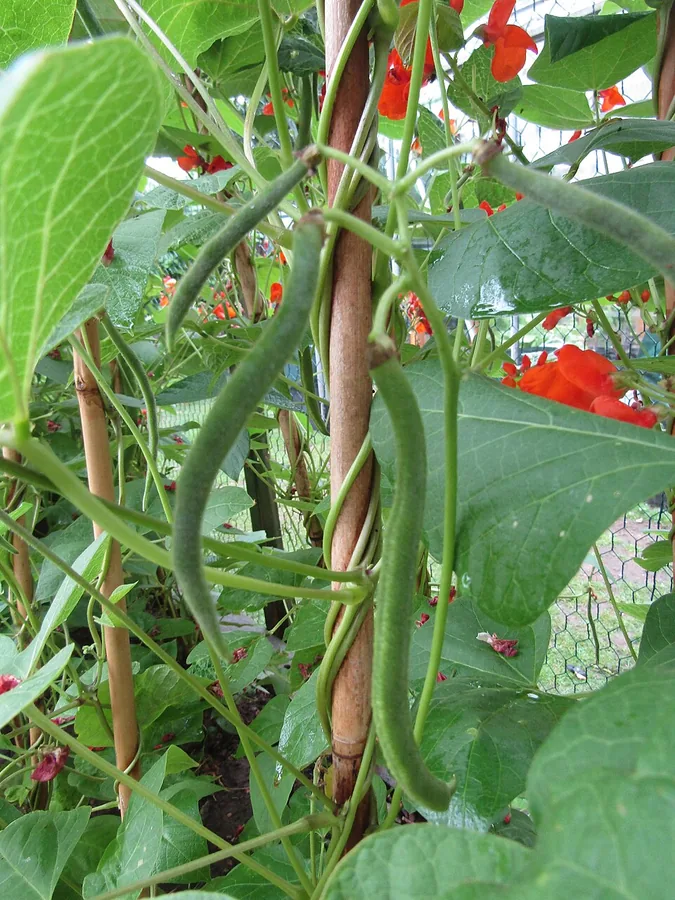
The runner bean is a fast, twining climber grown as much for its show of flowers as for its long, tender pods. It belongs to the bean family and comes back as a perennial in mild zones 7 to 11, where its fleshy tuberous roots survive the winter, though most gardeners simply grow it as an annual. Set it at the foot of a tall support and it races skyward, reaching 6 to 10 feet in a single season.
Flowering runs from early summer right up to the first frost, and the blooms come in scarlet, white, or a painted mix of pink and white depending on the variety. Those flowers draw bees and hummingbirds, then turn into the green pods you pick young. Leave a pod too long and it toughens, but shell out the mature seeds and you've got a fresh or dried bean for the kitchen.
Runner beans are an easy crop that forgives a beginner. They fix their own nitrogen, ask for little feeding, and climb on their own once you give them something to grab. The two things they really want are cool summers and even moisture, since heat is what makes the flowers drop before they set.
Care
The short version: full sun and a tall support, fertile well-drained soil kept evenly moist with about an inch of water a week, and a light hand with fertilizer since the plants make their own nitrogen.
Light
Runner beans need full sun, with no shade in their tolerated list. Plenty of direct light fuels the fast climbing growth and the steady run of flowers, so give them the sunniest spot you have.
Water
Aim for about 1 inch of water a week and keep the soil evenly moist, especially while the plants are flowering and setting pods. Sandy ground dries out faster and needs watering more often. Steady moisture is what keeps the flowers from dropping in warm spells.
Soil
Plant in fertile, well-drained loam with a pH of 6.0 to 7.0. Work in some compost before sowing, and the deep climbing roots will take it from there.
Temperature
They do best between 50°F and 77°F (10°C to 25°C). Cool summers suit them, and once the heat climbs the flowers start dropping before they can set pods.
Humidity
Average humidity of 40% to 70% is all they need, which ordinary outdoor air supplies. There's no number to chase here, so just give the plants room for air to move.
Feeding
Go light on the fertilizer, since the plants fix their own nitrogen. A modest 5-10-10 at planting is plenty, and too much nitrogen only grows leaves at the expense of pods.
Pruning
Pruning is mostly not required. Once the vines reach the top of their support, pinch out the growing tip to push branching and pod set, and keep picking spent pods to stretch the harvest.
Repotting
Runner beans aren't really a container crop. Sow them directly in the garden at the base of a tall support rather than potting them up.
Size & spacing
The vines climb from 6 to 10 feet (1.8 to 3 m) tall and spread a modest 12 to 24 inches (30 to 60 cm) at the base. Give each plant a sturdy tall support and room for air to reach the foliage.
When to plant
Runner beans want warm soil and no frost. Sow them outdoors after the last spring frost once the ground hits 50°F to 60°F (10°C to 16°C), and you'll be picking young pods about two months later, on through to the first frost.
Northern hemisphere
Southern hemisphere
Typical months for a temperate climate: start earlier in warm zones, later where spring frosts linger.
- Sow: Optional: 2-3 weeks before the last spring frost in biodegradable pots to avoid root disturbance.
- Plant: After the last spring frost, once soil is at least 50-60°F (10-16°C).
- Harvest: Flowers from early-to-mid summer until frost; harvest young pods (10-15 cm / 4-6 in) about 65-75 days after sowing.
Hardiness
USDA hardiness zones: 7–11
Temperature: down to -18°C
Troubleshooting
Most runner bean trouble shows up at the flowers, the pods, or the leaves. Read those early signs and you can step in before a small problem costs you the harvest. Match what you see below, then act while it still helps.
Flowers open but fall off without forming pods
This is blossom drop, and heat is almost always behind it. Once daytime temperatures push past 80°F to 90°F (27°C to 32°C), the pollen stops working and the flowers let go before a pod can set. Keep the roots cool and evenly watered, throw some light afternoon shade over the plants in a heat wave, and pod set picks back up on its own once the weather eases.
Fix:
- Keep soil evenly moist and mulch to moderate root-zone temperature
- Provide light afternoon shade during heat waves
- Wait for cooler weather, when pod set typically resumes
Leaves chewed to lace or curled and distorted
Lacy, skeletonized leaves with yellow grubs underneath point to the Mexican bean beetle, while curled new growth crawling with small soft insects means aphids. Hand-pick the beetles, their larvae, and the orange egg masses, and knock the aphids off with a sharp blast of water, reaching for insecticidal soap only when an infestation gets heavy. Scout often, cover young plants with row fabric, and let lady beetles do their share of the work.
Fix:
- Hand-pick beetles, larvae and egg masses
- Dislodge aphids with a strong spray of water
- Apply insecticidal soap to heavy infestations
Pods turn tough, stringy, and fibrous
When pods sit on the vine too long they go over-mature, building up the fibers and strings that make them snap instead of bend. The fix is simple: pick them young, at 4 to 6 inches (10 to 15 cm), and check the plants every 2 to 3 days so none slip past their tender stage. Any that do get away from you can still be shelled for fresh or dried beans.
Fix:
- Harvest pods young, at 10-15 cm (4-6 in)
- Pick every 2-3 days to catch pods at peak tenderness
Toxicity
The cooked pods and beans are good food, and the growing plant is not a poison for pets or livestock. The one thing to watch is raw mature beans, which hold a natural lectin called phytohaemagglutinin that can upset the stomach. Always cook dried seeds through, and keep them away from cats and dogs that might swallow them raw.
Toxic to
Cats · Dogs
Safe for
People · Horses · Rabbits · Livestock · Birds
Cats Caution
The plant isn't listed as toxic to cats, and most won't bother with it. The one thing to watch is raw mature beans, which hold a lectin that can leave a cat with vomiting or diarrhea if it eats a few, so keep dried seeds out of reach.
Dogs Caution
Runner beans aren't a known poison for dogs, but a dog that gulps raw dried beans can end up with an upset stomach from the same lectin. Cooked pods and beans are fine; it's the raw mature seeds worth keeping away.
Horses Safe
Nothing here poses a real threat to a horse grazing nearby. As with any legume, large amounts of raw dried beans are best avoided, but the plant itself is not toxic.
Rabbits Safe
Rabbits can nibble the foliage without harm. Skip the raw mature seeds, which carry the same lectin that bothers other animals, and stick to leaves and young pods.
Livestock Safe
Cattle, goats, and sheep aren't put at risk by the growing plant. The only caveat is feeding quantities of raw dried beans, which should be cooked rather than offered uncooked.
Birds Safe
Backyard birds and poultry are fine around runner beans. Don't toss them raw dried beans in bulk, since the uncooked seed is hard on the gut, but pods and foliage are no trouble.
People Safe
Cooked pods and beans are a kitchen favorite and perfectly safe to eat. Raw mature beans are the exception because they contain phytohaemagglutinin, so always cook dried seeds thoroughly before they reach the plate.
Raw or undercooked mature (dry) seeds contain phytohaemagglutinin, a lectin that can cause nausea, vomiting and diarrhea if eaten in quantity; cook seeds thoroughly. Young pods, cooked, are safe.
Helpline numbers

United States
ASPCA Animal Poison Control: (888) 426-4435 (fee applies)

United Kingdom
Animal PoisonLine: 01202 509000 (fee applies)

Australia
Animal Poisons Helpline: 1300 869 738
Varieties
Runner beans come in a handful of distinct types, split mostly by flower color and whether you grow them to eat, to look at, or both. These are the ones worth knowing by name.
Scarlet Emperor
A classic scarlet-flowered heirloom that ripens in roughly 75 days and keeps the long green pods coming in heavy flushes.
Painted Lady
An ornamental favorite grown for its bicolored red-and-white blooms as much as for the beans.
White-flowered (e.g. 'Czar' / 'Albus')
A dual-purpose type with white flowers and large white seeds, prized both as a fresh pod and as a shell bean.
Companions
Runner beans shine in the Three Sisters planting, climbing the corn for support and feeding nitrogen back to it and the squash sprawling below.
Plant near
corn: In the Three Sisters planting, corn stalks give the climbing beans a natural support while the beans fix nitrogen for the corn.
squash: Part of the Three Sisters; sprawling squash shades the soil and deters pests while the beans climb the corn and fix nitrogen.
How to propagate
Runner beans are about as simple to start as a plant gets, going straight from seed into the ground with no special treatment.
SeedEasy
Direct-sow outdoors after the last spring frost once soil reaches at least 50-60°F (10-16°C). · Germinates in 7-14 days; begins flowering about two months after sowing.
Sow the seeds 1 to 1.5 inches (2.5 to 4 cm) deep right at the foot of a tall support, once the last frost has passed and the soil has warmed to 50°F to 60°F (10°C to 16°C). They break ground in 7 to 14 days and start flowering about two months on, so there's no rush to start them under cover, though you can sow indoors 2 to 3 weeks early if you want a head start. In mild zones you can even lift the tuberous roots in fall and overwinter them for an earlier crop the following year.
Myths
Runner beans are poisonous and shouldn't be eaten.
Cooked young pods are a safe, everyday vegetable that millions of people grow and eat. The only real risk sits in raw or undercooked mature dry seeds, which hold phytohaemagglutinin and can cause stomach upset. Cook the dried beans through and they're perfectly safe.
Runner beans need heavy nitrogen feeding to crop well.
Like other legumes, they pull their own nitrogen from the air through Rhizobium bacteria in their roots, so they ask for very little from you. Pile on the nitrogen and you grow leaves instead of beans, since lush foliage comes at the cost of pods.