Tree · Theaceae
Franklin Tree
Franklinia alatamaha
Late summer flowers and fiery fall color from a tree extinct in the wild since the early 1800s.
Full sun
Every 3–7 days
USDA 5–8
10–25 ft · 3–7.6 m
Overview
The Franklin tree is one of the great rarities of American gardens, a small flowering tree in the tea family that no longer grows anywhere in the wild. John and William Bartram found it along Georgia's Altamaha River in the 1760s and carried seed home, and that single collection is the source of every Franklinia alive today. By the early 1800s the wild population was gone for good.
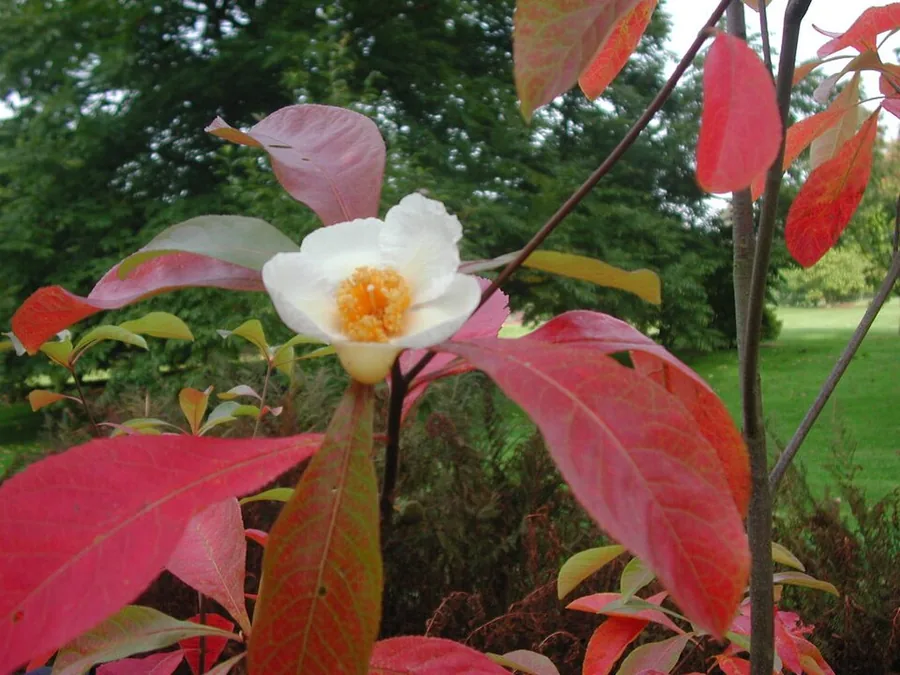
What earns it a place in the garden is the show it puts on late in the year. Cup-shaped white flowers with a boss of gold stamens open from late summer into early fall, often while the leaves are already turning deep red and orange. It stays modest in size, reaching 10 to 25 feet (3 to 7.6 m) as a slow-growing single trunk or multi-stemmed small tree.
None of that makes it easy. The Franklin tree is demanding to grow, fussy about drainage, and quick to die from root rot in the wrong spot. Plant it in cool, moist, sharply drained acidic soil, keep it out of clay and heat, and you have a chance at one of the most distinctive trees you can own.
Care
The short version: full sun to part shade in rich, acidic, sharply drained soil that never sits wet. Keep the soil evenly moist, spare the tree from heat, drought, and clay, and guard above all against root rot.
Light
Give the Franklin tree full sun to partial shade. It flowers and colors best with good light, yet a little shade through the hottest part of the day helps it cope where summers run warm.
Water
Keep the soil consistently moist but never waterlogged, which is the whole trick with this tree. It tolerates neither drought nor wet feet, so water through dry spells while making sure the ground drains freely. Sodden soil invites the root rot that kills most Franklin trees.
Soil
Plant in organically rich, well-drained, acidic sandy loam with a pH of 4.5 to 6.0. Sharp drainage matters as much as fertility here, so work in plenty of organic matter and steer well clear of heavy clay.
Temperature
The tree is hardy across a wide range, from about -20°F to 95°F (-29°C to 35°C), suiting USDA zones 5 through 8. It dislikes prolonged heat, so the cooler end of that range brings out its best.
Humidity
Ordinary outdoor humidity suits it fine, with no figure to aim for. Good drainage and air movement count for far more than moisture in the air.
Feeding
Feed in spring with an acidic, slow-release fertilizer made for acid-loving plants. One seasonal feeding is enough, and matching the fertilizer to the tree's love of acid soil keeps it growing steadily.
Pruning
The Franklin tree asks for very little pruning. Take out dead, damaged, or crossing branches in late winter, and shape it then too if you're training it as a single-trunk tree.
Repotting
Trees in the ground never need repotting, and even container specimens are rarely moved up. Roots circling the pot, roots pushing through the drainage holes, or water that runs straight through tell you a potted tree has finally outgrown its home.
Size & spacing
Expect a mature height of 10 to 25 feet (3 to 7.6 m) and a spread of 6 to 15 feet (1.8 to 4.6 m). Give it room to stand on its own as a specimen, where its late flowers and fall color get the attention they deserve.
When to plant
The Franklin tree works on a slow, cool-climate schedule. Start seed in late winter to early spring after a spell of cold stratification, set young trees out in spring after the last frost or in early fall, and watch for flowers from late summer through the first frost.
Northern hemisphere
Southern hemisphere
Typical months for a temperate climate: start earlier in warm zones, later where spring frosts linger.
- Sow: late winter to early spring after cold stratification
- Plant: spring after last frost or early fall
- Harvest: late summer to early fall (July to first frost)
Hardiness
USDA hardiness zones: 5–8
Temperature: down to -29°C
Troubleshooting
Almost every Franklin tree failure traces back to its roots and the water around them. Learn to tell rot from wilt from simple drought, since the cure differs for each. Match what you see below and act early, because this tree gives little margin for delay.
Sudden wilting and dieback with dark, rotted roots
This is Phytophthora root rot, the single biggest killer of Franklin trees, and it takes hold in soggy, compacted, or clay ground that holds water around the roots. Dig down and you'll find dark, mushy roots and a discolored stem base. There's no saving a tree once it's far gone, so improve the drainage at once, move survivors onto a raised mound of well-drained acidic soil, and pull and destroy the worst cases before the rot spreads.
Fix:
- Improve drainage immediately and stop overwatering
- Plant or transplant into a raised bed or mound of well-drained, organically rich acidic soil
- Remove and destroy severely affected plants to limit spread
Wilting branches when the roots are not waterlogged
When a Franklin tree wilts even though the soil drains well and stays evenly moist, suspect wilt disease, which hits this species hard, or plain drought stress, since the tree has no tolerance for dry ground. Cut out and bin the affected branches and hold the soil steadily moist without ever letting it sit wet. The best defense is keeping the tree in a cool, moist, well-drained acidic spot and sparing it the stress of heat, drought, and pollution.
Fix:
- Remove and dispose of affected branches
- Maintain even soil moisture without waterlogging
- Avoid stressing the plant with drought, heat, or transplanting
Leaves chewed, notched, or stripped to the veins
Ragged, skeletonized foliage usually means sawfly larvae are feeding through the growing season. On a small tree you can pick them off by hand or knock them loose with a strong jet of water. Save any insecticide for a heavy outbreak, and scout the leaves often so you catch the larvae when they first show up.
Fix:
- Hand-pick larvae from small trees
- Use a strong spray of water to dislodge larvae
- Treat with an appropriate insecticide only if infestation is heavy
Toxicity
Good news for households with animals: the Franklin tree is not toxic. It isn't on the lists of plants known to poison cats or dogs, and the same goes for the other animals around a garden. A pet that chews a leaf might get a brief stomach upset from the roughage, nothing more.
Safe for
People · Cats · Dogs · Horses · Rabbits · Livestock · Birds
Cats Safe
The Franklin tree carries no known toxins, so a curious cat that nibbles a leaf has nothing to fear. A big mouthful of any non-food plant might bring on a little drooling or a brief upset stomach, and that passes on its own.
Dogs Safe
Dogs can chew the foliage without harm, since the tree isn't listed among plants that poison them. The most you'd expect from a real gorge is some mild vomiting that clears quickly.
Horses Safe
Nothing in the leaves, bark, or flowers is toxic to horses, so a grazing nibble is fine.
Rabbits Safe
Rabbits can browse the leaves safely. As with any new green, introduce only a small amount at first so their gut adjusts.
Livestock Safe
Cattle, goats, and sheep face no poisoning from this tree, and a stray mouthful in pasture won't trouble them.
Birds Safe
The tree poses no chemical risk to birds, whether they perch in it or pick at the seed capsules.
People Safe
No part of the Franklin tree is poisonous to people. It isn't grown for food, though, so there's no reason to eat it.
No special handling precautions are required for pets, though ingestion of any non-food plant can cause mild stomach upset.
Varieties
There are no garden cultivars of the species itself, but a hybrid and a few close relatives in the tea family are worth knowing.
x Gordlinia grandiflora (Mountain Gordlinia)
Bred at NC State in 2002 by crossing Franklinia with Gordonia, this semi-evergreen hybrid grows faster than either parent and carries larger flowers up to 5 inches (13 cm) across.
Gordonia lasianthus (Loblolly Bay)
A closely related evergreen tree in the same tea family that lent its toughness as a parent of the Gordlinia hybrid.
Schima and Stewartia relatives
Schima and Stewartia round out the Franklin tree's close kin in the tea family (Theaceae), with Schima, Gordonia, and Franklinia all grouped together in the tribe Gordonieae.
How to propagate
Multiplying a Franklin tree takes patience and a tolerance for failure. Seed is the proven route, while cuttings are a long shot worth trying only if you have plants to spare.
SeedModerate
Sow in late winter to spring after cold stratification · Several years to reach flowering size
Seed is the traditional way to raise a Franklin tree, drawn from the woody capsules just as every cultivated plant has descended from the Bartrams' original collection. Give the seed a spell of cold stratification, then sow from late winter into spring. Be patient, because a seedling needs several years before it reaches flowering size.
Stem cuttingsDemanding
Softwood cuttings in summer · Slow and challenging to root
You can also try softwood cuttings taken in summer, but be ready for a low success rate. They root slowly and stubbornly, and the species is awkward to establish by any method, so expect to lose a fair share before one takes.
Myths
Franklin trees still grow wild along the Altamaha River in Georgia.
The tree has been gone from the wild since the early 1800s, and repeated searches have never turned up a single wild plant. Every Franklin tree alive today traces back to seed the Bartrams collected before the species vanished from its only known home.
A rare named ornamental like this must be easy to keep alive in any garden.
Rarity says nothing about how forgiving a plant is, and this one is famously hard to grow. It falls quickly to root rot and won't put up with clay, wet feet, drought, heat, or pollution. Give it cool, moist, sharply drained acidic soil or expect to lose it.