Houseplant · Droseraceae
Venus Flytrap
Dionaea muscipula
Give it full sun, rainwater, and a cold winter rest, and a Venus flytrap will catch its own dinner for years.
Full sun
Every 1–3 days
USDA 7–10
2–5 in · 5–13 cm
Overview
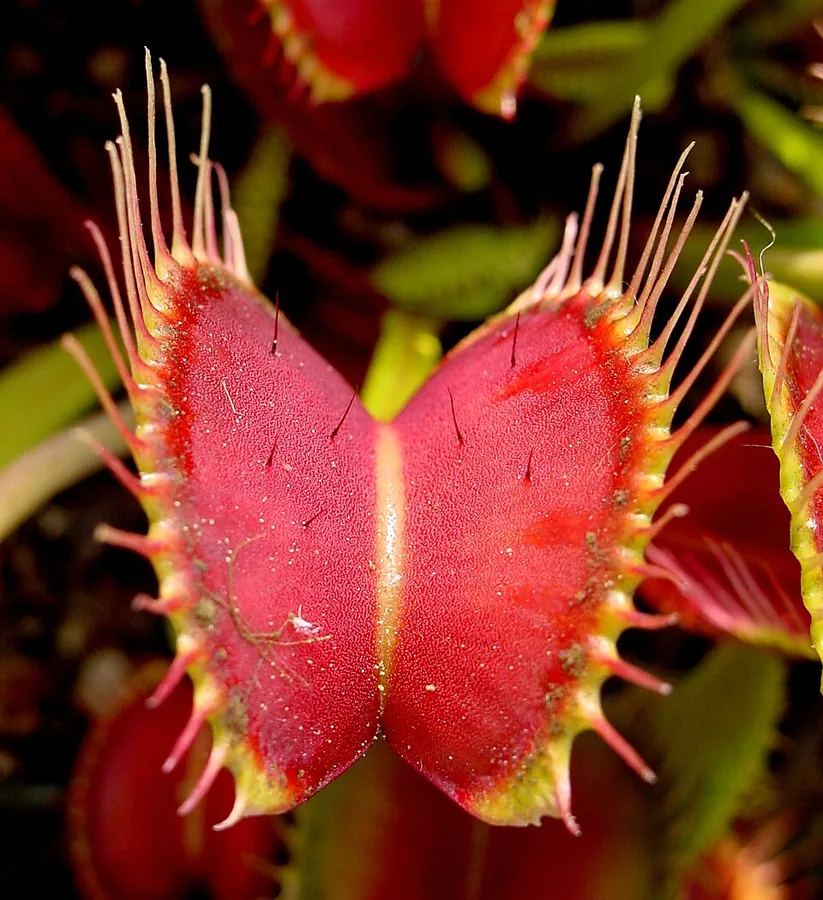
The Venus flytrap is the plant everyone recognizes, with hinged traps that snap shut on a passing insect. It comes from a small patch of bog land in the Carolinas, where the soil is so poor that the plant turned carnivore to make a living. That trick is also what makes it tricky to keep, because almost everything we do for a normal houseplant is wrong for a flytrap.
It stays small, only a few inches across, and grows as a low rosette of traps rather than a leafy stem. The plant is a true perennial, but it isn't a year-round grower. It runs hard through spring and summer, then needs a cold winter rest, and skipping that rest is the most common way people kill it.
Get a few things right and the rest takes care of itself. Strong light, water with no minerals in it, lean acidic soil, and a cold dormancy each winter are the whole recipe. The plant catches and digests its own food, so the help it really wants from you is mostly leaving it alone.
Care
The short version: give it full sun, water only with distilled, reverse-osmosis, or rainwater, plant it in a lean peat-and-sand mix, never fertilize or feed it meat, and let it go cold and dormant for 3 to 4 months each winter.
Light
A flytrap wants full, direct sun, at least 6 hours a day and ideally more. Starved of light it stretches pale and floppy and the traps stay small and won't redden up, so a south-facing window or a spot outdoors in summer beats any dim corner.
Water
Use only distilled, reverse-osmosis, or rainwater, never tap or bottled mineral water, because the dissolved salts build up and kill the plant. Stand the pot in a tray with about 1 to 2 cm of water during the growing season and keep the media damp. In winter dormancy, cut back so the mix stays just barely moist rather than standing wet.
Soil
Plant it in a lean, acidic carnivorous mix of sphagnum peat with perlite or silica sand, and nothing richer. Ordinary potting soil, compost, or any fertilized mix will burn the roots and rot the plant. The right blend sits at a very acidic pH of 3.5 to 5.0.
Temperature
It handles a wide range during the year, from about 41°F to 95°F (5°C to 35°C). Summer warmth drives growth, but the plant also needs a genuine cold spell in winter to rest, so don't try to keep it cozy all year round.
Humidity
Average room humidity around 50% to 70% suits it fine, and the constantly damp tray keeps the air near the plant moist enough. There's no need to mist it or shut it in a terrarium, which can actually invite mold.
Feeding
Don't fertilize, ever. A flytrap feeds itself by catching insects, and fertilizer in the soil burns the roots and kills it. The traps pull in all the nutrients the plant needs on their own.
Pruning
Snip off blackened or dead traps and spent leaves at the base with clean scissors to keep mold down. On a young or stressed plant, cut the tall flower stalk in spring as well, since flowering drains energy the small rosette can't spare.
Repotting
Repot every 1 to 2 years in early spring, into fresh carnivorous mix. Do it when the rhizomes crowd the pot edge, the media has broken down and compacted, or several offsets are crammed together, and use the chance to divide.
Size & spacing
This is a small plant, only 2 to 5 inches (5 to 13 cm) tall and about as wide. One flytrap sits happily in a single small pot, so spacing is rarely a concern unless you're growing a cluster in a shared bog planter.
Troubleshooting
Almost every flytrap problem traces back to four mistakes: the wrong water, too little light, ordinary potting soil, or no winter rest. The signs below tell you which one you're dealing with. Catch it early and the plant usually bounces back.
Sudden collapse with a soft, rotting crown
Lift the plant and you'll find a mushy brown rhizome, almost always because it was potted in ordinary soil or fed fertilizer. Repot at once into a nutrient-poor mix of sphagnum peat and perlite or sand, cut away the rotted tissue, and go back to mineral-free water. Any firm white rhizome that's left can still regrow.
Fix:
- Repot into nutrient-poor sphagnum peat and perlite/sand mix
- Resume mineral-free water only
- Remove rotted tissue; healthy white rhizome may still regrow
Slow decline year after year until the plant gives out
A flytrap kept warm and growing all year slowly fades, because it never got its winter dormancy. Give it a cold rest of 3 to 4 months at roughly 35°F to 50°F (2°C to 10°C) with less light and water. Overwinter it outdoors in a mild zone, or in an unheated space or the refrigerator where winters run hard.
Fix:
- Provide a 3-4 month cold dormancy at roughly 2-10°C (35-50°F) with reduced light and watering
- Overwinter outdoors in mild zones or in an unheated cold space/refrigerator in colder climates
Traps and leaves blackening and dying back
The usual culprit is mineral buildup from tap or bottled water, which leaves a whitish crust on the media and weakens new growth. Switch to distilled, reverse-osmosis, or rainwater and flush the pot to wash the salts out. A few old traps blackening on a plant that's otherwise growing well is just normal aging, since each trap dies off after several catches.
Fix:
- Switch immediately to distilled, reverse-osmosis, or rainwater
- Flush the media with mineral-free water to leach out salts
- Trim off fully blackened traps at the base
- Stop hand-feeding and let the plant catch its own insects
Pale, stretched growth with small traps that barely close
This is too little light, plain and simple. The petioles stretch long and floppy and the traps come in small and greenish instead of compact with red interiors. Move the plant into full direct sun, at least 6 hours a day, and let it adjust over a week so the leaves don't scorch.
Fix:
- Move to full direct sun (a minimum of 6+ hours, ideally outdoors or a very bright sunny window/grow light)
- Acclimate gradually over a week to avoid scorch
Toxicity
Good news for a pet owner: the Venus flytrap is non-toxic to people and animals. The ASPCA clears it for cats and dogs, and the snap-traps are far too small and weak to hurt anything bigger than a fly. The only real harm is to the plant itself, if someone keeps poking the traps shut for fun.
Safe for
People · Cats · Dogs · Horses · Rabbits · Livestock · Birds
Cats Safe
The ASPCA lists the Venus flytrap as non-toxic to cats. The little snap-traps are far too small and weak to pinch a paw or a curious nose.
Dogs Safe
Safe for dogs, with nothing poisonous in the leaves or traps. A dog that mouths the plant might get a startle when a trap closes, but no harm comes of it.
Horses Safe
No toxins here, so a horse runs no risk from a nibble. A tiny bog plant just a few inches across is never going to be part of a horse's diet anyway.
Rabbits Safe
Nothing in a flytrap will poison a rabbit. The traps are too flimsy to do any damage, though there's no reason to let a rabbit graze a slow-growing plant down to nothing.
Livestock Safe
Cattle, goats, and sheep face no poisoning from this plant. It's a harmless curiosity rather than anything that belongs in a pasture.
Birds Safe
Birds are in no danger from a flytrap. The traps shut on insects, not feathers, and hold nothing toxic.
People Safe
Harmless to handle, children included. The traps close on a fingertip with the gentlest pinch and can't break skin, so the worst risk is wasting the plant's energy by setting them off for fun.
Touching the trigger hairs makes traps close; repeatedly poking traps for fun wastes the plant's energy and should be avoided.
Varieties
Beyond the common green-and-red flytrap, breeders have selected cultivars for unusual color, trap size, and tooth shape. A few stand out.
'Akai Ryu' (Red Dragon)
This one turns a deep maroon-red all over, foliage and traps alike, instead of the usual green leaves with red-lined jaws.
'B52'
Bred for size, 'B52' grows some of the largest traps of any flytrap you can buy.
'Dente'
Rather than the long bristle teeth most flytraps carry, 'Dente' edges its traps with short, triangular tooth-like spines.
How to propagate
You can make more flytraps by splitting a clump, rooting a leaf, or growing from seed. The first is quick and easy, the last takes years of patience.
DivisionModerate
Early spring, during or just after dormancy when repotting · Several weeks to a few months
The simplest way to make more flytraps is to split a clump in early spring, during or just after dormancy when you're already repotting. Tease apart the offsets so each piece keeps its own roots and growth point, then pot them up in carnivorous mix. They settle in over several weeks to a few months.
Leaf cuttingsModerate
Spring to early summer during active growth · About 1-3 months for plantlets to form
Take leaf cuttings in spring or early summer while the plant is growing hard. Gently pull a whole leaf away with a bit of the white rhizome base attached, lay it flat on damp media, and keep it bright. Small plantlets sprout from the base over about 1 to 3 months.
SeedDemanding
Sow after cold-moist stratification in late winter to spring · 3-5 years to reach mature size
Growing from seed is the slow road and a test of patience. Sow in late winter or spring after a cold-moist stratification to break dormancy. The seedlings come up fine, but they take 3 to 5 years to build full-size traps, so most people start with a division instead.
Myths
Feed a Venus flytrap raw meat like hamburger or chicken.
Meat is too fatty and rich for a flytrap, and it rots inside the trap and turns it black. The plant evolved to digest insects and spiders, which it catches perfectly well on its own.
Venus flytraps are tropical and need to stay warm all year.
They aren't tropical at all. They're temperate bog plants from the Carolinas, and they need a cold winter dormancy of 3 to 4 months to live more than a season or two.
Tap water is fine for watering a flytrap.
The minerals and salts in tap and bottled water build up in the media and slowly poison the roots. Use only distilled, reverse-osmosis, or rainwater, nothing else.
Flytraps must be hand-fed regularly to stay alive.
Given full sun, a flytrap makes its own food and traps plenty of insects without your help. Hand-feeding is optional and never required, and overdoing it just wears the traps out.