Houseplant · Droseraceae
Cape Sundew
Drosera capensis
Give it bright sun and pure rainwater, and the Cape sundew glitters with insect-catching dew all year.
Full sun
Every 1–3 days
41–86°F · 5–30°C
180–365 days
Overview
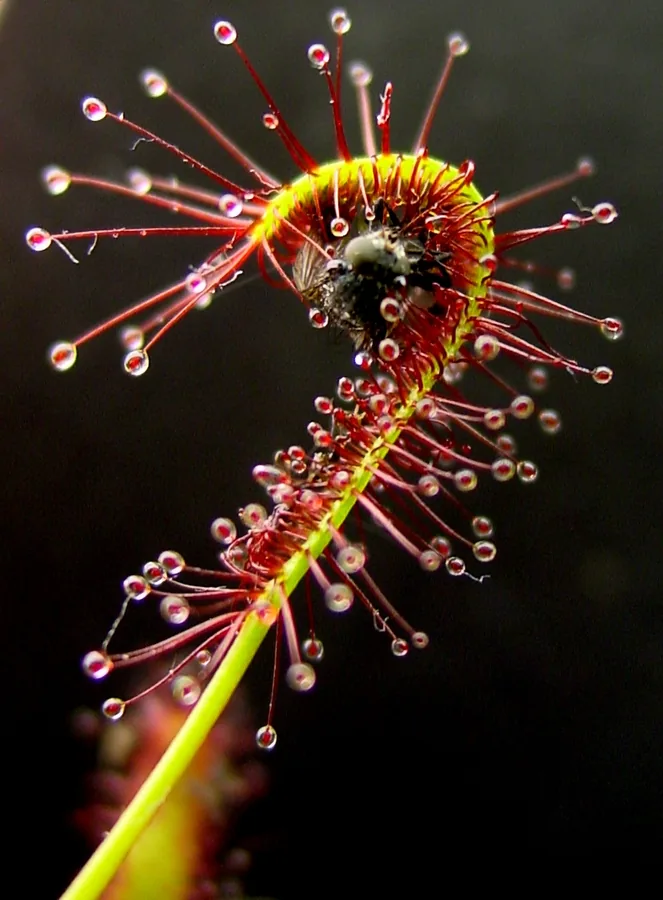
The Cape sundew is a carnivorous plant from the bogs of South Africa, and it earns its keep by trapping insects instead of drawing all its food from the soil. Each leaf is lined with red dew-tipped tentacles that glisten like drops of nectar, luring gnats and flies that stick fast and are slowly digested. It belongs to the family Droseraceae and stays small, a tidy rosette only a few inches across.
What makes it carnivorous is also what makes it fussy: it grew up in nutrient-poor, acidic ground and cannot stomach ordinary potting soil or fertilizer. The same goes for its water. Tap and mineral water carry salts that build up and poison the plant, so distilled, reverse-osmosis, or rainwater is the rule, not a nicety.
Get those two things right and the Cape sundew is one of the more forgiving carnivorous plants to keep. It grows happily on a bright windowsill year-round, flushes deep red in strong light, and self-seeds so freely you'll soon have more than you started with.
Care
The short version: give it the brightest sun you have, keep the pot standing in mineral-free water so the peat mix never dries, and never feed the roots or use anything but distilled, RO, or rainwater.
Light
Give the Cape sundew the brightest spot you have, ideally several hours of direct sun on a south-facing sill. Strong light is what flushes the tentacles red and keeps the rosette compact, while a dim corner leaves it pale and stretched. A strong grow light works well where windows fall short.
Water
This is the part that makes or breaks the plant. Use only distilled, reverse-osmosis, or rainwater, because the salts in tap and mineral water build up and kill carnivorous plants. Stand the pot in a tray holding 1 to 3 cm of that mineral-free water so the peat mix stays soaked, and ease off only slightly in winter, never letting it dry out.
Soil
Plant it in a lean, acidic carnivorous mix, roughly equal parts peat moss or live sphagnum and sand or perlite, with a pH around 4.0 to 5.5. Ordinary potting soil, compost, or anything fertilized will burn the roots and kill it.
Temperature
The Cape sundew is comfortable across a wide range, from about 41°F to 86°F (5°C to 30°C). Normal room temperature suits it all year, and it doesn't need a cold winter rest the way some carnivorous plants do.
Humidity
It likes the air on the humid side, around 50% to 80%, which a windowsill tray of water helps supply. It tolerates average household air better than most carnivorous plants, but very dry rooms can slow the dew.
Feeding
Never feed the roots. The plant evolved in nutrient-poor bogs, and fertilizer in the soil scorches them, so it pulls its nitrogen straight from the gnats and flies it catches on its dew. Indoors it usually traps all it needs on its own.
Pruning
There's little to do here. Snip off fully blackened or dead leaves and spent flower stalks at the base with clean scissors to keep things tidy. Leave the sticky dew alone, since wiping it off robs the plant of how it traps prey.
Repotting
Refresh the plant every 1 to 2 years in spring, moving it into fresh carnivorous mix. Repot sooner if the roots circle the pot, the rosettes crowd into a clump, or the old mix breaks down and stays compacted.
Size & spacing
This is a small plant, a rosette reaching only 2 to 14 inches (5 to 35 cm) tall and spreading 3 to 6 inches (8 to 15 cm) across. Its compact size makes it an easy fit on any bright windowsill.
Troubleshooting
Almost every sundew problem traces back to one of two things: the wrong water or too little light. Read the leaves and you'll usually spot the cause fast. Match what you see below, then fix it before the plant slides further.
Leaves stop making their sticky dew
When the tentacles go dry and dull, the usual cause is the wrong water, since tap and mineral water leave salts behind that poison a carnivorous plant. Weak light or parched air can slow the dew as well. Switch to distilled, reverse-osmosis, or rainwater, flush the mix to wash out the salts, then move the plant somewhere brighter and more humid so the new leaves glisten again.
Fix:
- Switch immediately to distilled, RO, or rainwater
- Flush the mix with mineral-free water to leach out salts
- Move to brighter light and raise humidity
Leaves turn black and die off
Blackening leaves point to mineral buildup from the wrong water, though transplant shock or the plant's normal leaf cycle can do it too. The clue is which leaves go: if only the old ones blacken while fresh ones push up healthy, that's just routine turnover. Correct the water source, snip the dead leaves at the base, and hold steady wet, bright conditions while it recovers.
Fix:
- Correct the water source to mineral-free water
- Remove blackened leaves at the base
- Maintain stable wet conditions and bright light during recovery
Pale, stretched growth with the red color fading
A sundew that turns green and leggy is simply starved for light. Grown in full sun, the tentacles and leaf blades flush a deep red and the rosette stays tight and compact. Move it to a sunnier window or under strong grow lights, and step up the brightness over a few days so the leaves don't scorch.
Fix:
- Move to a sunnier window or add strong grow lights
- Acclimate gradually to avoid scorching
Toxicity
Good news for a house with pets and children: the Cape sundew is not toxic to anyone. The sticky dew on its leaves is a harmless mucilage that may cling to a finger or a paw for a moment, but it causes no irritation. The only thing worth guarding is the water tray, which a curious pet could tip over.
Safe for
People · Cats · Dogs · Horses · Rabbits · Livestock · Birds
Cats Safe
A curious cat can sniff or nibble a sundew without harm, since the plant carries no toxin. The sticky dew may cling to whiskers for a moment, but it washes off and causes no irritation.
Dogs Safe
Dogs are in no danger from this plant. If one chews a leaf, expect nothing worse than a bit of harmless sticky residue on the muzzle.
Horses Safe
There is no toxin here that would trouble a horse, though its small size makes a sundew an unlikely mouthful in the first place.
Rabbits Safe
Rabbits can be around a sundew safely. A nibbled leaf brings no poisoning, just the odd dab of dew on the fur.
Livestock Safe
Goats, sheep, and cattle face no risk from the plant. The dew is sticky rather than harmful, and the tiny rosette offers almost nothing to graze.
Birds Safe
Birds come to no harm from a sundew. The glistening tentacles are built to catch gnats and flies, not to threaten anything larger.
People Safe
The plant is harmless to handle, and the dew is a simple mucilage that wipes off skin. Leave it on the leaves, though, because that dew is how the plant feeds itself.
The dew is a harmless sticky mucilage; it may briefly cling to skin or fur but causes no irritation. Avoid wiping it off the plant, as it is the trapping mechanism.
Varieties
Drosera capensis comes in a few easy-to-find forms that differ mostly in leaf shape and color. These are the ones you're most likely to grow.
Drosera capensis 'Typical'
The most widely grown form carries narrow green strap-like leaves tipped with red dew, and its easy nature makes it the one most beginners start with.
Drosera capensis 'Alba'
This all-green form has lost its red pigment, so the tentacles stay pale and the flowers open white.
Drosera capensis 'Red'/'Wide Leaf'
Grown in bright light, this form shows broader leaves washed a strong red right across the blade.
How to propagate
Few plants multiply as eagerly as the Cape sundew. You can grow it from a single leaf, from its freely set seed, or by splitting an older clump.
Leaf cuttingsEasy
Spring to summer during active growth · 4-10 weeks for plantlets to form, several months to reach size
Take a leaf cutting in spring or summer while the plant is growing strong. Lay a healthy leaf on damp mineral-free carnivorous mix or float it in mineral-free water, and tiny plantlets sprout along the leaf within 4 to 10 weeks, then take several months more to reach full size.
SeedEasy
Spring; surface-sow on damp peat mix in light · 2-6 weeks to germinate, several months to a mature rosette
Drosera capensis self-pollinates and throws seed freely, so this is the easiest route of all. Surface-sow on damp peat mix in spring and leave it uncovered, since the seed needs light to sprout. Germination takes 2 to 6 weeks with no stratification, and a mature rosette follows a few months later.
DivisionEasy
Spring at repotting · A few weeks to re-establish
When you repot in spring, an established clump can be split into separate plants. Tease apart the offset rosettes with their roots attached, pot them up in fresh carnivorous mix, and they settle in within a few weeks.
Myths
Sundews must be hand-fed insects or they will starve.
A sundew makes its own food through photosynthesis like any green plant, and it catches plenty of small insects on its own. Feeding it by hand is optional, never a requirement, and an indoor plant usually traps all the gnats it needs.
You should mist or wipe the leaves to clean off the sticky dew.
That dew is the plant's prey-trapping mucilage, so wiping it away strips the sundew of the very thing that feeds it. Misting with tap water does double harm by leaving behind the minerals that poison carnivorous plants.
Carnivorous plants need rich soil and fertilizer to thrive.
Sundews evolved in nutrient-poor acidic bogs, and their roots can't handle the load. Ordinary soil and fertilizer burn the roots and kill the plant, which is why a lean peat-and-sand mix is the only safe choice.