Tree · Altingiaceae
Sweetgum
Liquidambar styraciflua
Give it deep, acidic soil and full sun, and the sweetgum repays you with star-shaped leaves and blazing fall color.
Full sun
Every 7–14 days
USDA 5–9
60–100 ft · 18.3–30.5 m
Overview
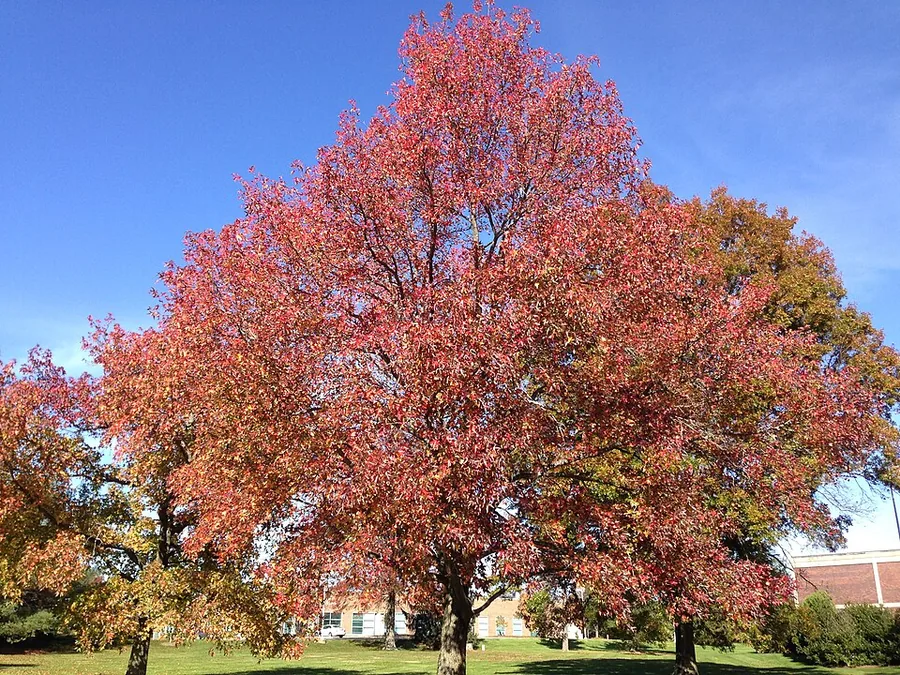
The sweetgum is a tall, fast-shading native of the eastern United States, easy to spot by its star-shaped leaves and corky, ridged bark. Left to grow, it reaches 60 to 100 feet (18 to 30 m) with a broad pyramidal crown, so it asks for real room rather than a small yard.
Fall is when the tree earns its keep. The foliage turns through yellow, orange, red, and deep purple, often holding several of those colors on the same branch at once. The catch arrives later, when a mature female tree drops a heavy crop of spiny gumball seed capsules that litter the ground from December into spring.
It's an undemanding tree once you get the site right. Sweetgum wants deep, moist, acidic ground and full sun, and it will sulk and yellow in alkaline soil. Give it space away from curbs and walkways, since the shallow roots run wide and the fruit is messy.
Care
The short version: plant in full sun in deep, moist, acidic soil with a pH of 7 or less, water young trees through their first seasons, and give the tree wide room away from paving for its surface roots and falling gumballs.
Light
Sweetgum grows best in full sun, which is where it builds the strongest form and the brightest fall color. It will take partial sun or partial shade, but the more sun it gets, the better it performs.
Water
Give a young tree steady moisture through its first seasons and water it again in any drought, watering it deeply every 7 to 14 days while it establishes. The tree prefers deep, moist bottomland soil, yet a mature one turns fairly drought tolerant once its roots are down.
Soil
Plant in deep, moist, fertile, slightly acidic loam that drains well, though sweetgum will handle clay and sand too. Keep the pH at 7.0 or less, somewhere from 5.5 to 7.0, because alkaline ground locks up iron and yellows the leaves.
Temperature
The tree is cold hardy across a wide range, from about -20°F to 95°F (-29°C to 35°C). That toughness puts it comfortably across USDA zones 5 to 9.
Humidity
Ordinary outdoor humidity suits sweetgum, so there's no level to manage. As a large landscape tree, it takes whatever the local air gives it.
Feeding
An established sweetgum rarely needs feeding. Apply a balanced complete fertilizer in early spring only if growth is poor, and reach for chelated iron or sulfur to correct the yellowing iron chlorosis brings on in high-pH soil.
Pruning
This tree asks for little pruning. Work in late winter to take out dead, damaged, or crossing branches, and shape a strong central leader while the tree is still young.
Repotting
Sweetgum is a landscape tree, not a container plant, so there's no repotting once it's in the ground. If a nursery tree shows roots circling the pot, poking from the drainage holes, or stunted top growth, it has outgrown its container and should go in the ground.
Size & spacing
Plan for a big tree that reaches 60 to 100 feet (18 to 30 m) tall and spreads 40 to 60 feet (12 to 18 m) wide. Site it at least 8 to 10 feet from curbs and paving, since the aggressive surface roots can lift hard surfaces.
When to plant
Sweetgum keeps to a slow start, so timing leans on getting the roots down before stress arrives. Cold-stratify seed over winter and sow it in late winter to spring, or set out a nursery tree in spring while the shallow, slow-to-establish roots have the whole season to settle. The tree is hardy across USDA zones 5 to 9.
Northern hemisphere
Southern hemisphere
Typical months for a temperate climate: start earlier in warm zones, later where spring frosts linger.
- Sow: Late winter after 1-3 months cold stratification
- Plant: Spring (preferred) due to shallow, slow-to-establish root system
- Harvest: Inconspicuous yellow-green flowers April to May; spiny gumball fruits ripen in fall and drop December to April
Hardiness
USDA hardiness zones: 5–9
Temperature: down to -29°C
Troubleshooting
Most sweetgum trouble is either cosmetic or tied to the wrong site, not a sign of a dying tree. The two that matter most are yellowing from alkaline soil and the litter of gumballs. Match what you see below and act while it still helps.
Sunken trunk cankers that ooze dark sap
Bleeding canker disease sinks into the trunk as discolored, weeping patches and works its way out into dying branches. It usually follows stress or a wound, so a drought-strained or freshly transplanted tree is the most likely target. Prune affected branches well below the canker and burn them, keep the tree watered and well sited, and stop letting mowers and trimmers nick the bark.
Fix:
- Prune out and destroy affected branches well below cankered tissue
- Maintain vigor with adequate water and proper siting
- Avoid mechanical trunk wounds from mowers and trimmers
Yellow leaves with veins that stay green
This is iron chlorosis, and it shows up first on the newest leaves when the soil runs too alkaline for the roots to pull iron. A soil test that reads above 7.0 confirms it. Lower the pH with elemental sulfur, feed chelated iron to the soil or as a foliar spray, and fix any drainage problem that's locking iron away.
Fix:
- Test and lower soil pH toward acidic with elemental sulfur
- Apply chelated iron to soil or as foliar spray
- Improve drainage and avoid planting in alkaline sites
Chewed leaves and silken nests in the canopy
A short list of leaf-eaters works sweetgum, led by fall webworm, tent caterpillars, bagworms, and leaf miners that strip foliage and string up silken nests. Scale insects and borers tend to move in only after a tree is already stressed. Prune out and destroy the nests, treat scale with horticultural oil, and keep the tree vigorous so borers find no opening. A healthy established tree can shrug off a little caterpillar feeding.
Fix:
- Prune out and destroy webworm and bagworm nests
- Control scale with horticultural oil; keep trees vigorous to limit borers
- Tolerate minor caterpillar feeding on healthy established trees
Spiny seed balls all over the ground
These are the tree's gumballs, the normal woody seed capsules a mature female tree drops in great numbers from December to April. Each one runs 1 to 1.5 inches across and turns underfoot into a tripping and mowing nuisance. Rake them up as they fall, or sidestep the whole problem by planting a fruitless cultivar like Rotundiloba and siting the tree away from walkways and play areas.
Fix:
- Rake and remove gumballs regularly
- Plant fruitless or low-fruit cultivars such as Rotundiloba where litter is a concern
- Site the tree away from walkways, patios, and play areas
Spotted leaves dropping before fall
Fungal leaf spot dots the foliage and can shake leaves loose ahead of season, mostly in a wet spring or summer. It looks worse than it is. Rake and bin the fallen leaves to clear the spores, keep the tree healthy, and skip the fungicide, since the damage is almost always cosmetic.
Fix:
- Rake and remove fallen leaves to reduce inoculum
- Maintain good air circulation and tree vigor
Toxicity
Good news for households with pets and children: sweetgum is not poisonous. The ASPCA does not list it as toxic to cats, dogs, or horses, and no part of the tree will poison an animal that nibbles it. The one real hazard is physical, not chemical, since the hard, spiny gumballs can prick a paw or choke a curious pet or child if swallowed.
Safe for
People · Cats · Dogs · Horses · Rabbits · Livestock · Birds
Cats None
No poisoning risk. A cat can brush against the leaves and bark without harm, though a spiny gumball underfoot can still prick a paw.
Dogs None
Safe to be around. The foliage holds no toxin, so the only thing to watch is a dog mouthing a hard gumball, which is a choking and obstruction risk rather than a poison.
Horses Safe
Not toxic to horses. Sweetgum carries no compound that would poison a grazing animal.
Rabbits Safe
Poses no chemical danger to rabbits, since the plant is not poisonous.
Livestock Safe
Cattle, goats, and sheep can share a pasture with sweetgum without any risk of poisoning.
Birds Safe
Harmless to birds, which actually feed on the seeds inside the dried gumballs.
People Safe
Not poisonous to people. The only real caution is the spiny seed ball, which is easy to roll an ankle on or for a small child to put in their mouth.
No poisoning risk from foliage. Watch pets and children around fallen spiny gumballs, which can injure paws and feet or cause obstruction if swallowed.
Varieties
Most of the named sweetgums exist to fix the two things people complain about, the messy fruit and the wide footprint. These are the selections worth knowing by name.
Rotundiloba
An essentially fruitless cultivar with rounded rather than pointed leaf lobes, which spares you the messy spiny gumballs.
Slender Silhouette
A narrow columnar tree just 5 to 6 feet wide that fits tight spaces and sets only a few fruits.
Worplesdon
A broadly pyramidal to oval tree with deeply cut finger-like lobes and fall color that runs through purple, orange, and yellow.
Moraine
Reputed to be the most cold-hardy selection, turning a dependable red each fall.
Burgundy
Carries deep burgundy-red fall foliage, though it takes the cold a little less well than the others.
How to propagate
Sweetgum is most often raised from seed, while the named cultivars are grafted to stay true. Cuttings are possible but stubborn, so seed and grafting carry most of the work.
SeedModerate
Sow stratified seed in late winter to spring · Seedlings establish over 1 to 2 growing seasons; some seed may take up to 2 years to germinate
Seed is the usual route. Collect the ripe capsules in fall, shake out the seed, and give it a cold spell of 1 to 3 months before sowing in late winter to spring. Be patient, because germination comes slow and uneven and some seed sits for up to two years, with seedlings settling in over one to two growing seasons.
Stem cuttingsDemanding
Summer, from half-ripe (semi-hardwood) wood · Several months to root, often with low success
Cuttings are the hard way in. Take half-ripe semi-hardwood in summer and give it bottom heat and rooting hormone, but expect several months of waiting and a low strike rate even then. Seed is the easier bet.
GraftingDemanding
Late winter to spring onto seedling rootstock · One to two seasons to establish a grafted plant
Named cultivars don't come true from seed, so growers graft or bud them onto seedling sweetgum rootstock in late winter to spring. That's how a fruitless Rotundiloba stays fruitless, and the grafted tree takes one to two seasons to establish.
Myths
Sweetgum gumballs are poisonous and will harm a dog or cat that touches or chews them.
The ASPCA does not list sweetgum as toxic, and it counts as non-toxic to cats and dogs. The gumballs are a mechanical hazard, not a poison, spiny enough to injure a paw or block a throat if swallowed, but they carry nothing that will poison a pet.
Planting a Rotundiloba sweetgum guarantees a completely fruitless tree forever.
Rotundiloba is essentially fruitless and the one selection described that way without qualification. Low-fruit cultivars like Slender Silhouette can still drop a few gumballs over time, so fruitless is the goal rather than an absolute promise for the rest.