Ornamental · Brassicaceae
Stock
Matthiola incana
Give stock a cool start and full sun, and it answers with tall spikes of sweetly scented bloom.
Full sun
Every 3–7 days
80–100 days
USDA 6–10
Overview
Stock is a cottage-garden flower grown for its dense spikes of bloom and a clove-sweet scent that carries on cool air. It belongs to the cabbage family, Brassicaceae, and behaves as a cool-season annual, doing its best work in the mild stretch of spring or fall rather than the heat of midsummer.
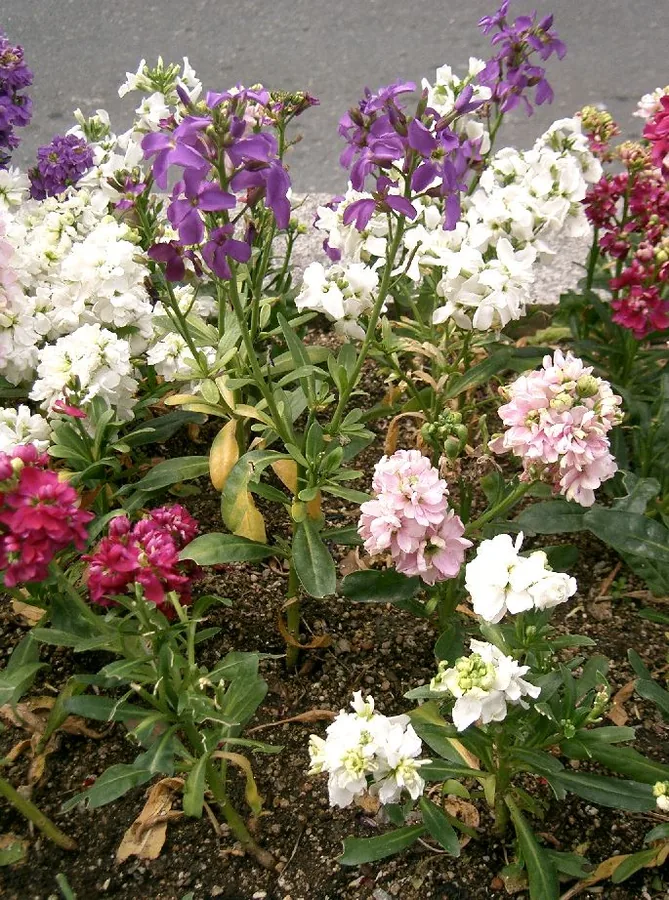
Color runs through soft pinks, purples, creams, and white, on plants that stand anywhere from 1 to 3 feet (30 to 91 cm) tall. The tall types are a favorite for the cutting garden, where the long, fragrant stems last well in a vase. Shorter strains hold their own as edging or in a pot.
The one thing stock asks for is cool weather while it sets its flowers. Plant it early enough to catch that chill, keep the soil evenly moist, and give it sun, and it rewards you with weeks of bloom. Plant it late and let summer arrive first, and it sulks, then fades.
Care
The short version: full sun and cool weather, with steady moisture in rich, well-drained soil that isn't acidic, planted early enough to bloom before summer heat sets in.
Light
Stock wants full sun for the strongest stems and the heaviest bloom. It will take a little partial shade, especially where spring turns warm early, but too much shade leaves you with weak, leggy plants and few flowers.
Water
Keep the soil evenly moist and never let stock dry out while it's growing through the cool season. Water roughly every 3 to 7 days, more in dry spells, and aim the water at the base rather than over the foliage to keep mold at bay.
Soil
Plant in fertile, well-drained ground, whether that's loam, sand, or clay, worked over with organic matter. A pH between 6.0 and 8.0 suits it, so lean slightly alkaline rather than acidic, since stock dislikes sour soil.
Temperature
This is a cool-weather plant through and through. It comes through light frost and grows best in the chill of spring or fall, holding up across a range of about 28°F to 81°F (-2°C to 27°C), then declining fast once heat pushes past the top of that band.
Humidity
Ordinary outdoor humidity is no problem, so there's no number to hit. What matters is airflow, because stock packed too tight in damp weather is exactly how white mold gets started.
Feeding
Work a balanced, general-purpose fertilizer into the bed at planting, then feed again about monthly while the plants are growing hard. That steady feed keeps the spikes coming without pushing soft, floppy growth.
Pruning
Stock needs little cutting back. Pinch or snip off spent spikes to keep plants tidy and, if you're growing for the vase, harvest the stems while they're fresh. Grown as a short annual, it asks for nothing more.
Size & spacing
Plants stand 1 to 3 feet (30 to 91 cm) tall and spread about 9 to 18 inches (23 to 46 cm) wide. Give each one that much room so air moves freely between them and mold finds no quarter.
When to plant
Stock runs on cool weather, so the calendar matters more than for most flowers. Start seed indoors in late winter, set the young plants out in early spring while it's still chilly, and they bloom from late spring into early summer before the heat shuts them down.
Northern hemisphere
Southern hemisphere
Typical months for a temperate climate: start earlier in warm zones, later where spring frosts linger.
- Sow: 6 to 8 weeks before the last spring frost; seed germinates in 7 to 14 days at 65 to 75°F (18 to 24°C)
- Plant: Transplant in early spring while weather is still cool; plants tolerate light frost. In mild-winter regions plant in fall or late winter.
- Harvest: Blooms May through July under cool conditions; cool exposure near 50 to 55°F (10 to 13°C) is needed to trigger flowering
Hardiness
USDA hardiness zones: 6–10
Temperature: down to -23°C
Troubleshooting
Most stock trouble comes down to two things: damp, crowded conditions that invite rot, and weather that's wrong for the plant. Read the early signs below and you can fix the spacing, the support, or the timing before a planting is lost.
Fluffy white mold and collapsing stems
This is white mold, a fungus called Sclerotinia that takes hold in the mild, wet, humid spells stock grows through. Pull and bin any plant showing the cottony growth and water-soaked rot. Space the rest well, water at the base, and keep the air moving so spores never get a damp foothold.
Fix:
- Remove and discard affected plants
- Improve air circulation by proper spacing
- Avoid overhead watering and excess moisture
Plants fading and dying as summer warms up
Stock is a cool-season flower, and heat is what finishes it. Once temperatures push past 80°F (27°C), the plants quit blooming and go downhill fast. There's no saving a heat-struck planting, so the answer is timing: grow it through spring or fall and have your flowers cut before the hot weather settles in.
Fix:
- Grow as a cool-season crop and harvest before summer heat
- Time plantings for spring or fall cool periods
Leafy plants that never put up flowers
When stock grows lush and green but throws no flower spikes, it never got the cool spell it needs to switch into bloom. The plants want a stretch near 50°F to 55°F (10°C to 13°C) while they are still young. Give young plants that cool conditioning at the right leaf stage, or pick early varieties that bloom on a shorter cool window.
Fix:
- Expose young plants to cool temperatures near 50 to 55°F (10 to 13°C)
- Choose early varieties for short cool windows
Stems flopping over after transplanting
This is lodging, and it has nothing to do with disease. Tall, top-heavy spikes simply bend or lay flat once wind or a heavy watering pushes them. Set a layer of horizontal netting at planting and give each plant enough room, and the stems grow up straight through the mesh.
Fix:
- Install a layer of horizontal support netting
- Provide even moisture and avoid overcrowding
Toxicity
Stock is one of the safe ones. The ASPCA lists it among the non-toxic flowers, so it poses no danger to cats, dogs, or other animals that share the garden, and its scented blooms are even edible. Plant it freely around pets and children.
Safe for
People · Cats · Dogs · Horses · Rabbits · Livestock · Birds
Cats None
Safe around cats. The ASPCA lists stock among the non-toxic flowers, so a curious nibble won't poison your cat.
Dogs None
No concern for dogs. Stock carries no known toxin, though a dog that wolfs down a lot of any plant may get a passing upset stomach.
Horses Safe
Horses can graze near stock without trouble, since the plant holds nothing harmful to them.
Rabbits Safe
Rabbits are fine with stock. The leaves and flowers are harmless if one happens to browse them.
Livestock Safe
Cattle, goats, and sheep face no risk from stock growing within reach.
Birds Safe
Birds can peck at the plant or its seeds without harm.
People Safe
Stock is safe for people, and its sweetly scented flowers are even edible as a garnish.
Varieties
Stock comes in a few distinct strains, sorted mostly by how fast they bloom and how much cold they'll take. These are the ones worth knowing.
Harmony Series
A series, including Harmony Cherry Blossom and Harmony Purple, bred to hold up in warmer climates like Florida.
Brompton Stock
A biennial-type strain that gardeners often overwinter for a flush of bloom the following spring.
Ten Weeks Stock
A fast annual that earns its name by flowering roughly ten weeks after you sow it.
How to propagate
Stock is grown from seed, and the trick isn't sprouting it but timing the cool spell that turns a leafy plant into a flowering one.
SeedModerate
Sow indoors 6 to 8 weeks before the last frost, or in seedling trays for transplanting; germinates in 7 to 14 days at 65 to 75°F (18 to 24°C) · 30 to 50 days to reach transplant size
Stock comes from seed. Start it indoors 6 to 8 weeks before your last frost, and the seed sprouts in 7 to 14 days at 65°F to 75°F (18°C to 24°C), taking another 30 to 50 days to reach transplant size. Sow a fresh batch every couple of weeks to stretch the bloom across the season, and give the young plants a cool spell so they flower.
Myths
Stock flowers are toxic and dangerous to keep around cats and dogs.
The ASPCA puts stock (Matthiola incana) on its list of non-toxic flowers, the kind that turns up safely in bouquets. It is not poisonous to cats or dogs, so you can grow it and cut it without worry.
Stock will bloom in any season as long as it gets enough sun.
Sun alone won't do it. Stock is a cool-season plant that needs a cool spell to set its flowers, and it falls apart once summer heat climbs past about 80°F (27°C). Grow it in spring or fall, not the heat of summer.