Vegetable · Brassicaceae
Cabbage
Brassica oleracea (Capitata Group)
Give it steady moisture, rich soil, and cool weather, and cabbage rewards you with a heavy, tight head.
Full sun
Every 3–7 days
41–77°F · 5–25°C
60–100 days
Overview
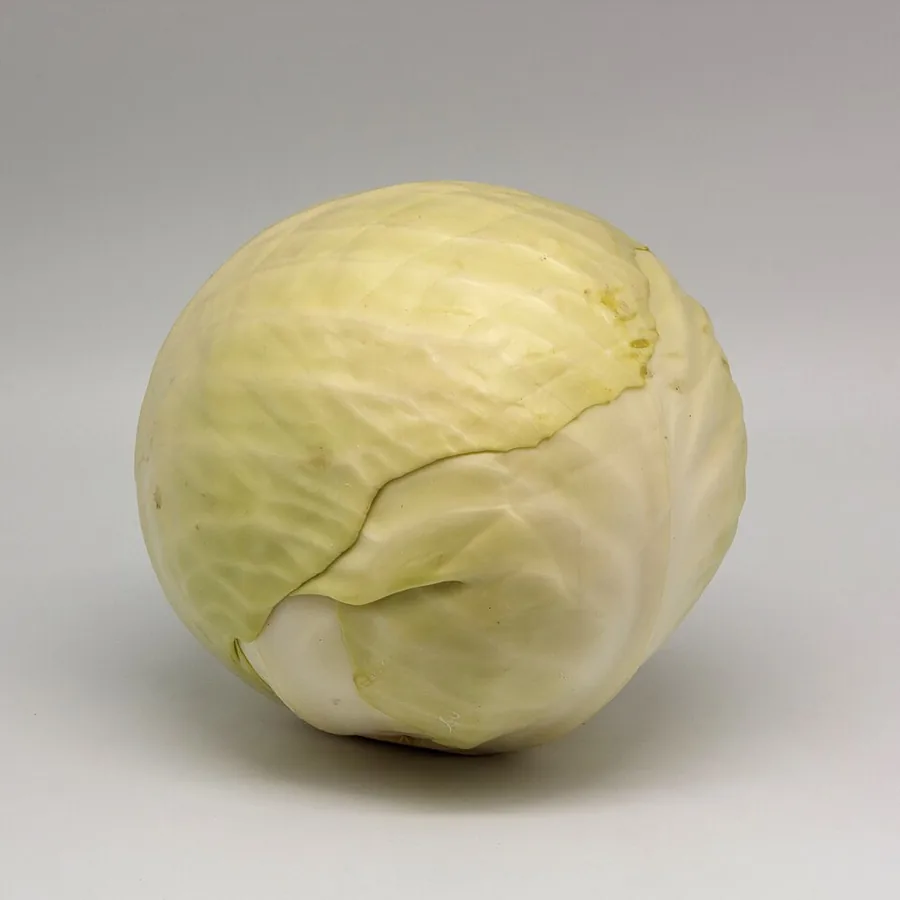
Cabbage is a cool-season vegetable grown for the dense head it forms from tightly wrapped leaves. It belongs to the brassica family alongside broccoli, kale, and Brussels sprouts, and it comes in smooth green, deep red, and crinkled savoy forms. As a biennial grown as an annual, it puts everything into that head in its first season, and you harvest before it ever tries to flower.
The plant likes things on the cool side and holds up to a light frost, which is why it does so well as both a spring and a fall crop. It stays compact, reaching only 12 to 18 inches (30 to 45 cm) tall, so it fits a tight bed. The two things it asks for above all are rich soil and even water, and most cabbage troubles trace straight back to a lapse in one of those.
Cabbage takes some patience, since a head needs 60 to 100 days to firm up. It also draws a steady crowd of caterpillars and a few stubborn diseases. Stay ahead of those, keep the moisture even, and you end the season with solid heads that store for weeks and only sweeten after a fall chill.
Care
The short version: full sun and cool weather, rich soil kept evenly moist with about an inch to an inch and a half of water a week, a feed at planting and again a few weeks on, and harvest as soon as the heads turn firm.
Light
Cabbage wants full sun, around six hours or more a day, to build a dense head. It will take partial shade and still grow, but the head comes in looser and slower, so save the shadier spots for hotter weather when a little relief helps.
Water
Keep the soil evenly moist with about 1 to 1.5 inches of water a week, wetting down at least 6 inches and watering in the morning. The key is uniform moisture, because once a head is firm, a sudden drink after a dry spell makes it split.
Soil
Plant in fertile, well-drained sandy loam worked full of organic matter so it holds moisture without going soggy. Aim for a pH of 6.0 to 7.0, since slightly acidic to neutral ground also helps keep clubroot at bay.
Temperature
Cabbage is a cool-season crop that runs best between 41°F and 77°F (5°C to 25°C). It takes a light frost in stride, and a fall chill even sweetens the head, but real summer heat pushes it to bolt instead of forming tight leaves.
Humidity
Ordinary outdoor humidity suits cabbage, so there's no figure to hit. Good airflow does more good than any humidity reading, since crowded, damp leaves invite the diseases that spoil a head.
Feeding
Work a balanced fertilizer into the bed at planting, guided by a soil test, then side-dress with nitrogen about 3 to 4 weeks after transplanting to carry the plant through heading. Cabbage is a hungry feeder, and that mid-season boost is what fills the head out.
Pruning
Cabbage needs no real pruning. Strip away yellowed, damaged, or pest-chewed outer leaves as they appear, and cut the head with a sharp knife at harvest. Leave the outer leaves on the stalk and you may coax a second crop of small mini-heads.
Size & spacing
Plants stay compact at 12 to 18 inches (30 to 45 cm) tall and spread 12 to 24 inches (30 to 61 cm) across. Give each one that much elbow room so heads size up well and air can move through to keep disease down.
When to plant
Cabbage runs on cool weather, not heat. Start seeds indoors in late winter and set the transplants out a few weeks before the last frost for an early summer harvest, or plant again in mid to late summer for heads that finish in the fall, sweeter for the cold.
Northern hemisphere
Southern hemisphere
Typical months for a temperate climate: start earlier in warm zones, later where spring frosts linger.
- Sow: 6-8 weeks before last spring frost
- Plant: Set hardened transplants out 2-4 weeks before the last spring frost; for a fall crop, transplant in mid-to-late summer about 6-8 weeks before the first fall frost
- Harvest: Harvest when heads are firm and dense, typically early summer for spring plantings and mid-to-late fall for fall plantings; flavor improves after light fall frost
Hardiness
USDA hardiness zones: 2–11
Temperature: down to -46°C
Troubleshooting
Most cabbage trouble shows up on the leaves or in the head, and a quick look usually tells you whether you're dealing with a chewing pest, a disease, or a watering slip. Match what you see below, then act early, while the head can still be saved.
Plants wilting in the heat with yellow leaves and swollen roots
This is clubroot, a soilborne disease that thrives in acidic ground and twists the roots into useless clubs. There is no rescue once a plant has it, so lift the affected ones and destroy them rather than composting them. Sweeten the bed with lime toward a pH of 6.8 to 7.2, buy clean transplants, and keep brassicas out of that ground for several years.
Fix:
- Remove and destroy infected plants; do not compost them
- Lime soil toward pH 6.8-7.2 in affected beds
Yellow V-shaped wedges creeping in from the leaf edges
Those yellow wedges with blackened veins are black rot, a bacterial disease that rides in on infected seed and transplants. Pull and destroy any plant that shows it, and stay out of the patch while the leaves are wet so you don't carry it down the row. Start with certified disease-free stock, water at the base, and rotate brassicas on a 2 to 3 year cycle.
Fix:
- Remove and destroy infected plants
- Avoid working among wet plants to limit spread
Ragged holes in the leaves with green caterpillars and dark frass
The culprits are cabbage caterpillars, usually the imported cabbageworm, the looper that arches as it crawls, or the small diamondback moth larva. Handpick them the moment you see them and spray Bacillus thuringiensis (Bt) while the larvae are still small, stepping up to spinosad only if pressure stays heavy. A floating row cover put on at transplanting keeps the butterflies and moths off in the first place.
Fix:
- Handpick caterpillars when first spotted
- Apply Bacillus thuringiensis (Bt) consistently while larvae are small
- Use spinosad per label if pressure is heavy
A firm, mature head that cracks or splits open
Splitting happens when a dry spell ends in heavy rain or watering and a dense head drinks too fast for its skin to keep up. It is not a disease, so look for it after a downpour on heads that are already firm. Harvest a split head right away and use it, and slow the water uptake on the others by giving each plant a quarter twist or slicing down one side of the root zone with a spade.
Fix:
- Harvest split heads immediately and use promptly
- Twist plants a quarter turn or spade one side of the root zone to slow water uptake on remaining mature heads
Curled, puckered leaves crusted with waxy gray-green insects
These are cabbage aphids, gray-green and dusted with a whitish wax, and they pack into leaf undersides and the folds of the head. Knock the colonies off with a strong jet of water, then follow with insecticidal soap or horticultural oil worked right into the clusters. Inspect transplants before they go in, leave room for ladybugs and other natural enemies, and clear out crop residue once the harvest is done.
Fix:
- Dislodge with a strong spray of water
- Apply insecticidal soap or horticultural oil, ensuring contact with colonies
Toxicity
Cabbage is one of the safest plants you can grow around a household. It carries no toxins, and pets, livestock, and people can all eat it without worry. The only thing to watch is quantity, since a big serving of raw brassica can leave any animal a bit gassy.
Safe for
People · Cats · Dogs · Horses · Rabbits · Livestock · Birds
Cats None
Cabbage holds nothing that harms a cat. A nibble of cooked leaf now and then is harmless, though most cats won't bother with it.
Dogs None
Safe to share in small amounts. A dog that wolfs down a lot of raw cabbage may get a little gassy or pass a soft stool, but that is digestion, not poisoning.
Horses Safe
No toxic risk. Big helpings of any brassica can leave a horse gassy, so keep it to an occasional treat rather than a staple.
Rabbits Safe
Rabbits can eat cabbage, and the leaves make a fine green. Introduce it slowly and in small pieces, since a sudden pile can upset a tender gut.
Livestock Safe
Cattle, goats, and sheep graze brassicas without harm. Cabbage and its trimmings are a common feed, best balanced against other forage so it isn't the whole diet.
Birds Safe
Chickens and other birds peck happily at a hung cabbage head, and many keepers use one to keep a flock busy. Nothing in it does them harm.
People Safe
Cabbage is a kitchen staple, eaten raw, cooked, or fermented, and safe for everyone. Only chronic, very high intake of raw brassicas raises any goitrogen concern.
No special handling needed. Large quantities of raw brassicas can cause mild gas in pets and people, and brassicas contain goitrogenic compounds that matter only with chronic, very high intake; this is a dietary note, not poisoning.
Varieties
Cabbage comes in far more types than the plain green ball most people picture. A few stand out for flavor, timing, or how well they hold in the garden.
Early Jersey Wakefield
An heirloom early type known for its pointed, conical head and sweet flavor.
Stonehead
An early hybrid that forms very dense, solid round heads which resist splitting.
Ruby Ball
A red cabbage with firm round heads and a slightly peppery flavor that holds well in the garden.
Savoy King
A savoy type with deeply crinkled blue-green leaves that turn milder once cooked.
Companions
Plant near
dill: Aromatic herb that attracts ladybugs and parasitic wasps that prey on cabbage pests
sage: Aromatic herb traditionally interplanted with cabbage to help deter cabbage moths
mint: Aromatic herb reported to deter cabbage pests; best kept contained due to spreading roots
onion: Onion-family crops grow well alongside cabbage-family crops and may help confuse pests
beet: Compatible root crop that shares cool-season conditions without competing with cabbage heads
Keep apart
strawberry: Companion planting guides list strawberries as incompatible neighbors for cabbage-family crops
tomato: Traditional companion charts advise keeping tomatoes away from cabbage plantings
pole bean: Companion planting guides list pole beans as poor companions for the cabbage family
How to propagate
Cabbage is grown from seed, started indoors for an early crop or sown later for a fall one. There's no cloning here, just a packet of seed and a head start under cover.
SeedEasy
Sow indoors 6-8 weeks before the last spring frost, or direct sow/transplant in mid-to-late summer for a fall crop · Germinates in about 4-10 days; transplants are garden-ready in 4-6 weeks
Cabbage grows easily from seed. Start it indoors 6 to 8 weeks before the last spring frost, or sow for a fall crop in mid to late summer, and the seed comes up in about 4 to 10 days. The seedlings are ready for the garden in 4 to 6 weeks, but harden them off first. Direct-seeded plants skip the transplant shock yet can take up to three weeks longer to mature.
Myths
Frost ruins a cabbage crop, so every head has to come in before any cold weather.
Cabbage is a hardy cool-season crop that shrugs off light frost, and a fall chill actually sweetens the flavor. Only a hard freeze damages a mature head, so there's no rush to clear the bed at the first cold night.
Split cabbage heads are a sign of disease in the soil.
Splitting is a physical problem, not an infection. A firm, ripe head drinks up water fast after uneven watering or heavy rain and bursts its own skin. No pathogen is involved, just the swing from dry to wet.