Vegetable · Amaryllidaceae
Onion
Allium cepa
Match the variety to your day length, keep the water steady, and onions all but grow themselves.
Full sun
Every 3–7 days
55–75°F · 13–24°C
90–120 days
Overview
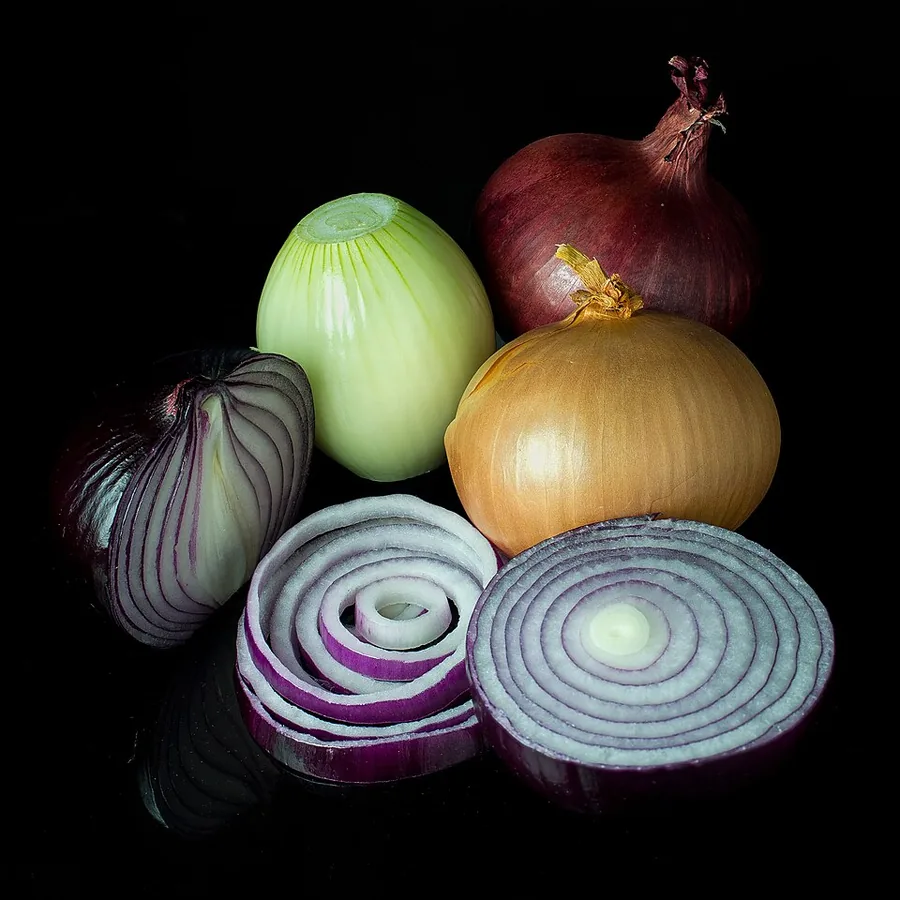
Onions have been in the kitchen garden for thousands of years, and they earn their keep. Grown as a biennial but harvested in a single season, the plant pours its first year of growth into the swelling bulb you pull and store. It belongs to the same family as garlic, leeks, and chives, and shares their sharp scent.
The one thing every onion answers to is day length. Long-day types wait for the long days of a northern summer before they start a bulb, while short-day types bulb on the shorter days of a southern winter, and day-neutral types sit comfortably in between. Plant the wrong type for your latitude and you get green tops with little to show underneath.
None of this makes onions hard. Give them full sun, loose and fertile soil, and water they can count on while the bulb forms, and they ask for almost nothing else. Most of what goes wrong traces back to cold-stressed sets that bolt or bulbs that were cured poorly and rotted in the bin.
Care
The short version: full sun, loose and fertile soil, and about an inch of water a week while the bulbs fill out. Feed nitrogen during leaf growth and stop once bulbing begins, then ease off the water as the tops fall over.
Light
Onions want full sun, the more the better, since the leaves are what feed the growing bulb. Skimp on light and you trade a fat onion for a thin one.
Water
Keep the soil evenly moist, around an inch of water a week, because the shallow roots can't reach far for a drink. Steady moisture matters most while the bulb is filling. Ease off once the tops start to fall over so the bulbs can dry down for storage.
Soil
Plant in loose, fertile, well-drained loam worked full of organic matter, which lets the bulb expand without a fight. A pH of 6.0 to 6.8 suits them, just on the acidic side of neutral.
Temperature
Onions grow well across cool to mild weather, roughly 55°F to 75°F (13°C to 24°C). The leaves can take a light frost early on, and that cool start is part of why they go in so early.
Humidity
Ordinary outdoor humidity is fine, so there's no number to chase. What counts far more is airflow, since the damp, crowded leaves that downy mildew loves are the real risk.
Feeding
Feed a nitrogen-based fertilizer through the leafy growth in spring and early summer, side-dressing every few weeks. Stop the moment bulbing begins, because late nitrogen makes soft necks that rot in storage.
Pruning
Onions need no regular pruning. Snap off any flower stalk the moment it appears, so the plant pours its energy back into the bulb, and pull away yellowed or diseased leaves as you spot them.
Size & spacing
Plants reach 12 to 18 inches (30 to 46 cm) tall with a narrow upright spread of just 4 to 6 inches (10 to 15 cm). That slim footprint lets you tuck a lot of onions into a small bed.
When to plant
Onions go in early and come out in late summer. Start seed indoors in late winter or push sets into the ground as soon as it can be worked in early spring, then lift the bulbs from midsummer on, once the tops yellow and flop over.
Northern hemisphere
Southern hemisphere
Typical months for a temperate climate: start earlier in warm zones, later where spring frosts linger.
- Sow: 6 to 8 weeks before the last spring frost
- Plant: As soon as soil can be worked in early spring, 2 to 4 weeks before the last frost
- Harvest: Mid to late summer when tops yellow and fall over
Hardiness
USDA hardiness zones: 3–9
Temperature: down to -40°C
Troubleshooting
Most onion trouble shows up in the leaves while the plant grows or in the bulbs after they're stored. Catch the early signs and you can save the crop or at least the harvest you've already pulled. Match what you see below, then act while it still helps.
Pale leaf spots furred with gray-purple mold
This is downy mildew, a fungus that takes hold in cool, damp, humid weather and shows a velvety violet-gray fuzz on the lesions come morning. The spots later turn pale and papery, and badly hit leaves yellow and fold over. Pull and destroy infected foliage, open the planting up for better airflow, and keep a multi-year rotation so the spores don't build in the soil.
Fix:
- Apply a labeled fungicide preventively where disease is common
- Improve air circulation
- Remove and destroy infected foliage
Bulbs go soft at the neck and rot in storage
This is neck rot, a Botrytis infection that shows up weeks after harvest as gray mold at the neck and brown, mushy inner scales. Bulbs lifted too green or cured badly are the usual victims, and a late shot of nitrogen makes thick, soft necks that invite it. Toss the rotted ones, cure the rest in a warm, dry, airy spot, and stop feeding nitrogen once the bulbs start to swell.
Fix:
- Discard affected bulbs
- Cure remaining bulbs thoroughly in a warm, dry, airy place
Plants run to flower instead of building a bulb
This is bolting, and it traces back to a cold spell after planting, often from setting out oversized sets or transplanting too early. Once the flower stalk shows, the bulb stays small and won't keep well. Snap the stalk off as soon as you see it and eat those bulbs fresh rather than storing them.
Fix:
- Remove flower stalks as soon as seen
- Use the affected bulbs fresh rather than for storage
Silvery streaks and stippling on twisted leaves
Onion thrips are at work, rasping the foliage and leaving silvery flecks where the leaves meet the neck. Heavy feeding shrinks the bulb you finally pull. Knock them back with a strong jet of water or a labeled spray, keep the plants from going dry, and clear out nearby weeds and volunteer alliums that shelter them.
Fix:
- Use a strong spray of water or labeled insecticide for heavy infestations
- Encourage natural predators
- Remove heavily infested debris
Toxicity
Onions are perfectly safe on your plate but genuinely dangerous to animals. Every part holds organosulfur compounds that attack the red blood cells of cats, dogs, horses, and livestock, and cats are the most sensitive of all. Keep raw and cooked onion, scraps, and anything seasoned with onion or garlic powder well away from pets.
Toxic to
Cats · Dogs · Horses · Rabbits · Livestock · Birds
Safe for
People
Cats Severe
Cats are the most sensitive of all, and even a small taste is dangerous. Watch for vomiting, pale gums, fast breathing, and red or brown urine as the red blood cells break down, followed by weakness and collapse.
Dogs Severe
A dog that eats onion may vomit and have diarrhea at first, then turn weak and tired with pale gums and a racing heart. Dark or reddish urine is the telltale sign that the red blood cells are being destroyed.
Horses Toxic
Horses grazing onion or wild alliums grow weak and dull, their gums go pale, and their urine darkens as anemia sets in. The damage builds with repeated grazing rather than a single bite.
Rabbits Toxic
Never feed onion to a rabbit. The same compounds that harm cats and dogs poison a rabbit's blood, bringing on weakness, pale gums, and a loss of appetite.
Livestock Toxic
Cattle, sheep, and goats that get into onions or onion-rich cull piles show anemia, weakness, and stained urine. Sheep handle small amounts better than cattle, but a steady diet harms them all.
Birds Toxic
Birds are vulnerable too, since the organosulfur compounds rupture their red blood cells just as they do in mammals. Keep onion, cooked scraps, and seasoned food well out of reach.
People Edible
Onions are a kitchen staple and safe for people to eat raw or cooked. The toxicity is a problem for animals, not for the cook.
Keep all parts of the plant, scraps, and any foods seasoned with onion or garlic powder away from pets and livestock. Cats are especially sensitive.
Helpline numbers

United States
ASPCA Animal Poison Control: (888) 426-4435 (fee applies)

United Kingdom
Animal PoisonLine: 01202 509000 (fee applies)

Australia
Animal Poisons Helpline: 1300 869 738
Varieties
Onions are sorted less by color than by the day length they need to bulb. Picking the right group for your latitude matters more than any other choice you make.
Long-day onions (e.g., 'Walla Walla', 'Yellow Sweet Spanish')
These start forming bulbs once the days stretch to roughly 14 to 16 hours, which makes them the right pick for northern gardens.
Short-day onions (e.g., 'Texas Early Grano', 'Granex')
These bulb on just 10 to 12 hours of daylight, so southern growers plant them in fall or winter for an early crop.
Intermediate/day-neutral onions (e.g., 'Candy')
Bulbing at around 12 to 14 hours of daylight, these do well across a wide band of latitudes and are a safe bet when you're unsure of your day length.
Companions
Onions earn their spot beside crops their strong scent helps protect, and they sit poorly next to the legumes whose growth alliums are said to check.
Plant near
Carrots: Onions are traditionally interplanted with carrots, as the strong scent of alliums is said to help deter carrot pests.
Keep apart
Beans: Alliums such as onions are traditionally said to inhibit the growth of beans.
Peas: Alliums such as onions are traditionally said to inhibit the growth of peas.
How to propagate
Onions grow either from seed or from sets, and the one you pick is a trade between choice and ease.
SeedModerate
Start indoors 6-8 weeks before the last frost, or sow directly in early spring · Several weeks to germinate and establish seedlings before transplanting
Growing from seed opens up the widest choice of varieties, but it asks for the longest season. Start the seed indoors 6 to 8 weeks before your last frost, or sow it straight into the ground in early spring, and give the seedlings several weeks to come up and toughen before they go out.
Bulbs & cormsEasy
Plant sets in early spring as soon as soil can be worked · About 1-2 weeks to root and begin top growth
Sets are the easiest way to grow onions. Push these small dormant bulbs into the ground in early spring as soon as the soil can be worked, and they root and push up green tops within 1 to 2 weeks. Pick sets smaller than a dime, since the bigger ones are the ones that bolt.
Myths
Only raw onions harm pets, so cooked onion or a pinch of onion powder is fine.
Cooking changes nothing here. Cooked onion and the onion or garlic powder hiding in gravy, baby food, and table scraps are just as toxic to dogs and cats. The dried powders are the worst of all, because they pack the toxin into a far smaller bite.
Bigger onion sets always grow bigger bulbs.
It usually works the other way. Sets larger than a dime have already felt enough cold to bolt, and a bolted plant puts its energy into a flower stalk instead of the bulb. Small sets, smaller than a dime, give you the bigger, better-keeping onions.