Vegetable · Brassicaceae
Daikon Radish
Raphanus sativus
Sow it in late summer and let the deep taproot do the digging before winter takes the plant.
Full sun
Every 3–7 days
50–60 days
USDA 2–11
Overview
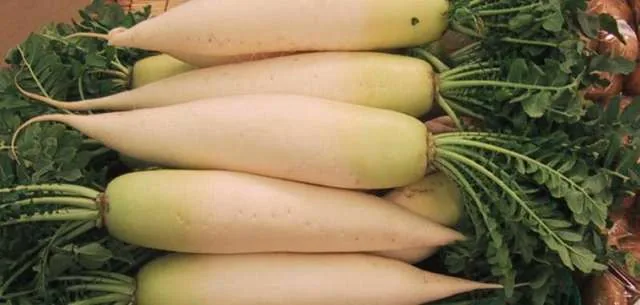
Daikon radish is the long white root you know from the kitchen, but the same plant earns its keep in the field as a cover crop. It belongs to the cabbage family and grows fast in cool weather, sending a thick taproot straight down through packed soil. Cover-crop growers lean on it for that root alone, the part that does the real work underground.
Sown in late summer or early fall, it bulks up in about two months and then, in cold zones, the first hard freeze kills it outright. That winterkill is the point. The root rots over winter and leaves deep open channels that carry water, air, and the next crop's roots far below the old hardpan, with no spring cleanup to do.
It also acts as a sponge for leftover nitrogen. A daikon stand pulls up residual soil nitrate that would otherwise wash away, holds it through the cold months, and hands it back as the residue breaks down. Easy to grow and quick to establish, it asks little beyond decent moisture and a timely sowing date.
Care
The short version: sow daikon in full sun in late summer to early fall, keep the soil moist enough to size the root, and plant it where there is leftover nitrogen for it to mop up.
Light
Daikon wants full sun, though it will take a bit of partial sun. Plenty of light through the short days of fall is what pushes the fast top growth and the big root below.
Water
Keep the soil evenly moist through the growing weeks, since the root needs steady moisture to size up. It thrives in the cool, damp conditions of late summer and fall and is not a drought-loving crop, so don't let it dry out while it's bulking.
Soil
Give it well-drained loam, but it adapts to most well-drained ground. Aim for a pH between 6.0 and 7.5, and make sure the soil holds enough nitrogen and moisture to fill out the root.
Temperature
It grows across a wide range, from about 18°F to 84°F (-8°C to 29°C), and does its best in cool fall weather. In cold zones a hard freeze winterkills the stand, which is exactly what the cover crop is meant to do.
Humidity
Ordinary outdoor humidity suits it fine, so there's no figure to aim for. What matters far more is steady soil moisture through the fall growing window.
Feeding
Feed at planting, in late summer to early fall, and that's it. Daikon doesn't fix its own nitrogen; instead it scavenges leftover soil nitrate, so it grows best where 40 to 60 pounds of nitrogen per acre is already on hand or applied.
Pruning
There is no pruning to do. Grown as a short-lived fall cover crop, it winterkills on its own in cold zones, leaving easy residue and open root channels with no spring termination needed.
Repotting
none
Size & spacing
Plants reach roughly 12 to 35 inches (30 to 90 cm) tall above ground, with the bulk of the action in the deep taproot below. As a broadcast or drilled cover crop it is sown thick rather than spaced like a row vegetable.
When to plant
Daikon runs on the fall calendar, not the spring one. Sow it in late summer to early fall, roughly 4 to 10 weeks before your first frost, and it bulks up fast in the cool weather before a hard freeze winterkills the stand and leaves the roots to break down over winter.
Northern hemisphere
Southern hemisphere
Typical months for a temperate climate: start earlier in warm zones, later where spring frosts linger.
- Sow: Not applicable; direct-sown as a cover crop.
- Plant: Sow in late summer to early fall, about 4-10 weeks before the first fall frost.
- Harvest: Grown for its deep taproot and biomass, not flowers; in cold zones it winterkills in late fall to early winter and is not harvested.
Hardiness
USDA hardiness zones: 2–11
Temperature: down to -46°C
Troubleshooting
Daikon is an easy crop, and most of its trouble comes from timing and placement rather than disease. Watch for the rot smell after winterkill, the disease risk near cabbage-family crops, and the weed risk when it bolts. Match what you see below and act before it spreads.
Disease and pest buildup near cabbage-family crops
Daikon is a brassica, so it shares the same enemies as cabbage, broccoli, and their kin, including clubroot, flea beetles, and cabbage root maggot. Slot it just before or after a cole crop and you stack those problems up in the soil. Swollen, galled roots are the tell for clubroot, so check your field history and keep radish out of any rotation where brassicas have run recently.
Fix:
- Do NOT rotate forage/tillage radish immediately before or after cabbage-family (brassica) vegetables
- Remove radish from rotations on fields with a clubroot history and grow cruciferous crops elsewhere
- Destroy residue and rotate away from brassicas for several years where clubroot is present
Plants bolt, go to seed, and turn into weeds
Sow too early, say back in July, and the crop runs to flower and sets seed before winter. The same happens in mild-winter zones, where the radish never freezes out and survives to bloom the next spring. Terminate any bolting or surviving plants before they seed, by mowing, tillage, or an approved herbicide, and kill the flower stalks before they top about 4 to 5 inches so the seed never spreads.
Fix:
- Terminate surviving or bolting plants before seed set by mowing, tillage, or an approved herbicide
- Kill plants before the flowering structure exceeds about 4-5 inches tall to prevent seed dispersal
A strong sulfur smell after the roots winterkill and rot
Once a hard freeze kills the stand and the fat taproots start to break down, they give off sulfur compounds from the glucosinolates inside, and the result is a skunky, rotting smell. It bothers people, not the soil or the next crop. The odor is worst when a quick kill is followed by a warm spell, and it fades within a few days as the roots finish decomposing.
Fix:
- Wait it out; the sulfurous smell normally dissipates within a few days as decomposition completes
- Plan no remedial action since this is a temporary nuisance, not a plant health problem
Toxicity
There is nothing to worry about here. Daikon is a food crop, not a poisonous plant, and it sits nowhere on the ASPCA toxic-plant lists, so the root and leaves are safe around cats, dogs, livestock, and people alike. The only thing it gives off is a strong sulfur smell once the roots rot after winterkill, and that is a nuisance, not a hazard.
Safe for
People · Cats · Dogs · Horses · Rabbits · Livestock · Birds
Cats None
A cat that nibbles the leaves or root has nothing to fear, since radish is not on the ASPCA toxic list.
Dogs None
Dogs can chew the foliage or a piece of root without harm, and many happily crunch the crisp taproot.
Horses Safe
Horses can graze the tops and roots safely; this is a food crop, not a poisonous plant.
Rabbits Safe
Rabbits handle the leaves and root well as part of a varied diet.
Livestock Safe
Cattle, sheep, and goats graze radish forage with no real risk, though animals gorging on huge amounts of any brassica may get a passing bout of mild digestive upset.
Birds Safe
Backyard poultry and wild birds peck at the seedlings and roots without trouble.
People Safe
The crisp white root and the young leaves are good to eat raw or cooked, the same as any kitchen radish.
Non-toxic as a food and plant. As a brassica it contains glucosinolates, and like other brassica forages, grazing livestock that eat very large amounts can occasionally have mild digestive upset; this does not affect cats or dogs. Note also that when the roots winterkill and decompose they release a strong sulfurous rotting odor that is a nuisance, not a toxicity hazard.
Varieties
Most daikon you'll meet falls into a few named types, split between the kitchen radish and the cover-crop selections bred from it. These are the ones worth knowing.
Tillage Radish
A daikon-type forage radish selected and trademarked for the very large, deep taproot that does the biological tillage of compacted ground.
GroundHog
A cover-crop radish bred for an aggressive, deep root that drills down hard to break up compaction.
Daikon
The long white culinary radish from which the cover-crop forage types were drawn.
Nitro
A cover-crop radish grown for fast fall growth and heavy nitrogen scavenging.
How to propagate
Daikon is grown one way only, straight from seed sown in the ground, and it could hardly be simpler.
SeedEasy
Direct-sow in late summer to early fall, about 4-10 weeks before the first fall frost. · Establishes quickly in cool weather, producing substantial growth in about 50-60 days.
You always start daikon straight in the ground from seed, sown in late summer to early fall, roughly 4 to 10 weeks before the first fall frost. Drill or broadcast it shallow, about a quarter to half an inch deep, and it takes off fast in cool weather to put on real size in 50 to 60 days. Many growers mix it with a cereal grain or grass, since radish sown on its own leaves bare soil open to erosion.
Myths
Tillage radish actually tills the soil like a plow.
What it really does is biological tillage, or biodrilling. The living taproot pushes through and fractures compacted layers and plow pans, and once it rots it leaves big vertical channels that let water, air, and the next crop's roots run deep. It cuts compaction without a single pass of machinery, but it won't fix whatever caused the compaction in the first place.
Sources
- University of Maryland Extension
- University of Wisconsin-Madison Extension (Crops and Soils)
- USDA NRCS (Plant Guide, oilseed radish)
- Ohio State University Extension (Ohioline ANR-0125)
- Michigan State University Extension
- Ohio State University Extension (Ohioline SAG-5, oilseed radish)
- ASPCA Animal Poison Control
- ASPCA Animal Poison Control