Ornamental · Brassicaceae
Candytuft
Iberis sempervirens
Give it full sun and sharp drainage, and candytuft spills a sheet of white flowers across the spring garden.
Full sun
Every 7–10 days
USDA 3–8
6–12 in · 15–30 cm
Overview
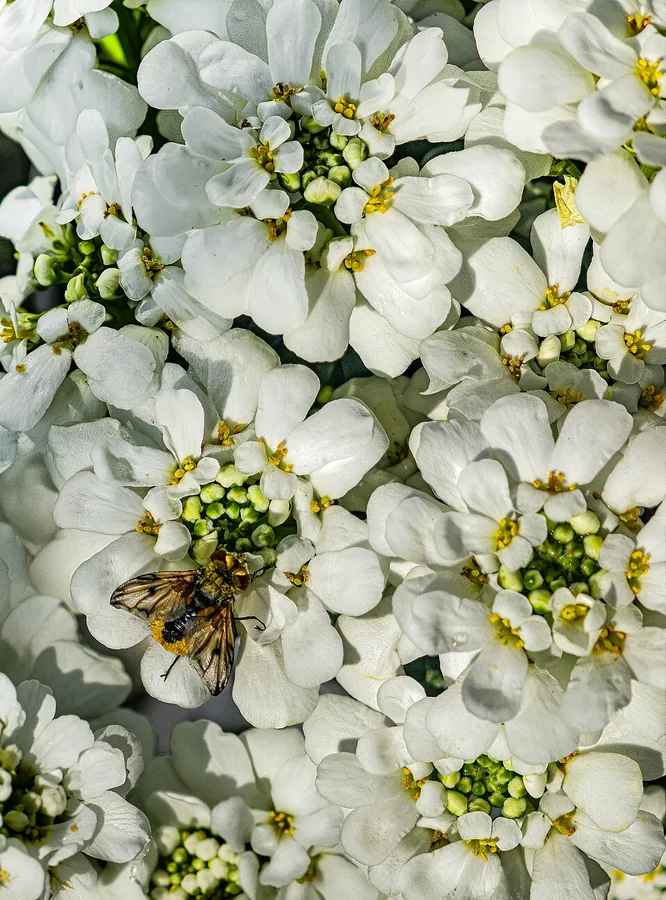
Candytuft is an evergreen perennial that hugs the ground and bursts into bloom each spring. It belongs to the cabbage family, and the low, woody mat of narrow dark leaves stays green right through winter in milder zones. Come April it disappears under a blanket of small white flowers that draw early bees.
This is a plant for the edge of a bed, a wall, or a rock garden, where it can tumble over stone and knit into a neat carpet 6 to 12 inches tall. It is tough where it counts, shrugging off cold down to zone 3 and dry spells once its roots take hold. The one thing it will not forgive is wet, heavy soil around the crown.
Care comes down to a sunny spot, ground that drains fast, and a quick shearing after the flowers fade. Do that and a single plant settles in for years, spreading slowly into a tidy evergreen mound that earns its keep long after the bloom is gone.
Care
The short version: full sun and fast-draining soil are everything, water sparingly once the plant is established, and shear it back by a third right after it finishes flowering.
Light
Candytuft flowers hardest in full sun, which keeps the mat dense and the bloom thick. It tolerates partial shade, but the plant grows looser there and gives you fewer flowers.
Water
Once established, this is a drought-tolerant plant that wants to dry out between drinks. Let the top half of the soil dry, then water every 7 to 10 days at most. The fastest way to kill it is soggy soil, which rots the crown.
Soil
Sharp drainage matters more than anything else. Candytuft is easy about texture and takes clay, loam, or sand, and it leans toward a neutral to alkaline pH of 6.0 to 8.0. What it cannot stand is ground that stays wet.
Temperature
This is a genuinely hardy perennial, comfortable from a brutal -40°F (-40°C) up to about 90°F (32°C). The evergreen foliage carries through winter across its range with no help from you.
Humidity
Plain garden air suits it, so there is no humidity figure to chase. Air movement is what counts here, since still, damp conditions invite mildew on the leaves.
Feeding
Candytuft is a light feeder that asks for very little. A single dose of slow-release general fertilizer in early spring covers the whole season, and overfeeding only grows soft, floppy growth.
Pruning
The one job that keeps the plant looking sharp is a shearing after bloom. Cut the stems back by about one-third as soon as the flowers fade, which holds the compact shape and pushes fresh new growth.
Repotting
Candytuft rarely needs repotting and resents being disturbed. Watch for roots circling the drainage holes or soil that dries out almost as fast as you wet it, and only then move it up a pot size.
Size & spacing
Plants stay low at 6 to 12 inches (15 to 30 cm) tall and spread to about 12 to 18 inches (30 to 45 cm) wide. Set them that far apart so air moves freely between the mounds and the foliage stays dry.
When to plant
Candytuft runs on the spring calendar. Start seed indoors in late winter, set plants out once hard frost has passed or in early fall, and the white flowers arrive from April into May, sometimes lingering into early summer.
Northern hemisphere
Southern hemisphere
Typical months for a temperate climate: start earlier in warm zones, later where spring frosts linger.
- Sow: Late winter, about 6-8 weeks before the last spring frost
- Plant: Spring after danger of hard frost has passed, or in early fall
- Harvest: Early to late spring (April to May), sometimes into early summer
Hardiness
USDA hardiness zones: 3–8
Temperature: down to -40°C
Troubleshooting
Candytuft is an easy plant, and nearly all of its troubles trace back to too much water or stale air. Read the early signs on the crown and leaves and you can step in before anything spreads. Match what you see below, then act while it still helps.
Plant wilts and collapses with a brown, rotting crown
This is crown and root rot, the one problem that takes down candytuft, and it comes from wet feet rather than disease you can spray away. Soggy soil suffocates the base, the stems turn mushy at the soil line, and the whole plant lifts out with blackened roots. Pull and destroy anything badly hit, then fix the drainage with grit or a raised bed before you replant.
Fix:
- Remove and destroy severely affected plants
- Improve drainage by amending soil with organic matter or planting on a slope or raised bed
- Reduce watering and avoid wetting the crown
Powdery white coating or spots on the leaves
A dusty white film usually means powdery or downy mildew, while spots and rust pustules point to fungal leaf trouble. Both show up where the air sits still and the leaves stay damp. Strip off the marked foliage, open the planting up to 12 to 18 inches between plants, and water at the base so the leaves dry fast.
Fix:
- Remove and dispose of affected foliage
- Improve air circulation by spacing plants 12-18 inches apart
- Avoid overhead watering and water at the base
Ragged holes chewed through leaves and flowers
Ragged holes that appear after a wet spell are the work of slugs and snails, with caterpillars sometimes joining in. Slime trails and overnight damage give them away. Pick the culprits off after dark, set out baits or traps where it makes sense, and clear away the mulch and debris that shelter them by day.
Fix:
- Handpick slugs, snails, or caterpillars
- Use slug baits or traps where appropriate
- Remove debris and mulch that harbors slugs near plants
Toxicity
Good news for households with animals and children: candytuft is not toxic. The ASPCA does not list it among harmful plants, and the extension and botanical sources agree there are no poisoning concerns. A nibble or a trample does no harm, so it earns a safe spot in any family garden.
Safe for
People · Cats · Dogs · Horses · Rabbits · Livestock · Birds
Cats None
Candytuft is not on the ASPCA toxic list, so a curious cat that nibbles the foliage has nothing to fear here.
Dogs None
A dog can sniff, chew, or trample the mat of leaves without any risk of poisoning.
Horses Safe
Grazing horses are in no danger from this plant, which carries no compounds known to harm them.
Rabbits Safe
Rabbits can browse the low groundcover freely, with no toxic parts to worry about.
Livestock Safe
Cattle, goats, and sheep face no poisoning risk if they reach a planting in the garden.
Birds Safe
Garden birds and backyard poultry can peck around candytuft without harm.
People Safe
The plant is harmless to handle and poses no concern around children, though it is grown for show rather than the table.
No special handling precautions are required; routine gardening hygiene such as washing hands after contact is sufficient.
Varieties
Most garden candytuft is sold by cultivar, and they differ mainly in size and the weight of the bloom. These are the ones worth knowing by name.
Snowflake
A vigorous selection with broad leaves and large, dense heads of pure white flowers.
Purity
A compact, free-flowering form prized for its sheets of bright white spring bloom.
Alexander's White
A low, tidy mound covered in white flowers that makes a clean edging plant.
Little Gem
A dwarf at only 6 to 8 inches tall, well suited to containers and tight corners.
How to propagate
Candytuft is best multiplied by cuttings or seed, since its thin main root makes the usual perennial trick of dividing a clump a hit-or-miss affair.
Stem cuttingsEasy
Early to midsummer, right after flowering has finished · A few weeks to root, then transplant once established
Cuttings are the surest way to copy candytuft. Take pieces about 6 inches long once the flowers fade in early to midsummer, push them into a moist, gritty mix such as sand or vermiculite, and they root within a few weeks ready to move on.
SeedEasy
Sow indoors in late winter or outdoors in spring · Germinates in a couple of weeks; blooms typically the following season
Seed is the easy, slow road. Sow indoors in late winter or straight into the ground in spring and seedlings appear within a couple of weeks, though they usually wait until the following season to bloom. Leave a few spent flowers in place and the plant will sow itself.
DivisionModerate
Early spring or fall · Several weeks; success is variable
Division is the least dependable method here. Lift a clump in early spring or fall and split it so each piece keeps roots and healthy stems, but expect patchy results because that thin main root resents being cut. It takes several weeks to settle in.
Myths
Candytuft is easily divided like most spreading perennials.
Its thin main root and woody base make division a gamble, and many splits simply fail to take. Stem cuttings after flowering or fresh seed give you far better odds of new plants.