Tree · Magnoliaceae
Star Magnolia
Magnolia stellata
One of the first trees to flower, star magnolia opens a cloud of fragrant white stars before its leaves unfurl.
Full sun
Every 5–10 days
USDA 4–8
15–20 ft · 4.6–6.1 m
Overview
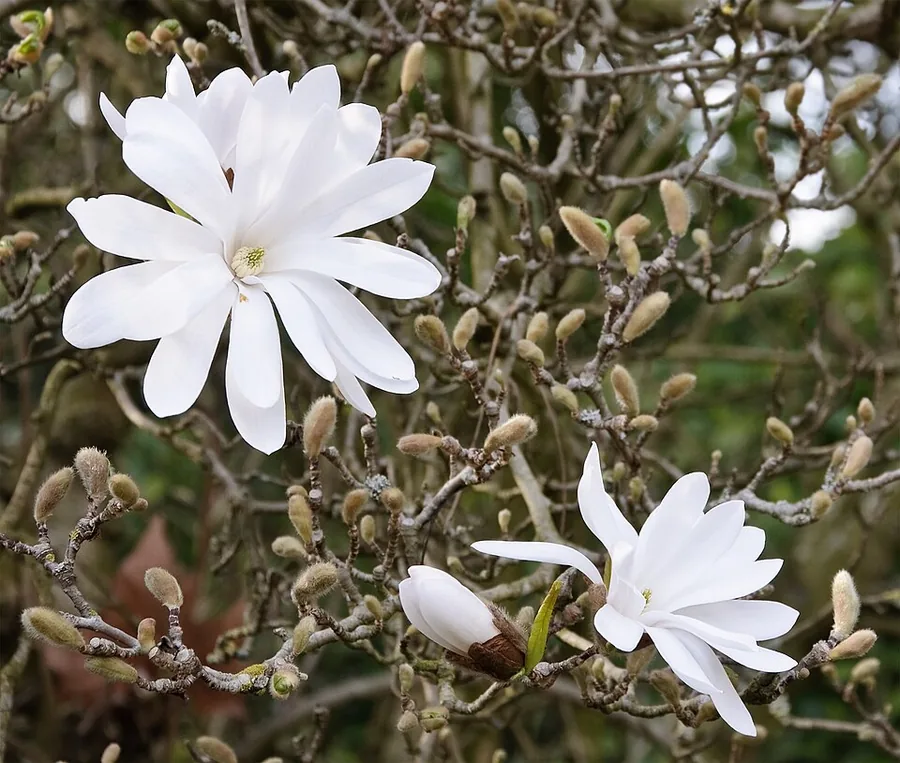
Star magnolia is a small, slow-growing tree that earns its place by blooming earlier than almost anything else in the yard. Often in March, before a single leaf appears, the bare branches fill with star-shaped white flowers carried on a compact, rounded frame. It grows hardy across zones 4 to 8, which suits gardens through much of the country.
What sets it apart is the shape of the flower. Each bloom spreads many narrow, strap-like tepals into a soft star, and on some forms they carry a sweet scent. Years pass slowly with this plant, since it grows at a deliberate pace and rarely needs much from you once it settles in.
The early flowers are the catch as much as the charm. Opening so soon means a late frost can brown them overnight, so the smartest move is to plant it where it has shelter from cold wind and morning sun on frozen blooms. Get the spot right and it rewards you for decades.
Care
The short version: full sun to part shade in moist, acidic, well-drained soil, with steady moisture through summer and a sheltered spot that protects the very early flowers from late frost.
Light
Star magnolia flowers best in full sun but takes partial shade without complaint. More sun means more blooms, while a little shade can shelter the early flowers, so the right balance depends on how frost-prone your spot is.
Water
Keep the soil evenly moist, especially through summer, since this tree dislikes both bone-dry and waterlogged ground. Water deeply while it's getting established and during droughts, roughly every 5 to 10 days depending on heat and rain.
Soil
Plant it in moist, organically rich, well-drained loam that runs acidic to neutral, ideally a pH of 6.0 to 7.0. It tolerates clay, but alkaline soil locks up iron and turns the leaves yellow, so lean acidic if you can.
Temperature
This is a cold-hardy tree, comfortable from about -29°F to 100°F (-34°C to 38°C) across zones 4 to 8. The flowers are the tender part, not the wood, so the real risk is a spring frost catching the early blooms rather than winter cold harming the tree.
Humidity
Ordinary outdoor air suits it, so there's no humidity target to hit. Average conditions are plenty, and the plant won't ask for misting or any extra moisture in the air.
Feeding
Feed in early spring with a balanced or acid-forming slow-release fertilizer. A tree growing in rich soil rarely needs much, so go light rather than heavy.
Pruning
Most years it needs no pruning at all. If you're shaping it or training it to a single trunk, cut right after flowering, since pruning later strips off the buds set for next spring.
Repotting
This tree is grown in the ground and rarely needs repotting. Watch a containerized young plant for roots circling the pot, water running straight through, or stalled growth, all signs it's ready to move into the garden.
Size & spacing
Expect a mature spread of 10 to 15 feet (3 to 4.5 m) and a height of 15 to 20 feet (4.5 to 6 m). Give it room to reach that full width without crowding a wall or path.
When to plant
Star magnolia runs on an early clock. It flowers in early spring, often March, before the leaves come out, which makes it one of the first magnolias to bloom. Plant it in early spring or fall, and give it a sheltered site so a late freeze doesn't catch the open flowers.
Northern hemisphere
Southern hemisphere
Typical months for a temperate climate: start earlier in warm zones, later where spring frosts linger.
- Plant: Early spring or fall; in the north move balled-and-burlapped plants while actively growing, in warmer zones plant from containers in late winter while dormant.
- Harvest: Early spring (often March), before the leaves emerge; one of the earliest magnolias to flower.
Hardiness
USDA hardiness zones: 4–8
Temperature: down to -34°C
Troubleshooting
Star magnolia has few real troubles, and the ones it does have are easy to read. Frost on the early flowers, sticky scale on the twigs, and yellowing leaves in the wrong soil cover nearly all of it. Match what you see below, then act while it still helps.
Sticky shiny leaves, a black coating, and brown bumps on the twigs
The brown, bud-like bumps on the twigs are magnolia scale, insects that suck sap and drip sticky honeydew. That honeydew then feeds the black sooty mold you see filming the leaves and anything below them. Prune out and destroy the worst-infested twigs, spray horticultural oil to smother the overwintering scale and crawlers at the timing on the label, then wash the sooty mold off once the insects are under control.
Fix:
- Prune out and destroy heavily infested twigs
- Apply horticultural oil to smother overwintering scale and crawlers per label timing
- Wash off sooty mold from foliage once scale is controlled
Leaves yellowing between the veins while the veins stay green
That pattern is iron chlorosis, and it usually means the soil is too alkaline for the plant to take up iron, with poor drainage making it worse. It shows up first and hardest on the newest leaves. Test the soil pH and shift it toward acidic with elemental sulfur or an acidifying fertilizer, use chelated iron for a quick fix, and improve drainage with mulch to keep the roots cool and evenly moist.
Fix:
- Test soil pH and amend toward acidic with elemental sulfur or acidifying fertilizer
- Apply chelated iron for a temporary correction
- Improve drainage and mulch to keep roots cool and evenly moist
Flowers browning and going mushy soon after they open
This is frost damage, the most common letdown with star magnolia. Because it blooms so early, a late freeze or cold wind can scorch the open tepals overnight, often sparing the flowers on sheltered sides of the plant. The blooms cannot be saved, but the damage is skin deep and the tree leafs out fine, so cover small plants with frost cloth when a freeze is forecast and consider a later-blooming cultivar like Royal Star in frost-prone spots.
Fix:
- Damaged flowers cannot be revived; remove spent blooms for appearance only
- Cover small plants with frost cloth when a late freeze is forecast during bloom
- Wait for the plant to leaf out normally, as frost damage to flowers does not harm overall health
Toxicity
Good news for pet owners and parents: star magnolia is safe. The ASPCA lists it as non-toxic to cats, dogs, and horses, and there are no poisonous compounds in any part of the plant. The most that can happen is a mild stomach upset if an animal eats a large amount of leaves, the same as with most ornamental plants.
Safe for
People · Cats · Dogs · Horses · Rabbits · Livestock · Birds
Cats None
Safe to share a home with a cat. The ASPCA lists star magnolia as non-toxic, so a curious nibble brings no poisoning risk, though a big mouthful of any plant can leave a cat briefly queasy.
Dogs None
No worry for dogs. There are no toxic compounds in the leaves, flowers, or bark, and the worst a determined chewer faces is a passing upset stomach from the roughage.
Horses None
Horses can graze nearby without harm, since the ASPCA rates the plant non-toxic to them. Only an unusually large amount of foliage might cause mild digestive grumbling.
Rabbits Safe
Fine to grow where rabbits roam. Nothing in the plant is poisonous, though rich, woody leaves are best given in small amounts so they don't unsettle a sensitive gut.
Livestock Safe
Cattle, goats, and sheep can browse it without danger. The plant carries no toxic principles, so a stray taste is nothing to fear.
Birds Safe
Harmless to backyard and pet birds alike. There is no toxin in any part, and many birds happily shelter in the branches.
People Safe
No hazard to adults or children. The plant is not poisonous, but the flowers and leaves aren't food, so there's no reason to eat them.
No special handling precautions for toxicity; as with any plant, ingestion of large amounts of plant material may cause mild stomach upset.
Varieties
A few named selections improve on the species, mostly for bigger flowers, a touch of pink, or later bloom that dodges frost. These are the ones worth knowing.
Royal Star
A popular pick with larger, showier double white flowers that open about two weeks later than the species, which keeps the blooms safer from late frost.
Centennial
A vigorous selection carrying large white flowers faintly tinged with pink, and it grows bigger than the typical species.
Rosea
A pink form whose buds open rosy and fade toward white as the flowers age.
Waterlily
Its pink buds open into many-tepaled, deeply fragrant flowers that look like a waterlily, on a plant that blooms a touch later than most.
How to propagate
Star magnolia can be increased a few ways, though none of them are quick. Pick your method based on whether you want an exact copy of a cultivar or don't mind some patience and surprise.
Stem cuttingsModerate
Early to mid summer · Several weeks to root, then grow on for one to two seasons before planting out
Take softwood cuttings in early to mid summer, the most reliable way to copy a named cultivar. Rooting is slow and goes better with rooting hormone and steady humidity, taking several weeks before roots form. Grow the young plant on for one to two seasons before you set it out.
SeedDemanding
Fall sowing after cleaning seed · Slow; germination and growth to flowering size take several years
Growing from seed asks for patience. Clean the pulp off the seeds, sow in fall, and give them cold stratification to break dormancy. Germination is slow and the seedlings won't match the parent, and it takes several years to reach flowering size.
LayeringModerate
Spring · One or more growing seasons to root before separating
Layering is the simplest route for a home gardener. In spring, pin a low branch down into the soil and let it root over one or more growing seasons before you sever it from the parent.
Myths
Star magnolia is poisonous to pets and should be kept away from cats and dogs.
The ASPCA lists Magnolia stellata as non-toxic to dogs, cats, and horses, so it poses no poisoning risk. As with any plant, a pet that eats a large amount of leaves might get a mildly upset stomach, but the tree itself is safe to grow around animals.
You can prune a star magnolia anytime to keep it tidy.
Cutting at the wrong time strips off the flower buds the plant already set for next spring. Prune right after flowering if you must, though this tree generally needs very little pruning at all.