Tree · Magnoliaceae
Saucer Magnolia
Magnolia × soulangeana
Plant it where late frost can't reach the buds, and a saucer magnolia opens goblet-shaped pink blooms before a single leaf shows.
Full sun
Every 5–10 days
USDA 4–9
20–30 ft · 6.1–9.1 m
Overview
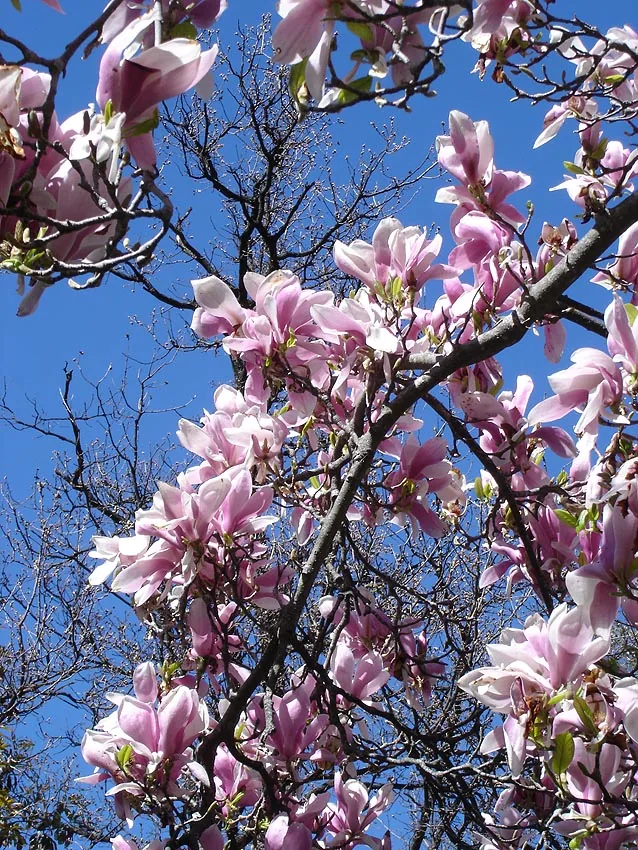
The saucer magnolia is one of the first big shows of spring. It opens wide, goblet-shaped flowers in shades of pink, purple, and white on bare branches, weeks before the leaves arrive. The result is a small tree that looks like it's been hung with cups of color, and it's earned a spot in gardens across temperate climates because of it.
It's a hybrid, a cross of two Asian magnolias, and it grows as a multi-stemmed tree or large shrub. Expect it to reach 20 to 30 feet (6.1 to 9.1 m) tall over time at a moderate pace, with a broad, rounded crown that often spreads as wide as the tree is high. That scale makes it a specimen plant, the kind you give room to and build a corner of the garden around.
The one real catch is timing. Those early flowers open so soon that a late frost can brown them in a single cold night, which is why where you plant it matters as much as how you care for it. Get the site right and it's an easy, long-lived tree that asks for little once established.
Care
The short version: full sun to light shade, moist and acidic well-drained soil, steady water, and a sheltered spot that keeps late frost off the early blooms. Prune only lightly, right after it flowers.
Light
Give it full sun for the best flowering, though it takes partial shade and partial sun without much complaint. The more direct light it gets, the heavier the bloom and the fuller the crown.
Water
Keep the soil evenly moist year-round, since this tree dislikes both drought and waterlogging. Water deeply while it's getting established and through any dry spell, roughly every 5 to 10 days depending on weather and soil.
Soil
It wants moist, acidic, organically rich loam that still drains freely. Aim for a pH between 5.0 and 6.5 and work in plenty of organic matter; alkaline or compacted ground will hold it back.
Temperature
The tree is hardy across a wide range, shrugging off winter cold down to about -29°F (-34°C) and summer heat up to 100°F (38°C). The real weak point isn't the tree but its early flowers, which a late frost can ruin.
Humidity
Ordinary outdoor humidity suits it fine, so there's no figure to aim for. Steady soil moisture matters far more than the air around it.
Feeding
Feed in early spring with a balanced slow-release fertilizer or a layer of compost, once a season. Skip heavy feeding late in the year, since fresh tender growth won't harden off before cold weather.
Pruning
Prune as little as you can, and only right after flowering, to take out dead, damaged, or crossing branches. Magnolias bloom on old wood and resent hard cutting, so heavy pruning trades away next spring's flowers.
Repotting
This is a landscape tree that's rarely grown in a container, so repotting almost never comes up. If one is potted and the roots start circling the surface, growth stalls, or water runs straight through, it's time to move up a size.
Size & spacing
Plan for a mature tree of 20 to 30 feet (6 to 9 m) tall with a broad crown spreading 15 to 25 feet (4.5 to 7.5 m) wide. Give it that full width of open ground from buildings and other trees so the rounded shape can develop.
When to plant
Saucer magnolia runs on an early-spring clock. It blooms in late March to mid-April, before the leaves break, which is exactly why a sheltered site matters so much. Plant it in spring or fall while it's dormant, well ahead of summer heat, so the roots can settle in.
Northern hemisphere
Southern hemisphere
Typical months for a temperate climate: start earlier in warm zones, later where spring frosts linger.
- Plant: Spring or fall while dormant or before heat of summer
- Harvest: Early spring (late March to mid-April), before the leaves emerge
Hardiness
USDA hardiness zones: 4–9
Temperature: down to -34°C
Troubleshooting
A healthy saucer magnolia stays mostly trouble-free, and what does go wrong tends to be cosmetic. The flowers are the most vulnerable part, then the twigs and leaves. Match what you're seeing below and you'll know whether to act or just wait it out.
Waxy white bumps on the twigs with sticky black film
These soft white mounds are magnolia scale, one of the largest scale insects you'll meet, feeding on the twigs. The sticky honeydew they leave behind grows black sooty mold and draws in wasps and ants. Prune out the worst twigs, hit overwintering nymphs with dormant oil in late fall or early spring, and time crawler sprays for late summer when the young scales are on the move.
Fix:
- Prune out and destroy heavily infested twigs
- Treat overwintering nymphs with dormant horticultural oil in late fall or early spring
- Time crawler-stage treatments to late summer when young scales are active
Open blooms turn brown and mushy overnight
This is almost always late-spring frost catching the early, pre-leaf flowers, not a disease. A warm site against a south-facing wall makes it worse by coaxing the buds open even sooner. The frosted blooms are done, but the tree is fine and will leaf out as normal, so leave the live wood alone and just tidy the spent flowers if you want.
Fix:
- Accept that frosted blooms cannot be revived; remove spent flowers for appearance only
- Do not prune live wood in response, as the tree itself is unharmed and will leaf out normally
Spots on the leaves or sunken patches on the stems
Most spotting and blotching is fungal or bacterial leaf spot, while sunken, discolored lesions on the wood point to canker that tends to strike trees already under stress. Neither is usually serious on a healthy magnolia. Rake up and bin the fallen infected leaves, cut out cankered wood with clean tools, and give the canopy room to breathe.
Fix:
- Rake and dispose of fallen infected leaves
- Prune out cankered or dead wood with sanitized tools
- Improve air circulation and avoid overhead wetting of foliage
Toxicity
Good news for pet owners and parents: the saucer magnolia is safe. The ASPCA lists magnolia as non-toxic to cats, dogs, and horses, and it poses no poisoning risk to other animals or people either. The worst a big mouthful of leaves might do is a brief, mild stomach upset, the same as with most plants.
Safe for
People · Cats · Dogs · Horses · Rabbits · Livestock · Birds
Cats None
Safe to have around cats. A curious nibble on a leaf or fallen petal causes no poisoning, though a big mouthful of any plant can leave a cat briefly queasy.
Dogs None
No toxic compounds here, so a dog that chews a low branch or picks up a dropped bloom is in no danger. The most you might see from a real binge is some passing stomach upset.
Horses None
The ASPCA lists magnolia as safe for horses. A horse browsing the foliage faces no poisoning risk.
Rabbits Safe
Rabbits can graze the leaves without harm. As with any new green, introduce it gradually so their gut has time to adjust.
Livestock Safe
Cattle, goats, and sheep can browse a saucer magnolia with nothing to fear. There's no toxin in the leaves, bark, or flowers.
Birds Safe
Birds that pick at the buds, flowers, or seeds come to no harm from this tree.
People Safe
Nothing on this tree is poisonous to people. The flowers are even used in some kitchens, though there's no need to keep children away from it.
No special handling precautions needed; as with any plant, ingestion of large amounts of foliage may cause mild, transient stomach upset.
Varieties
Most saucer magnolias sold are named cultivars chosen for flower color, size, or bloom timing. A handful turn up again and again, and these are the ones worth knowing.
Alexandrina
A vigorous, widely planted favorite that carries large flowers, deep rose-purple outside and white within.
Lennei
Its big goblet-shaped blooms are dark rose-purple outside and white inside, and they often open a little later, which dodges some of the frost risk.
Brozzonii
One of the largest-flowered forms you can grow, with huge white blooms flushed light purple at the base.
Rustica Rubra
A strong grower hung with rosy-red to reddish-purple cup-shaped flowers.
How to propagate
Because the saucer magnolia is a hybrid, seed won't give you a copy of the parent. Every reliable method clones the plant instead, and they range from easy to expert.
GraftingDemanding
Late winter to early spring for bench grafting onto seedling rootstock · 1 to 2 growing seasons
Named hybrids have to be propagated vegetatively to come true, so seed won't reproduce a cultivar reliably. Bench grafting onto seedling rootstock in late winter to early spring is the usual commercial route, and the young tree takes a season or two to settle in.
LayeringModerate
Spring, on low flexible branches · 1 to 2 years to root before separating
For a home gardener this is the most forgiving option. Pin a low, flexible branch down in spring, or air-layer one higher up, and it copies the parent cultivar exactly. Give it 1 to 2 years to root well before you cut it free.
Stem cuttingsDemanding
Early summer using softwood to semi-hardwood cuttings · Several weeks to root, then a season to establish
Take softwood to semi-hardwood cuttings in early summer, but expect slow, hit-or-miss results. Rooting hormone and a mist bench tip the odds in your favor. Cuttings root over several weeks and then need a full season to establish.
Myths
Saucer magnolia is poisonous to cats and dogs and should be kept away from pets.
The ASPCA lists magnolia as non-toxic to dogs, cats, and horses, so it isn't a poison hazard at all. A pet that nibbles a leaf or petal is safe, and the tree needs no special fencing or precautions.
Frosted, browned blooms mean the magnolia tree is dying and needs heavy pruning.
A late frost only burns the open early flowers, not the tree itself. The wood is unharmed and leafs out on schedule, so cutting it back hard does nothing but cost you next year's blooms, since magnolias flower on old wood.