Houseplant · Cactaceae
Star Cactus
Astrophytum asterias
Give it bright light, gritty soil, and a long dry spell between waterings, and this little spineless star asks for almost nothing else.
Bright indirect
Every 14–21 days
USDA 9–11
1–2 in · 3–6 cm
Overview
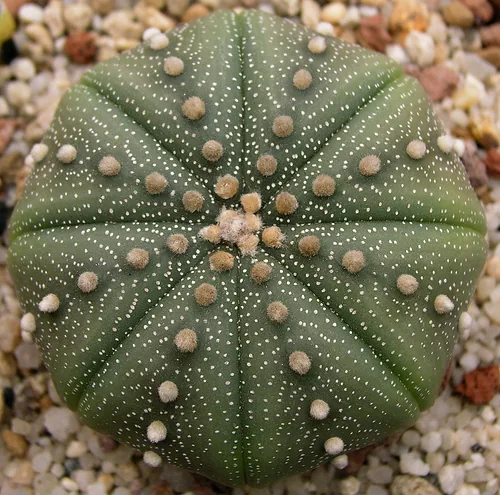
The star cactus is a small desert gem, a spineless, ribbed dome that looks like a sand dollar pressed into the ground. It comes from a narrow stretch of south Texas and northern Mexico, where it sits flat among the rocks, and it grows so slowly that a plant the size of a coin can be years old. The pale woolly flecks scattered across its green body give it the soft, starry look that earns it its name.
It belongs to the cactus family but breaks the usual mold by carrying no spines at all. That makes it easy to handle, though it is also what fuels a long-running mix-up with peyote, a resemblance that has driven heavy illegal collection in the wild. In late spring it opens yellow flowers with red throats that sit right on top of the body.
This is a plant that wants very little, just not the wrong kind of care. It is one of the most protected cacti on the planet, endangered in the wild and tightly controlled in trade, so any plant you grow should come from a nursery. Get the soil and the watering right and the rest looks after itself.
Care
The short version: give it bright light and a sharply draining, gritty mix, then water deeply only after the soil has dried out completely and back off almost entirely through winter.
Light
Give it bright light above all. It does best in bright, indirect light and will take some direct sun, but move it into strong sun slowly, since a plant used to shade can scorch if you push it straight into a hot window.
Water
This is where most star cacti are lost. Water deeply only once the gritty mix has dried out completely, which works out to roughly every 14 to 21 days in the spring and summer growing season. Through winter, keep it nearly dry, because the fleshy body rots fast if it sits wet in the cold.
Soil
Plant it in a fast-draining mineral mix, the sandy or gravelly kind with very little organic matter. A neutral pH of 6.5 to 7.5 suits it, and the grit is what lets water rush through before it can rot the roots.
Temperature
It is comfortable across a wide range, from about 23°F to 95°F (-5°C to 35°C), though the low end assumes a plant kept bone dry. Warmth drives its growth, while cold and damp together are what do real damage.
Humidity
Keep the air on the dry side, around 20% to 40%. This is a desert plant, so still, humid air invites the rot and fungus it has no defense against.
Feeding
Feed lightly and only while it is growing in spring and summer. A dilute, low-nitrogen cactus fertilizer once a month is plenty, since too much nitrogen pushes soft growth that splits and rots.
Pruning
There is nothing to prune on a star cactus. With a sterile blade you only ever need to clear away spent flowers or rotted tissue, never to shape it.
Repotting
Repot every 2 to 3 years, or sooner if roots push out the drainage holes or the body fills the pot. Move it into fresh gritty mix, and wait a few days before watering so any disturbed roots can heal.
Size & spacing
This is a tiny plant. It tops out at just 1 to 2 inches (3 to 6 cm) tall and spreads to about 2 to 6 inches (5 to 15 cm) across, growing so slowly that it can sit happily in a small pot for years.
Troubleshooting
Almost every problem a star cactus runs into comes back to water, and it shows up on the body itself. Learn to read whether the flesh is soft, shriveled, or studded with cottony pests, and you can act before a small slip turns fatal. Match what you see below and treat it quickly.
Soft, dark mushy patches on the body or near the base
This is rot, and with a star cactus it nearly always traces back to too much water or a mix that holds it. The trouble usually starts right at the soil line, where damp sits against the fleshy body. Stop watering at once, cut back to firm green tissue with a sterile blade, let the wound callus in dry shade, and repot into fresh gritty mineral mix.
Fix:
- Stop watering immediately
- Cut away all rotted tissue with a sterile blade until only firm green tissue remains
- Let the cut surfaces callus in dry, airy shade
- Repot into fresh fast-draining mineral mix and water only sparingly once healed
A wrinkled, shrunken or soft, sagging body
A shriveled body points one of two ways. If the soil is bone dry and the roots are sound, the plant is simply thirsty and a thorough soak brings it back. If the soil is still moist, suspect lost or rotted roots and treat it the same way you would treat rot, cutting back to healthy tissue and re-rooting in dry mineral mix.
Fix:
- If dehydrated, give a thorough soak and resume regular dry-down watering
- If roots are rotted, treat as rot: cut back to healthy tissue, callus, and re-root in dry mineral mix
White cottony tufts in the areoles with weak, off-colour growth
Those cottony masses are mealybugs, and they hide in the woolly areoles where they are easy to miss. Probe one: the pest smears, while the plant's own white wool and flecks do not. Isolate the cactus, dab each insect with a swab of 70 percent isopropyl alcohol, then repeat weekly and check the roots, since root mealybugs hide below the soil too.
Fix:
- Isolate the plant
- Dab visible insects with a cotton swab dipped in 70 percent isopropyl alcohol
- Repeat weekly and inspect the roots, drenching with an appropriate insecticide if root mealybugs are present
Toxicity
Good news on this one: the star cactus is safe around pets and people. It carries no toxin, and despite the peyote nickname it holds no mescaline. It is also spineless, so it won't even prick a curious nose, though it isn't a plant meant for eating.
Safe for
People · Cats · Dogs · Horses · Rabbits · Livestock · Birds
Cats None
Safe to share a room with. A curious cat that nibbles the body might drool or bring up a little, but only because any plant matter can unsettle a stomach, not from any toxin.
Dogs None
No poisoning risk here. A dog that chews a piece may have a brief upset stomach from the fibrous tissue, and being spineless the cactus won't prick its mouth either.
Horses Safe
Nothing in this cactus is poisonous to horses, so there's no cause for worry around it.
Rabbits Safe
Harmless to rabbits. It carries no toxin, though it isn't a food plant and shouldn't make up part of their diet.
Livestock Safe
Cattle, goats, and sheep can graze near it without poisoning, since the plant holds no harmful compounds.
Birds Safe
No toxic threat to birds. A pet bird that pecks at the flesh comes to no chemical harm.
People Safe
Safe to handle and keep around children. It holds no mescaline despite the peyote mix-up, but it isn't grown for eating, so there's no reason to taste it.
Though spineless, handle this rare protected plant minimally and wash hands after contact with any houseplant; keep out of reach of pets or children inclined to chew it.
Varieties
A few named forms turn up among collectors, mostly chosen for how their white flecks and wool play across the body. These are the ones worth knowing.
'Super Kabuto'
A selected cultivar so thickly dusted with large white woolly flecks that they can almost hide the green body beneath.
var. nudum
A naturally fleckless form that shows a smooth, plain green body, and Kew recognizes it as a distinct variety.
'Ooibo Kabuto'
Known for the unusually large, raised wool spots that sit on its areoles.
How to propagate
There are two practical ways to make more star cactus, and neither is quick. One keeps the plant true from seed, the other speeds things up by grafting onto a stronger root.
SeedDemanding
Spring, in warmth · Several months to germinate and establish; years to reach flowering size
Seed is the main route and the one that keeps the most genetic variety. Sow fresh seed in spring on a sterile gritty mix and hold it warm and humid until it sprouts. The seedlings are slow and prone to rot, so harden them off gradually, and be patient: it takes several months to establish and years more to reach flowering size.
GraftingModerate
Spring-summer, during active growth · A few weeks for the graft union to take
Growers often graft star cactus onto a vigorous rootstock to push faster growth and sidestep the rot that kills so many seedlings, especially with prized cultivars. Done in spring or summer while the plant is in active growth, the union knits together in a few weeks.
Myths
Star cactus is peyote and contains mescaline.
People mix it up with peyote so often that one of its nicknames is star peyote, but the two are different plants and this one holds no mescaline at all. The confusion only fuels illegal collection of a species that is already endangered.
Being spineless, it is tough and can be watered like a leafy houseplant.
The smooth body has nothing to do with how thirsty the plant is. Its fleshy tissue rots fast under frequent watering and needs the same dry-down and gritty soil as any other desert cactus.
You can legally dig up or buy wild star cactus.
It is federally endangered and listed on CITES Appendix I, so taking plants from the wild or trading wild-sourced specimens breaks the law. Only nursery-propagated plants are lawful to own.