Houseplant · Cactaceae
Easter Cactus
Rhipsalidopsis gaertneri
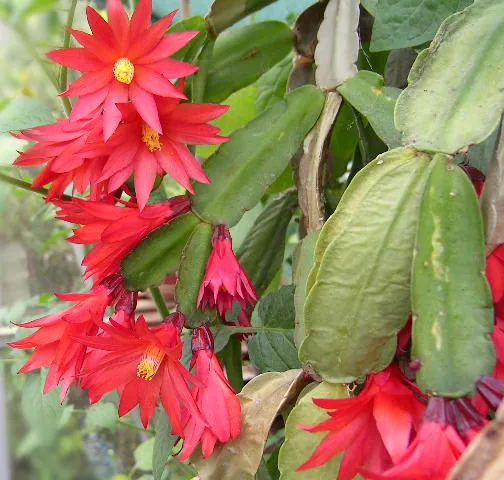
Give it a cool winter rest and a spot it can settle into, and the Easter cactus answers with scarlet, star-shaped spring blooms.
Bright indirect
Every 7–14 days
50–77°F · 10–25°C
USDA 10–12
Overview
The Easter cactus earns its name by flowering in spring, right around the holiday, in scarlet stars that open along the tips of its flat, jointed segments. It belongs to the cactus family, but it grows wild as a forest epiphyte, perched on tree branches in the Brazilian rainforest rather than baking in desert sand. That history shapes everything about how you grow it: it wants shade, steady moisture, and humidity, not the dry heat people expect from a cactus.
It is easy to mix up with its cousins, the Thanksgiving and Christmas cacti, but the Easter cactus stands apart. Its segment edges are rounded and scalloped instead of clawed, and it blooms in spring rather than the depths of winter. It is also the slower, more particular grower of the group, which is part of why a plant in full flower feels like a real reward.
The one thing it asks for is a cool, short-day rest through late autumn and winter, with less water and lower temperatures. That quiet spell is what triggers the buds. Skip it, or move the plant around once buds appear, and you trade flowers for a pile of dropped buds.
Care
The short version: bright indirect light, never direct sun, with the top few cm of mix allowed to dry between waterings. Give it a cool, drier rest from autumn through winter to set buds, and once buds form, leave the plant where it stands.
Light
Give it bright, indirect light and keep it out of direct sun, which scorches and reddens the segments. It will get by in medium light or light shade, but the brightest spot short of a sunbeam brings the best flowering.
Water
Let the top few cm of mix dry before you water again, then water thoroughly and let it drain, roughly every 7 to 14 days. This is a forest cactus, not a desert one, so never let it bake bone dry, but soggy soil rots the roots fast. Cut back through the autumn-to-winter rest, and once buds set, keep watering steady, because a sudden change makes the buds drop.
Soil
Plant it in a well-drained, organic-rich potting mix that holds some moisture without staying wet; a blend made for cactus or epiphytes works well. It prefers slightly acidic soil, around a pH of 5.5 to 6.5.
Temperature
Ordinary room warmth of 50°F to 77°F (10°C to 25°C) suits it through the year. The cool end of that range in autumn and winter, paired with shorter days, is what coaxes the buds into forming.
Humidity
Average household humidity is fine, with no number to chase. Coming from the rainforest, it appreciates a bit of extra moisture in the air, so a grouping of plants or a nearby pebble tray helps in dry winter rooms.
Feeding
Feed with a balanced, diluted liquid houseplant fertilizer about once a month, starting after the plant finishes flowering and running through the summer growth. Stop feeding in autumn so the plant can settle into its rest.
Pruning
After the blooms fade, twist or pinch off a few of the terminal segments to push the plant into branching and filling out. Those removed pieces aren't waste; root them as cuttings for new plants.
Repotting
Repot only every 3 to 4 years, after flowering, and only when the plant is truly crowded, since it blooms best a little pot-bound. Roots poking from the drainage holes, mix that dries out fast, and stalled growth all signal it's time.
Size & spacing
It stays compact, reaching about 6 to 12 inches (15 to 30 cm) tall and spreading 12 to 16 inches (30 to 40 cm) wide, often arching as the segments lengthen. That trailing habit makes it a natural fit for a hanging pot or a shelf edge.
Troubleshooting
Most Easter cactus trouble traces back to two things: watering that swings too wet or too dry, and the plant being disturbed while it's in bud. Read the early signs below and you can usually fix the cause before the plant sheds its flowers or its roots give out.
Segments going limp, soft, or red at the base
Soft, reddish segments usually mean root rot from soil kept too wet, though the same wilting can come from letting the mix bake bone dry. Tug a segment and check the roots: mushy brown means rot, firm and white in dust-dry mix means drought. For rot, cut away the dead roots and repot into fresh, fast-draining mix; for drought, water well and let it drain.
Fix:
- If rotted, unpot, cut away mushy roots, repot into fresh well-drained mix, and water sparingly
- If drought-stressed, water thoroughly and let excess drain
- Salvage healthy segments as cuttings if the base is lost
Flower buds drop before they open
Bud drop is the classic Easter cactus complaint, and it comes from change rather than neglect. Once buds form, the plant resents being moved, turned, drafted, or watered on a new schedule, and it answers by shedding the buds. Pick a stable spot, keep the top few cm just moist, and leave the plant alone until it blooms.
Fix:
- Leave the plant in one spot once buds appear and avoid turning it
- Keep watering even and the top few cm just moist while budded
- Shield from heat vents, cold drafts, and doorways
White cottony tufts or sticky film on the joints
Those cottony specks at the segment joints are mealybugs, and small bumps with a sticky honeydew film point to scale. Both spread fast indoors, so isolate the plant the moment you spot them. Wipe the pests off with a cotton swab dipped in 70 percent alcohol, then follow up with insecticidal soap until they are gone.
Fix:
- Dab pests with a cotton swab dipped in 70 percent isopropyl alcohol
- Treat with insecticidal soap, repeating per label
- Isolate the plant until clear
Toxicity
Good news for a home with pets: the Easter cactus is not toxic. The ASPCA lists the whole holiday cactus group as safe for cats and dogs, and nothing in the plant poisons people, horses, or other animals. A pet that gobbles a large mouthful of the fibrous segments might be briefly sick to its stomach, but that's the extent of it.
Safe for
People · Cats · Dogs · Horses · Rabbits · Livestock · Birds
Cats Safe
The ASPCA lists the holiday cactus group as non-toxic to cats, so a nibble won't poison one. A cat that eats a big mouthful of the fibrous stems might drool or be briefly sick to its stomach, and that's all.
Dogs Safe
Dogs face no real danger from this plant. If one chews off and swallows a large piece, the rough plant tissue can bring on some short-lived vomiting, which passes on its own.
Horses Safe
Nothing in the plant is poisonous to horses, though as a small indoor cactus it rarely crosses their path anyway.
Rabbits Safe
Safe around rabbits. The fleshy segments hold no toxin, so a curious nibble does no harm.
Livestock Safe
No toxic compounds here, so grazing animals are in no danger from it.
Birds Safe
Pet birds can perch and peck near it without worry, since the segments carry nothing harmful.
People Safe
Harmless to people, including children. It isn't grown to be eaten, but a tasted segment poses no poisoning risk.
Fibrous plant material can still cause mild stomach upset or vomiting if a pet eats a large amount.
Varieties
Most plants sold as Easter cactus trace back to two species and the hybrids between them. These are the names worth knowing.
Rhipsalidopsis gaertneri (type)
The original species carries scarlet, star-shaped spring flowers on flat segments edged with rounded, scalloped, faintly bristled teeth.
Rhipsalidopsis rosea and its hybrids
This smaller pink-flowered species crosses readily with R. gaertneri to give the pink, salmon, and white-flowered Easter cactus cultivars sold today.
How to propagate
The Easter cactus is simple to copy from its own segments, so one plant can become many with a little patience while the cuttings root.
Stem cuttingsEasy
After flowering in late spring or early summer · Roots in about 2 to 4 weeks; flowering-size plant in 1 to 2 years
Take cuttings right after flowering, in late spring or early summer. Twist off a piece of 2 to 3 jointed segments, let the cut end callus over for a day or two, then stand it in barely moist, well-drained mix in bright indirect light. Roots form in 2 to 4 weeks, though a young plant takes a year or two of patience before it blooms.
Myths
Easter, Thanksgiving, and Christmas cactus are all the same plant sold at different times.
They are three different plants. Easter cactus blooms in spring and has rounded, scalloped segment edges with star-shaped flowers, while the Thanksgiving and Christmas cacti are Schlumbergera that bloom in late autumn and winter on segments with pointed or toothed edges. The Easter cactus is also the fussier, slower grower of the bunch.
Holiday cacti are poisonous to pets.
The ASPCA lists holiday cactus as non-toxic to cats and dogs. The worst a pet faces is a brief upset stomach from the fibrous tissue, not actual poisoning.
The Easter cactus has always had one settled scientific name.
Its classification has bounced around for years, landing in Rhipsalidopsis, Hatiora, and Schlumbergera in turn. That is why you'll see it sold under all three names, gaertneri tagged onto each.