Houseplant · Cactaceae
Moon Cactus
Gymnocalycium mihanovichii
Two cacti grafted into one, the moon cactus trades a brilliant chlorophyll-free cap for a life that leans entirely on the green stem below.
Bright indirect
Every 14–21 days
59–86°F · 15–30°C
USDA 10–11
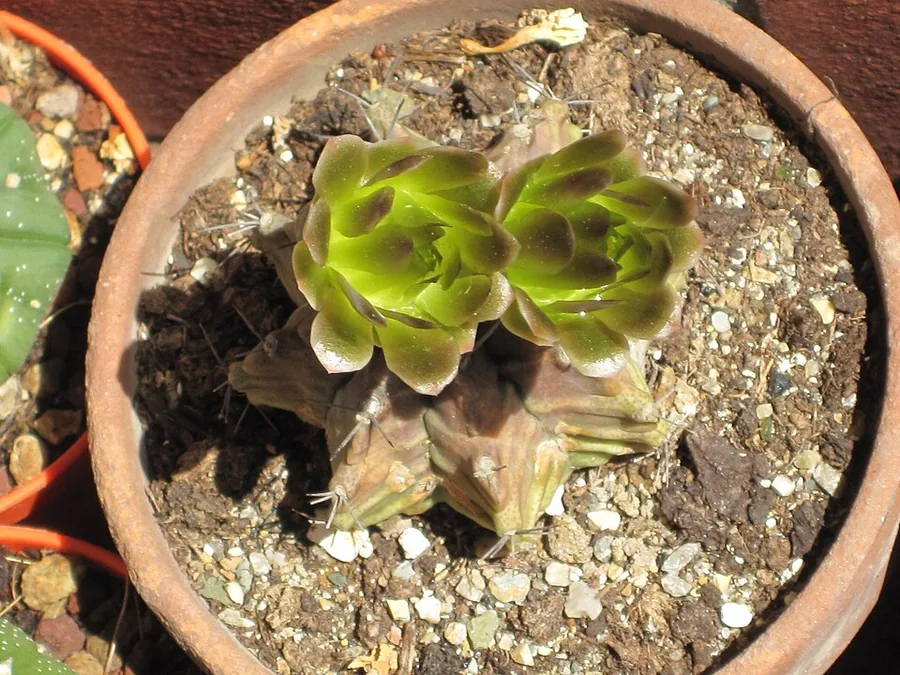
Overview
The moon cactus is a striking houseplant built from two different cacti grown as one. The bright red, yellow, pink, or orange ball on top is a Gymnocalycium that lacks chlorophyll, so it can't feed itself. To survive, that colored cap is grafted onto a green columnar rootstock, usually a Hylocereus, which does the work of turning light into food for both.
Because the cap has no green tissue, it cannot live on its own roots, and that single fact shapes everything about the plant. It stays small, between 4 and 12 inches (10 to 30 cm) tall, and grows slowly. The graft union also tends to weaken over a few years, so a moon cactus is often a short-lived novelty rather than a plant you keep for decades.
Care comes down to bright filtered light and a very dry root zone. Too much harsh sun bleaches the colorful top, and too much water rots either half of the graft. Get those two right and the plant asks for almost nothing else.
Care
The short version: bright indirect light, a gritty fast-draining mix, and water only when the soil is fully dry, since both the colored cap and the green rootstock rot the moment they sit wet.
Light
Give the moon cactus bright but indirect light, like a spot near a window that stays out of the hottest midday sun. The colored cap carries no chlorophyll to protect itself, so harsh direct sun scorches and bleaches it fast.
Water
Water only when the mix has dried out completely, which usually falls every 14 to 21 days and stretches longer in winter. Never let the pot sit wet, since both the cap and the rootstock rot quickly. When in doubt, wait.
Soil
Plant it in a gritty, sharply drained cactus mix that lets water rush straight through. A pH between 6.0 and 7.0 suits it, and a pot with a drainage hole is not optional for a plant this rot-prone.
Temperature
Ordinary room warmth works well, anywhere from 59°F to 86°F (15°C to 30°C). Keep it away from cold drafts and frost, which this tropical graft won't survive.
Humidity
Low household humidity is exactly right, so there's no number to chase. Dry air actually helps here by keeping the cap and rootstock from staying damp.
Feeding
Feed only during the spring and summer growing season, about once a month, with a diluted balanced or low-nitrogen cactus fertilizer. Skip feeding entirely through the dormant cooler months.
Pruning
There's little to prune. Remove any pups or offsets that sprout on the rootstock so its energy stays with the colored cap, and trim away any shriveled or rotted tissue with a clean blade.
Repotting
Repot every 2 to 3 years into a slightly larger pot with fresh gritty mix. Signs it's ready include roots poking from the drainage holes, soil that dries unusually fast, or a plant that has grown loose and top-heavy.
Size & spacing
This is a small, slow plant that tops out at 4 to 12 inches (10 to 30 cm) tall and just 2 to 4 inches (5 to 10 cm) across. A single small pot on a bright sill is all the room it needs.
Troubleshooting
Most moon cactus trouble traces back to light, water, or the graft itself. Watch the colored cap and the green base for the first signs, then match what you see below and act before it spreads.
Soft, mushy base or rootstock
Squishy dark tissue and a sour smell mean root rot has set in, almost always from a pot that stayed wet too long. Stop watering at once and cut back to firm, healthy flesh with a clean blade. Repot into dry, gritty mix and water only when the soil has gone bone dry, since both halves of this plant rot fast.
Fix:
- Stop watering immediately
- Cut back to firm, healthy tissue with a clean blade
- Repot into dry, gritty, fast-draining mix
Colored top loosening or pulling away from the rootstock
This is graft failure, and it's the most common way a moon cactus reaches the end of its life. The join between the two plants dries out, goes hollow, and breaks apart after a few years. If the colored cap is still firm you can re-graft it onto fresh rootstock, but no care routine reliably stops a graft from weakening with age.
Fix:
- Re-graft the colored top onto fresh rootstock if the scion is still healthy
- Accept that the plant may have reached the end of its grafted lifespan
The whole plant shriveling or refusing to grow
A wrinkled body paired with a thin, weak rootstock points to underwatering or a failing rootstock that can no longer feed the colored top. Go back to a careful routine of letting the mix dry, then watering well. Check the graft union and the green base too, because the cap lives entirely on the strength of the rootstock below it.
Fix:
- Resume a careful dry-then-water routine
- Check the graft union and rootstock health
Brown or bleached patches on the colored top
This is sunscald, and it shows up because the bright cap carries no chlorophyll to shield itself. The marks land on the side that takes the strongest light, usually right after a move to a sunnier spot. Shift the plant back to bright but filtered light, and ease it into any brighter window over a week or two rather than all at once.
Fix:
- Move to bright indirect light away from intense midday sun
- Acclimate gradually to any brighter spot
Toxicity
Good news for homes with pets and children: the moon cactus carries no known toxins, and cacti as a group don't appear on the ASPCA's poison lists. The only thing to mind is the small spines, which can prick a nose, paw, or finger, so keep the plant somewhere out of easy reach.
Safe for
People · Cats · Dogs · Horses · Rabbits · Livestock · Birds
Cats None
There's no chemical poison here, so a cat that nibbles the plant won't be harmed by any toxin. The one thing to watch is the spines, which can prick a curious nose or paw.
Dogs None
Safe to be around, with nothing toxic in the tissue if a dog takes a bite. A mouthful of spines is the only real risk, leaving a sore mouth rather than poisoning.
Horses Safe
No toxic compounds to worry about for horses. The stiff spines are the sole hazard and can jab a soft muzzle.
Rabbits Safe
Nothing in the plant will poison a rabbit. Keep it out of reach anyway, since the spines can hurt a small animal that chews on it.
Livestock Safe
Cattle, goats, and sheep face no chemical danger from this cactus. The prickly spines are all that could cause trouble, mostly a poke to the mouth.
Birds Safe
Free of any toxin that would affect a pet bird. A bird that lands on it could catch a spine, so placement matters more than poison.
People Safe
There's nothing toxic for people, including children. The spines can scratch or splinter the skin, so handle the plant with care and keep it somewhere small hands won't grab it.
Spines can prick skin, so handle with care and keep out of easy reach of curious pets.
Varieties
Moon cacti are sold by the color of the grafted cap rather than by true cultivar names. These are the ones you'll see most often.
Red Hibotan
This is the classic bright red cap and by far the most widely sold form of the moon cactus.
Yellow/orange Hibotan
Its chlorophyll-free top shows in a yellow to orange tone instead of red, but it grows the same way.
Pink moon cactus
A pink-toned cap chosen purely for its novelty color rather than any difference in growth.
How to propagate
A moon cactus can't be grown from seed or rooted like an ordinary plant, because its colored top has no chlorophyll. Both ways of making more rely on grafting onto a green rootstock.
GraftingModerate
Warm active growing season in spring or summer · A few weeks for the graft union to fuse
Grafting is how a moon cactus is made in the first place. During the warm growing season in spring or summer, the colored top is joined onto a green columnar rootstock such as Hylocereus, and the union takes a few weeks to fuse. Because the cap carries no chlorophyll, this is the only way it can survive, since it can never grow on its own roots.
Offsets & pupsModerate
Spring to summer · Several weeks once grafted onto rootstock
Colored pups sometimes form on the scion, and you remove them in spring or summer to start new plants. They can't be rooted on their own because they can't photosynthesize, so each pup gets grafted onto fresh rootstock, where it settles in over several weeks.
Myths
The moon cactus is a single naturally colorful cactus.
It is really two plants joined together, a colorful chlorophyll-free Gymnocalycium top grafted onto a separate green rootstock. The bright cap cannot live on its own because it has no green tissue to feed itself, so it depends entirely on the plant beneath it.