Houseplant · Cactaceae
Cholla Cactus
Cylindropuntia fulgida
Give it full sun and sharp drainage, then keep your distance from those barbed, grabbing joints.
Full sun
USDA 8–11
3–13 ft · 1–4 m
Overview
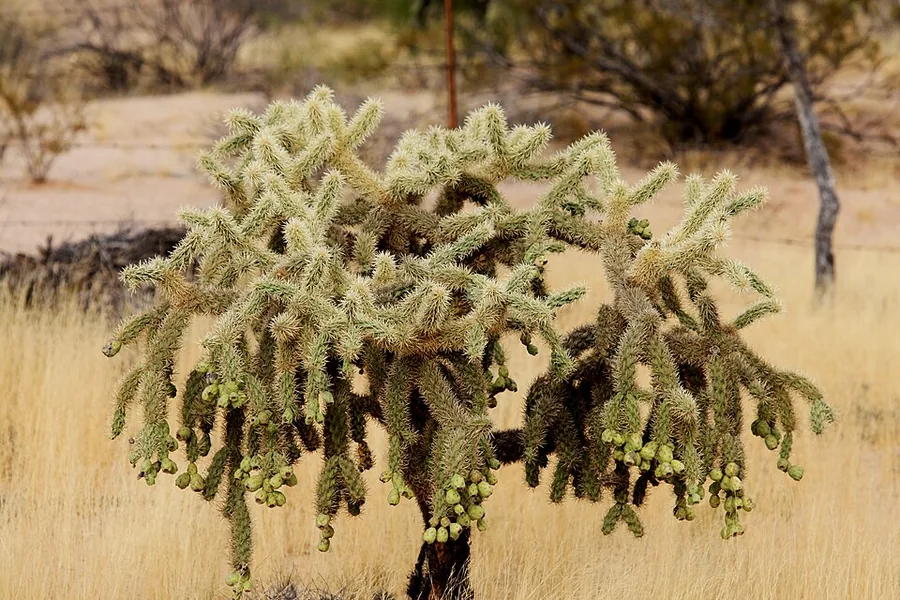
Cholla is a desert cactus built for heat and drought, with cylindrical, segmented joints that stack up into a small spiny tree. It grows wild across the arid Southwest and stands up to a wide swing in temperature, from 23°F to 104°F (-5°C to 40°C). Left to its own devices it climbs slowly toward 3 to 13 feet (1 to 4 m) tall.
What sets this cactus apart is how loosely its joints hang on. A light brush is enough to pull a barbed segment free, and it rides off on skin, fur, or a pant leg, which is how it earned the name jumping cholla. Those same detachable joints are how the plant spreads, dropping to the ground and rooting where they land.
Grown well, cholla asks for almost nothing once it settles in. Give it sun, sandy ground, and very little water, and it shrugs off conditions that would kill most plants. The real work is respecting the spines and siting it where nobody walks too close.
Care
The short version: full sun, a gritty fast-draining mix, and water only when the soil has dried out completely. It handles a huge range of temperatures and wants very little fuss beyond sharp drainage and a wide berth.
Light
Cholla wants full sun and plenty of it, just as it gets in the open desert. It will tolerate a bit of partial sun, but anything less leaves it weak and far more likely to rot.
Water
Water sparingly and only after the soil has dried out completely. This plant is built for drought and rots fast when its roots stay wet, especially in cool or dim conditions, so err well on the dry side.
Soil
Plant it in a gritty, sharply drained sandy or cactus mix that never holds water. A pH anywhere from 6.0 to 8.0 suits it, which covers most desert ground.
Temperature
Cholla takes a remarkable range, from about 23°F to 104°F (-5°C to 40°C). That toughness is why it thrives outdoors in USDA zones 8 through 11 where many cacti would not.
Humidity
Low humidity is exactly what this plant wants, so dry desert air is ideal. Damp, still air invites rot, so there is no number to chase here beyond keeping things on the dry side.
Feeding
Feed lightly during the spring and summer growth, using a dilute low-nitrogen cactus fertilizer once a season. Too rich a feed pushes soft growth that the plant neither needs nor wants.
Pruning
Cholla needs little cutting back, just the removal of dead or damaged joints. Always reach for long tongs or thick gloves, because the barbed joints detach at the lightest touch and embed in skin.
Repotting
Repot only every 2 to 4 years, or when the plant clearly outgrows its container or turns top-heavy. Roots pushing through the drainage holes or soil that dries out unusually fast are the signs it is time.
Size & spacing
A mature cholla reaches 3 to 13 feet (1 to 4 m) tall and spreads 3 to 7 feet (100 to 200 cm) wide. Give it plenty of clearance so no one brushes the barbed joints in passing.
Troubleshooting
Cholla rarely struggles, and when it does the trouble shows up in the joints. Soft dark segments and shriveled ones point in opposite directions, so read what you see before you reach for the watering can. Always handle the plant with tongs while you sort it out.
Joints turning soft, mushy, and dark at the base
This is root and stem rot, and it almost always traces back to too much water sitting in soil that drains poorly. The base often smells foul and the affected joints lose their firmness. Stop watering at once, cut the rotted joints away with tongs well into healthy green tissue, then let the cuts callus and repot into a dry gritty mix.
Fix:
- Stop watering immediately
- Cut away rotted joints with tongs well into healthy tissue
- Allow cuts to callus and repot into dry gritty mix
Joints looking shriveled, puckered, and thin
Wrinkled joints point to prolonged drought or roots that have died back and can no longer take up water. The soil has usually been bone dry for a long stretch. Go back to a deep but infrequent soak during the growing season and check that the roots are still firm and working.
Fix:
- Resume a deep but infrequent watering schedule
- Check roots are intact and functional
Toxicity
Nothing in this cactus will poison a person or an animal, so there is no toxin to worry about. The hazard is purely physical. The barbed, detachable joints catch and embed in skin, mouths, and fur at the lightest touch, and they hurt and resist removal, so the safe move is to keep people and pets well clear and handle the plant only with tongs.
Safe for
People · Cats · Dogs · Horses · Rabbits · Livestock · Birds
Cats None
Nothing in the plant will poison a cat. The danger is the barbed joints, which catch in paws and faces and can lodge in the mouth or tongue if a curious cat bats at the spines.
Dogs None
A dog that noses or chews this plant won't be poisoned, but the detachable spined segments cling hard and embed in the muzzle, lips, and paw pads, where they cause real pain and need careful removal.
Horses None
No toxin here for horses. A grazing horse can still drive the barbed spines deep into its lips and gums, so keep the plant clear of any spot a horse can reach.
Rabbits None
Rabbits face no poisoning risk, though the spines are a hazard to small soft mouths and feet, and a bramble of fallen joints can trap a hopping rabbit.
Livestock None
Cattle, goats, and sheep won't be poisoned, but the chain-fruit segments stick to legs and faces, and embedded spines around the mouth can stop an animal from feeding.
Birds None
Birds aren't poisoned by any part of this cactus. Some desert birds even nest among the spiny joints for protection, so the only caution is the physical sharpness of the barbs.
People None
No part of the plant is poisonous to people. The barbed joints are the whole problem: they detach at the lightest brush and lodge painfully in skin, and they are slow and difficult to pull back out, so handle only with long tongs.
The real danger is physical: detachable, barbed spine joints (the 'jumping cholla') cling to and embed in skin at the slightest brush, are very painful, and are difficult and hazardous to remove. Keep well away from people and pet traffic and handle only with tongs.
Varieties
Cholla is one of many in its genus, and a couple of close relatives turn up often enough to know by name.
Cylindropuntia fulgida var. mamillata
This form carries smoother joints with far fewer spines than the heavily armed type most people picture.
Cylindropuntia bigelovii (teddy bear cholla)
A close cousin cloaked in dense golden spines, with joints that detach even more readily than those of the chain-fruit cholla.
How to propagate
Cholla all but propagates itself, since its loose joints root wherever they fall. You can copy that trick on purpose, or start from seed if you have the patience.
Stem cuttingsEasy
Spring to summer during active growth · 4 to 8 weeks to root
Rooting a detached joint is by far the easiest way to make more, and it works best in spring or summer while the plant is growing. Set the joint aside until the cut end forms a dry callus, then stand it in gritty mix, and it puts down roots in 4 to 8 weeks. Move it only with tongs, since the barbed spines grab skin at a touch.
SeedModerate
Spring in warm conditions · Several months to a year for seedlings to establish
Seed is the slower, less certain route. Sow in spring and give the seeds steady warmth to coax them up, then be patient, because the seedlings take several months to a year to establish into sturdy young plants.
Myths
Cholla jumps and throws its spines at you.
It does not jump or fire anything. The barbed joints sit so loosely that the lightest brush, or even a static spark, pulls one free and onto whatever touched it. The cactus never moves; you simply collect a segment before you notice the contact, which is exactly how the jumping name took hold.