Houseplant · Bromeliaceae
Pineapple
Ananas comosus
Give it strong light, warmth, and a pot that drains fast, and a grocery-store crown turns into a houseplant that fruits.
Full sun
Every 7–14 days
55–90°F · 13–32°C
540–720 days
Overview
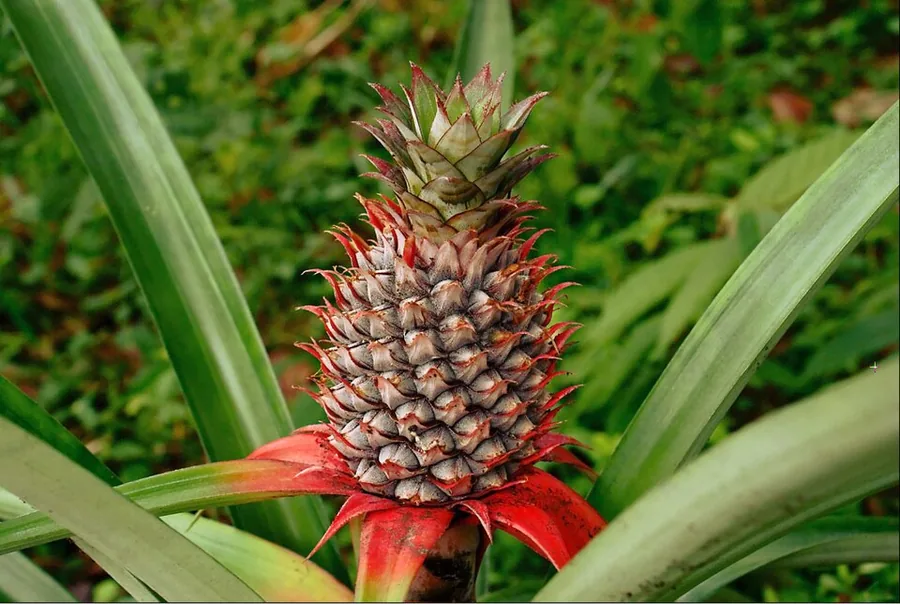
The pineapple is a bromeliad from tropical South America, grown as much for its bold rosette of arching leaves as for the fruit that crowns it. It pulls water and nutrients through both its roots and the cup at its center, which is why it shrugs off a missed watering but resents wet feet. Indoors it stays a slow, sculptural plant that asks for little once you get the light right.
Fruit is the long game. A plant takes 18 to 24 months to carry a crown all the way to a ripe pineapple, and each rosette pulls off that trick only once before it hands the job to its offsets. Most people grow it for the foliage and treat any fruit as a bonus, but with strong light and patience a windowsill crown really can deliver.
It earns its place as a houseplant on looks alone. The leaves are stiff and striking, the ornamental forms add cream, green, and pink stripes, and the whole plant takes neglect better than most. The catch is the spines along the leaf edges, so it wants a spot where no one brushes past it.
Care
The short version: as much bright light as you can give it, ideally full sun, water only when the top half of the pot has dried, and plant it in a light, fast-draining mix. Keep it warm, feed it monthly in the growing season, and never let water stand in the central cup.
Light
Pineapple wants all the light it can get, full sun if you have it, and at minimum a bright window. Skimp on light and the leaves turn pale and floppy, and fruit becomes a distant hope.
Water
Let the top half of the pot dry out before you water again, roughly every 7 to 14 days. As a bromeliad it copes with a dry spell far better than with soggy roots, so when in doubt, wait. Don't leave water pooling in the central rosette, especially in cool weather, or you risk crown rot.
Soil
Use a light, fast-draining mix, sandy or loamy and rich in organic matter, so water runs straight through. Pineapple likes things on the acidic side, a pH of 4.5 to 6.5, which suits its bromeliad roots.
Temperature
Keep it warm, between 55°F and 90°F (13°C to 32°C), and treat 13°C as the floor. Cold, wet conditions are what tip a healthy plant into rot, so a steady warm spot matters more than a precise number.
Humidity
Average room humidity of 40% to 60% is plenty, so there's no misting routine to keep up. The plant handles ordinary indoor air without fuss.
Feeding
Feed monthly with a balanced soluble fertilizer through spring and summer while the plant is in active growth. Mature plants take well to a more nitrogen-rich feed when you want to push leaf growth.
Pruning
There's little to do here. Pull or cut off dead and spent lower leaves at the base, and once a plant has fruited, remove the old fruiting stalk, since that rosette is finished and won't fruit again.
Repotting
Move it up a pot size every 2 to 3 years, or sooner if roots push out the drainage holes, the plant turns top-heavy, or water races through without soaking in. Slow growth means it rarely needs more than that.
Size & spacing
Indoors it reaches about 3 to 4 feet (90 to 120 cm) tall and spreads 24 to 35 inches (60 to 90 cm) across. Give the rosette enough clearance that no one walks into its spiny leaf edges.
Troubleshooting
Almost every pineapple problem indoors traces back to water and light. Too much wet, too little sun, and a sudden blast of heat cover most of it. Match what you see below and fix the cause before it spreads.
A soft, smelly center with leaves that lift out at a touch
This is crown or heart rot, the most serious thing that goes wrong indoors, and it starts when water sits in the central cup or the soil stays soaked in cool weather. Cut back on watering, switch to a fast-draining mix, and move the plant somewhere warm and bright with air moving around it. Once the core has gone brown and slimy the plant rarely recovers, so pull any healthy pups from the base and start fresh.
Fix:
- Reduce watering and improve drainage immediately
- Move to a warmer, brighter location with good airflow
- If rot is advanced the plant is usually unsalvageable; harvest any healthy offsets/pups to start over
Leaves fading to yellow or a pale, washed-out green
Pale color almost always means too little light, and a hungry, underfed plant looks the same way. Move it to the brightest window you have, or full sun, and start a monthly balanced feed through the growing season. Check the drainage too, since roots left sitting in wet soil drive the same loss of color.
Fix:
- Move to the brightest available spot or full sun
- Begin a regular balanced feeding schedule in the growing season
- Check that soil drains freely and is not constantly wet
Scorched brown tips or bleached patches on the leaves
This is sunburn, and it shows up when a plant used to a window gets thrown straight into fierce direct sun without a chance to adjust. Dry air paired with dry soil makes it worse. Build up the light over a week or two instead of all at once, and keep the soil evenly moist while the weather is hot.
Fix:
- Acclimate gradually to stronger light over one to two weeks
- Maintain even soil moisture and moderate humidity
Toxicity
Good news for a home with pets and kids: pineapple is non-toxic, and the ASPCA lists it as safe for cats and dogs. The ripe fruit is good to eat for people and a fine treat for many animals. The only real cautions are mechanical, the sharp spines along the leaf edges and the tingle of bromelain in unripe fruit, neither of which is poisoning.
Safe for
People · Cats · Dogs · Horses · Rabbits · Livestock · Birds
Cats None
Safe to be around. A curious cat won't be poisoned by it, though the stiff, toothed leaf edges can prick a nose or paw, so set the plant where it won't get batted at.
Dogs None
No toxic risk for dogs. A bite of the fruit does no harm, and the worst a chewer will meet is the tingle of bromelain in unripe flesh and the sharp leaf spines.
Horses Safe
Not poisonous to horses. The plant simply isn't part of a horse's world, and the rigid spiny foliage makes it unappealing to graze in the first place.
Rabbits Safe
Safe for rabbits, with the ripe fruit fine as the occasional small treat. Skip the tough, spiny leaves, which a rabbit has no reason to nibble anyway.
Livestock Safe
Cattle, goats, and sheep face no poisoning from it. The spiny leaves are too coarse to be worth eating, so the only real caveat is the sharp edges.
Birds Safe
Safe for birds, and many enjoy a bit of the ripe fruit. There's nothing toxic to worry about beyond the firm, prickly leaves.
People Safe
The ripe fruit is a kitchen favorite and completely safe to eat. Unripe fruit and the bromelain in it can leave the mouth tingling, and the spiny leaves can scratch, so handle the plant with a little care.
Leaf margins of many varieties bear sharp, recurved spines that can scratch or prick skin; unripe fruit and the bromelain enzyme can irritate the mouth if chewed, but neither constitutes pet poisoning.
Varieties
A handful of pineapple types show up again and again, from the smooth commercial standard to the striped forms grown just to look at. These are the ones worth knowing.
Smooth Cayenne
This is the big commercial workhorse, with nearly spineless leaf margins and large cylindrical fruit that make it easy to grow and handle.
Red Spanish
A Caribbean classic with spiny leaves and squarish, aromatic fruit whose tough flesh ships and stores well.
Queen
A compact, spiny plant prized at home for smaller fruit that is very sweet with deep yellow flesh.
'Variegata' / ornamental forms
Grown for its cream-and-green striped foliage that often flushes pink, this one earns its keep as a houseplant rather than for fruit.
How to propagate
Pineapple is one of the most satisfying plants to multiply, since the top of a fruit you already bought is all you need to start a new one.
Offsets & pupsEasy
Any time during warm active growth; pups are best taken once they are several inches tall · 6 to 12 weeks to root well
You can twist the leafy crown off a store-bought fruit, or pull the slips and suckers that grow at the base of a mature plant once they reach several inches tall. Let the cut surface dry for a few hours, then set it in a light, fast-draining mix and keep it warm and bright while it roots, which takes about 6 to 12 weeks. Stick to warm, active growth and the strike rate is high.
Myths
A single pineapple plant fruits over and over from the same rosette.
Each rosette flowers and fruits just once, then begins to fade. The next crop comes from the offsets it throws up at the base, the pups, slips, and suckers, each of which grows on to fruit in its own turn.
You have to start pineapple from seed to ever get fruit.
Almost no one does. Pineapple is grown from the leafy crown or from offsets, which roots faster and gives you a known plant, while seed is left to breeders chasing new varieties.