Houseplant · Bromeliaceae
Bromeliad
Bromeliaceae (family)
Keep the cup full and the light bright but indirect, and a bromeliad rewards you with months of color.
Bright indirect
Every 7–14 days
55–81°F · 13–27°C
USDA 10–11
Overview
Bromeliads are tropical natives grown for their bold, long-lasting color and the rosette of stiff leaves that catches rain like a cup. Most of the ones sold as houseplants are epiphytes, which means in the wild they perch on trees rather than root in the ground. That habit shapes everything about how you grow them, from the loose mix they sit in to the way they drink from the center instead of the soil.
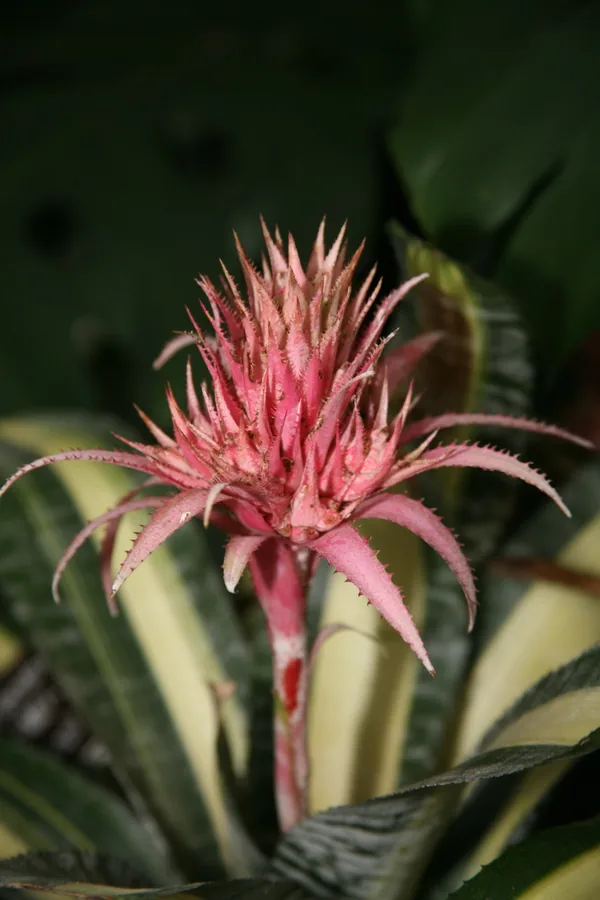
What looks like a flower is usually a spike of brightly colored bracts that can hold its color for months, far longer than a true bloom. Each rosette flowers only once. After that it slowly winds down, but not before raising a new generation of pups at its base, so a single plant turns into many over time.
These are forgiving plants, well suited to a beginner. Give them warmth, bright indirect light, and fresh water in the cup, and they ask for little else. The most common way to lose one is kindness in the form of too much water sitting where it shouldn't.
Care
The short version: bright indirect light, fresh low-mineral water kept in the central cup and flushed weekly, a loose fast-draining mix, and warm, humid air. Water the mix only when its surface dries.
Light
Give a bromeliad bright but indirect light, the kind near a window that never feels harsh. It will get by in medium light or light shade, though the color fades there. Direct midday sun bleaches and scorches the leaves, so keep it out of the hot beam.
Water
The center cup is the main way these plants drink. Keep about 2 to 3 cm of fresh, low-mineral water in it, rainwater or distilled if you can, and flush it out weekly so it never goes stale. Water the mix only when the top few cm have dried, since the roots rot fast if they stay soggy.
Soil
Use a loose, fast-draining epiphytic mix of bark, perlite, and coarse peat, the same sort sold for orchids. A slightly acidic pH of 5.0 to 6.0 suits them. Ordinary potting soil holds far too much water and will rot the roots.
Temperature
These tropicals are happiest between 55°F and 81°F (13°C to 27°C), which is comfortable room range. Keep them away from cold drafts and chilly windowsills in winter.
Humidity
Bromeliads want 50% to 70% humidity, higher than most homes sit at. Group plants together, set the pot on a pebble tray, or run a humidifier to lift it. Dry air shows up as brown, crispy leaf tips.
Feeding
Feed monthly through spring and summer with a balanced water-soluble fertilizer cut to a quarter or half strength, applied to the mix or as a dilute foliar spray. Never pour concentrated fertilizer into the cup, since that can burn the crown.
Pruning
Trim away dead or browning outer leaves at the base, and cut out the spent flower spike once it fades. The flowered mother rosette declines over many months, and you can remove it entirely after you've taken its pups.
Repotting
Bromeliads rarely need repotting, usually only every 2 to 3 years or when you're potting up an established pup. Repot when the plant tips over easily, the mix has broken down and stays soggy, or roots start pushing out of the pot.
Size & spacing
Most reach 12 to 35 inches (30 to 90 cm) tall with a spread of 12 to 24 inches (30 to 60 cm), depending on the genus. Give each plant enough elbow room that air moves freely around the rosette.
Troubleshooting
Most bromeliad trouble traces back to water and light, and it usually shows up first in the cup, the leaf tips, or the color. Catch the early signs and the fix is simple. Match what you see below, then act before rot or scorch spreads.
A soft, foul-smelling center and a rosette that collapses
This is crown or base rot, and it almost always starts with stale water sitting too long in the central cup or a potting mix that never dries out. Empty and flush the cup, let the mix dry, and move the plant into a coarse, fast-draining mix if the drainage is poor. If the mother crown is too far gone, salvage any healthy pups and start over from those.
Fix:
- Empty and flush the central cup, then refill with fresh water
- Allow the potting mix to dry and improve drainage or repot into a coarse, fast-draining mix
- Salvage healthy pups if the mother crown is rotted beyond recovery
Bleached or scorched patches and washed-out color
Too much direct sun bleaches the leaves and can scorch the most exposed surfaces, especially after a sudden move into a much brighter spot. Bright but indirect light is what these plants want. Shift the plant out of harsh midday sun and step it up to any brighter position over a week or two so it can adjust.
Fix:
- Move to bright but indirect light
- Acclimate gradually to brighter positions
Brown, crispy tips on otherwise healthy leaves
Dry tips usually point to low humidity or a slow buildup of minerals and salts from hard or fluoridated water. Raise the humidity to 50% to 70% with a pebble tray, a humidifier, or by grouping plants together, and switch the cup and mix to rainwater or distilled water. The browned tips won't turn green again, so trim them for looks if they bother you.
Fix:
- Raise humidity (grouping, pebble tray, or room humidifier)
- Switch to rainwater or distilled water for the cup and mix
- Trim crispy tips for appearance only
A healthy plant that never throws a flower spike
A bromeliad blooms only once it has reached mature size, and too little light is the usual reason a grown rosette stays stubbornly green. Move it somewhere bright and indirect, then give it time. If you want to push a mature plant along, seal it in a clear bag with a ripe apple for a few days, since the ethylene the apple gives off can trigger the bract to form.
Fix:
- Increase light to bright indirect levels
- Be patient until the rosette reaches mature size
- Optionally encourage bloom by enclosing the plant with a ripe apple for a few days to expose it to ethylene
Toxicity
Good news for a busy household: the common houseplant bromeliads are non-toxic to cats, dogs, and people, so you can place one wherever the light is right. The one thing to watch is the leaf edge, since genera like Aechmea carry stiff, toothed margins that can scratch skin or a curious paw.
Safe for
People · Cats · Dogs · Horses · Rabbits · Livestock · Birds
Cats None
The common houseplant bromeliads are non-toxic to cats, so a curious nibble won't poison one. The only thing to watch is the toothed leaf edge on types like Aechmea, which can scratch a paw or nose.
Dogs None
Dogs can be around these bromeliads without any risk of poisoning. A determined chewer might get a scrape from the stiffer, spiny-margined kinds, but the plant itself is safe.
Horses Safe
No toxins here that would trouble a horse. These are grown indoors and rarely cross a horse's path anyway.
Rabbits Safe
A rabbit that gnaws a leaf faces no poisoning from the common bromeliads. The tough, fibrous foliage is more chew-toy than meal.
Livestock Safe
The widely grown bromeliads carry no toxin that affects cattle, goats, or sheep.
Birds Safe
Pet birds are fine around these plants, with nothing toxic in the leaves or bracts.
People Safe
Safe to keep in any room of the house. Just mind the sharp, toothed leaf edges on some genera when you handle the plant.
Some bromeliads have stiff or finely toothed leaf edges; handle with care to avoid skin scratches.
Varieties
Bromeliad covers a huge family, but a handful of genera fill most homes and garden centers. These are the ones worth knowing by name.
Guzmania
Smooth, strap-like green leaves rise around a long-lasting upright spike of bright red, orange, or yellow bracts.
Aechmea (urn plant)
Broad, stiff leaves are often banded in silver and edged with teeth, topped by a pink flower head that lasts for months.
Neoregelia (blushing bromeliad)
Instead of a tall spike, its flat open rosette flushes bright red or pink at the center when bloom time nears.
Vriesea (flaming sword)
Often banded or mottled foliage sits below a flattened, feather- or sword-shaped flower bract that gives it its name.
Billbergia (queen's tears)
A tall, tubular rosette sends out arching, pendulous flower spikes that put on a showy display but fade fast.
How to propagate
You rarely need to buy a second bromeliad, because every plant hands you new ones for free as it finishes flowering.
Offsets & pupsEasy
After flowering, once pups reach about one-third to one-half the size of the mother plant · Several weeks to a few months to root and establish
Bromeliads multiply through pups, the small offsets that appear at the base after the mother flowers. Wait until a pup reaches about a third to half the size of its parent and has a few roots of its own, then cut or gently snap it free. Pot it into a loose, fast-draining bromeliad or orchid mix, keep it lightly moist with its cup filled, and it roots and settles in over several weeks to a few months.
Myths
A bromeliad is dead and worthless once it flowers.
The mother rosette does bloom just once and then slowly fades, but that isn't the end of the story. Before it goes, it sends up offsets, called pups, at its base, and each one grows into a fresh plant that will flower in turn. The plant renews itself, so one bloom is really the start of the next generation.
You should only ever pour water into the cup and never water the soil.
The central cup does need fresh water, but the roots still drink, so the potting mix wants watering once its surface dries. The cup also has to be flushed often, since water left sitting goes stale and rots the crown. Tend both the cup and the mix, and keep the cup water fresh.