Houseplant · Bromeliaceae
Blushing Bromeliad
Neoregelia carolinae
Keep its central cup full and give it bright, indirect light, and the blushing bromeliad colors up indoors with almost no fuss.
Bright indirect
Every 7–14 days
50–90°F · 10–32°C
USDA 10–11
Overview
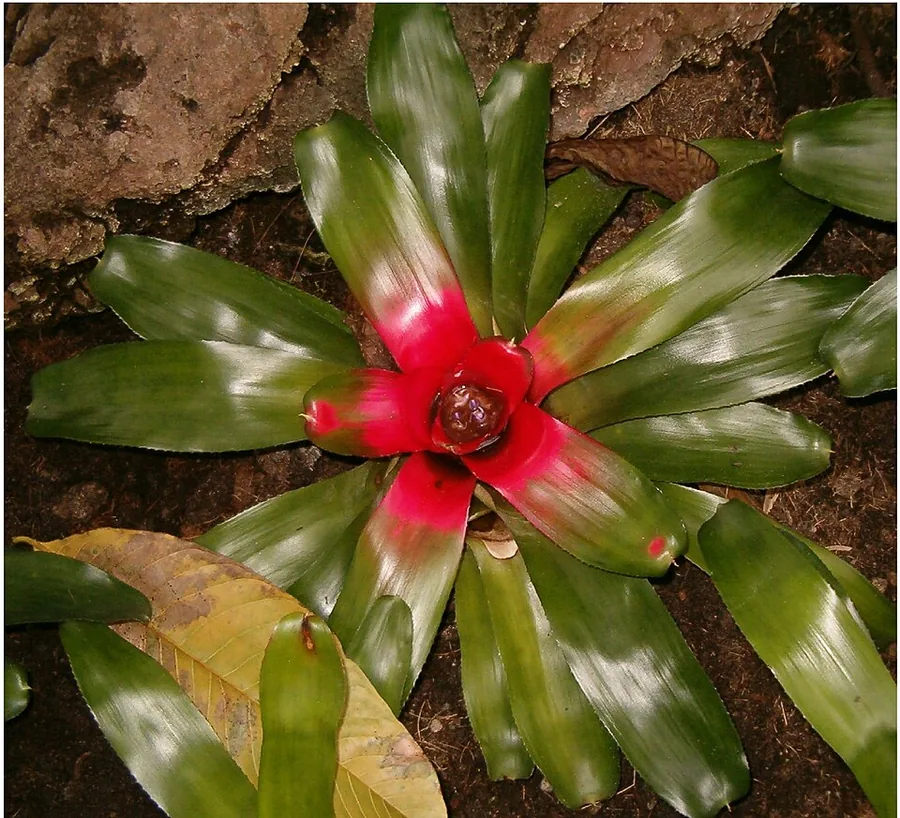
Neoregelia is a bromeliad grown for its rosette of broad, glossy leaves rather than for any showy flower. When the plant matures, the leaves at the heart of the rosette blush bright red or pink, and small flowers open deep in the central cup. That splash of color can hold for months, which is part of why it earns a spot on a shelf.
In the wild it lives as an epiphyte, perching on tree branches and gathering water and food through its leaves and the tank at its center rather than through a big root system. That habit shapes how you grow it. The roots are mostly anchors, so it wants a loose, fast-draining mix and a cup kept topped up with fresh water.
It earns its keep as an easy houseplant. Give it warmth, humidity, and light that's bright but never harsh, and it asks little in return. Each rosette flowers only once and then slowly fades, but it leaves behind pups that carry the plant on for years.
Care
The short version: bright indirect light, a central cup kept full of fresh water, and a loose bark mix that dries slightly between waterings, all in a warm, humid spot.
Light
Give it bright, indirect light to keep the rosette tight and the center color strong. It will take partial shade or some gentle morning sun, but harsh midday rays scorch the leaves, while too little light stretches them out and fades the blush.
Water
The trick here is the central cup. Keep the tank at the heart of the rosette filled with fresh water, ideally rainwater or distilled, and flush it weekly so it doesn't go stagnant. Let the bark mix dry slightly between waterings, every 7 to 14 days, since the limited roots rot in soggy media.
Soil
Plant it in a loose, fast-draining epiphyte mix, such as equal parts peat, bark, and coarse sand, or a ready-made orchid bark medium. A slightly acidic pH of 5.0 to 6.5 suits it, and the open texture keeps water moving past the shallow roots.
Temperature
It's comfortable in ordinary room warmth, roughly 50°F to 90°F (10°C to 32°C). Keep it away from cold drafts and chilly windowsills in winter, since it has no tolerance for a hard chill.
Humidity
This plant likes the air on the humid side, around 50% to 70%. Average rooms are often drier than that, so group it with other plants, set it near a humidity tray, or run a humidifier if your air runs dry.
Feeding
Feed lightly from spring through summer while it's growing, about once a month. Use a dilute balanced liquid fertilizer at quarter to half strength on the mix or misted on the leaves, and go easy pouring feed into the cup, where it can build up and foul the water.
Pruning
There's little to cut. Pull off spent flowers and dead outer leaves to keep it tidy. Once the rosette has bloomed it slowly declines, since each one flowers only once, so trim away the dying mother plant after the pups are established.
Repotting
You'll rarely need to repot, thanks to the small root system. Move it on only when the pups crowd the pot or the plant turns top-heavy and unstable, and step up to a slightly larger container with fresh bark mix.
Size & spacing
Expect a compact plant, about 6 to 12 inches (15 to 30 cm) tall with a spread of 12 to 20 inches (30 to 50 cm). That tidy, spreading rosette makes it an easy fit for a shelf or tabletop.
Troubleshooting
Most trouble with this bromeliad traces back to water or light. A soggy mix rots the base, harsh sun bleaches the leaves, and too little light washes out the color. Match what you see below and adjust before it spreads.
Soft, mushy base and a collapsing rosette
This is crown or root rot, and it sets in when the potting mix stays soggy or the cup water turns foul. Stop watering the mix and let it dry, then empty and flush the central cup with fresh water. If the rot is limited to the roots, repot into a loose, fast-draining bark mix and the plant can pull through.
Fix:
- Stop watering the mix and let it dry
- Empty and flush the central cup with fresh water
- Repot into a loose, fast-draining bark mix if rot is limited to roots
Tiny larvae wriggling in the central cup
Mosquitoes breed in the cup when the water sits undisturbed too long. Flush the cup with fresh water to wash the larvae out. For a stubborn problem, drop in some Bacillus thuringiensis israelensis (Bti) granules, and keep the water moving with regular flushing so it never goes stagnant.
Fix:
- Flush the cup with fresh water to dislodge larvae
- Apply Bacillus thuringiensis israelensis (Bti) granules to the cup for larval control
Sticky residue, cottony fluff, or bumps on the leaves
These are the calling cards of mealybugs, scale, or spider mites, which read as cottony masses, brown bumps, or fine webbing and stippling. Wipe them off with a cloth or cotton swab, then treat with insecticidal soap or horticultural oil. Isolate the plant until the infestation clears so it does not spread.
Fix:
- Wipe pests off with a cloth or cotton swab
- Treat with insecticidal soap or horticultural oil
- Isolate the plant until the infestation clears
Bleached or brown patches on the leaves
This is sun scorch from too much direct, intense light hitting the foliage. Move the plant into bright indirect light or partial shade, and trim badly burned tips if the look bothers you. Harsh midday sun is the thing to keep it away from.
Fix:
- Move to bright indirect light or partial shade
- Trim badly burned leaf tips if desired
Long, floppy leaves with washed-out center color
Too little light stretches the rosette and stops the central blush from developing. Move the plant somewhere brighter with more indirect light. Good light is what keeps the rosette compact and the color intense.
Fix:
- Move to a brighter spot with more indirect light
Toxicity
Good news for a pet household: this is a non-toxic plant. The ASPCA lists the blushing bromeliad as safe for cats and dogs, and NC State Extension adds horses to that list. The leaf tips can be stiff, and the cup water is worth keeping fresh, but there's no poison to worry about.
Safe for
People · Cats · Dogs · Horses · Rabbits · Livestock · Birds
Cats None
The ASPCA clears this bromeliad for cats, so a curious nibble is nothing to worry about. A pet that eats a lot of any houseplant might still get a passing upset stomach.
Dogs None
Dogs are fine around it too, with no toxic compounds in the leaves or cup. The leaf edges can be stiff, so keep an eye on a determined chewer.
Horses Safe
NC State Extension lists it as non-toxic to horses, and it poses no poisoning risk in a barn or paddock.
Rabbits Safe
There is no known toxin here that would harm a rabbit. It simply isn't a forage plant, so don't count it as part of their diet.
Livestock Safe
Grazing animals such as cattle, goats, and sheep face no poisoning risk from this plant.
Birds Safe
The foliage carries nothing toxic to pet birds. The water held in the central cup is the one thing to keep clean and fresh.
People Safe
It's safe to have around children and handle bare-handed. The plant isn't grown to eat, and the stiff leaf tips are the only thing worth a second thought.
No special handling precautions for pets; the plant is non-toxic.
Varieties
A few Neoregelia forms turn up most often, set apart mainly by how their leaves are marked and colored. These are the ones worth knowing by name.
Neoregelia carolinae 'Tricolor'
Its leaves run with lengthwise stripes of green, cream, and pink, and the center blushes bright red as the plant comes into bloom.
Neoregelia carolinae 'Blushing Bromeliad'
This is the classic form, named for the way its central leaves flush bright red and pink right before it flowers.
Neoregelia spectabilis (Fingernail Plant)
Each leaf ends in a vivid red tip that looks like a painted fingernail, with felty silver banding underneath.
How to propagate
Neoregelia multiplies on its own through pups, so growing more is mostly a matter of waiting for the offsets and potting them up.
Offsets & pupsEasy
After the mother rosette flowers and the pups reach about one-third the size of the parent · Several weeks to a few months
After the mother rosette flowers, it slowly dies back and sends up pups around its base. Wait until each pup reaches about a third of the parent's size, then twist it free and pot it into a loose, fast-draining bark mix. Give it several weeks to a few months to settle in and root.
Myths
Bromeliads are parasites that feed off the trees they grow on.
Neoregelia are epiphytes, not parasites. They perch on a tree only for support and take their water and nutrients through their leaves and central cup. They draw nothing from the host and never harm it.
The water in the central cup is fine to leave alone forever.
Left to sit, that water turns stagnant and can breed mosquitoes, especially outdoors. Flush the cup with fresh water regularly, and drop in Bti granules if larvae show up.