Tree · Proteaceae
Macadamia
Macadamia integrifolia
Give it warmth, deep soil, and a pollination partner, and the macadamia rewards your patience with rich nuts.
Full sun
Every 7–14 days
USDA 9–11
30–50 ft · 9.1–15.2 m
Overview
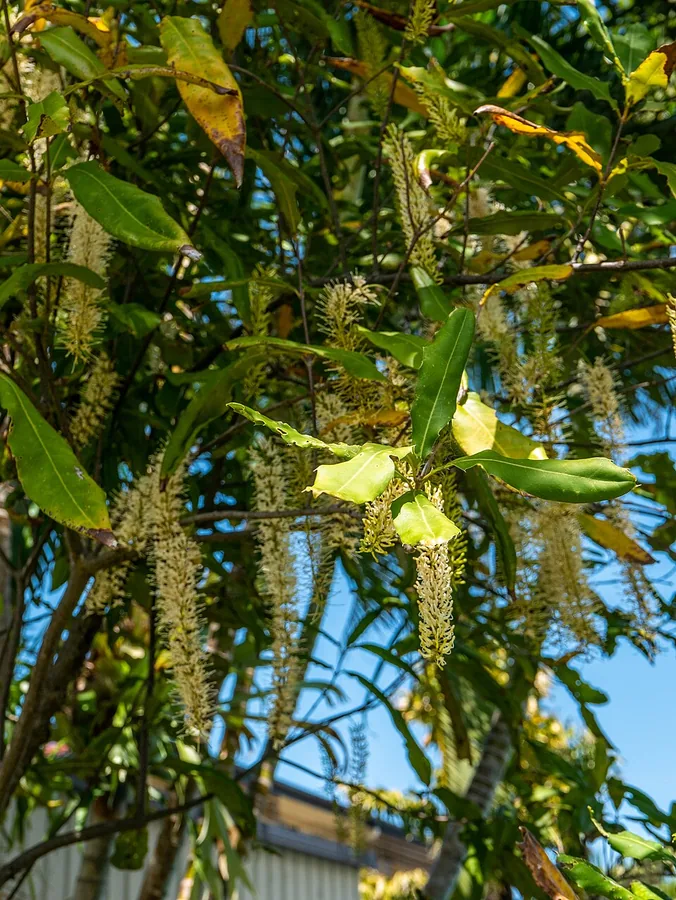
The macadamia is a large evergreen tree from the Proteaceae family, native to the subtropical forests of southeast Queensland. It grows slowly into a broad, heavy-canopied tree of 30 to 50 feet (9 to 15 m), then carries long racemes of white to pinkish flowers through winter and spring. The hard-shelled nuts ripen and drop from late summer into winter.
This is a tree for warm, frost-free ground in USDA zones 9 to 11. It wants full sun, deep and rich acidic soil, and a steady drink of at least 50 inches of rain or irrigation a year. One quirk sets it apart from most fruit trees: as a member of the Proteaceae, it cannot tolerate much phosphorus, so the usual heavy feeding will harm it.
Growing macadamias is a long game and a demanding one. A grafted tree takes about 2 to 5 years to bear, and most cultivars need a second compatible partner nearby to set a real crop. The reward is a backyard supply of one of the richest nuts there is, though every gardener with a dog should know the nuts are dangerous to them.
Care
The short version: full sun, deep rich acidic soil, and a frost-free spot out of strong wind. Keep the tree evenly watered, feed it lightly with a low-phosphorus blend, and plant a second cultivar nearby so the flowers actually set nuts.
Light
Macadamias crop best in full sun, though they take a little partial sun without much complaint. The more light the canopy catches, the more flowers and nuts it can carry.
Water
Give the tree consistent moisture and count on at least 50 inches of rain or irrigation a year. Water deeply during dry spells, every 7 to 14 days. An established tree handles some drought, but nut set and quality slide the moment it goes thirsty.
Soil
Plant in deep, rich, well-drained acidic loam at a pH of 5.0 to 6.5. Depth matters as much as fertility, since this is a big tree that puts down a substantial root system.
Temperature
The tree is happiest in subtropical warmth and holds up between about 32°F and 95°F (0°C to 35°C). Frost damages it and sustained heat past the top of that range burns the leaves and stalls the nuts.
Humidity
Average humidity of 50% to 70% suits it well. Damp, still air during bloom invites blossom blight, so good airflow through the canopy counts for more than the number itself.
Feeding
Feed through spring and summer while the tree is in active growth, but reach for a balanced blend that is low in phosphorus. As a Proteaceae, macadamia is sensitive to phosphorus, and too much will yellow the new leaves and kill the tips.
Pruning
Train a young tree to a single central leader and clear out low, crossing, or dead branches in late winter. Once it matures, it needs only light corrective cuts.
Repotting
This is a tree for the ground, so repotting barely applies. Pot up a young grafted tree only until it goes into the field, then plant it out and leave it.
Size & spacing
360–600 in (914–1524 cm) tall
When to plant
Macadamias run on warmth and have zero tolerance for frost. Plant a grafted tree out in spring once the cold has fully passed, watch for fragrant flowers through winter and spring, and gather the nuts as they ripen and drop from late summer into winter.
Northern hemisphere
Southern hemisphere
Typical months for a temperate climate: start earlier in warm zones, later where spring frosts linger.
- Sow: Late winter to spring if growing from seed, though grafted trees are strongly preferred
- Plant: Spring, after all danger of frost has passed
- Harvest: Fragrant white to pinkish flowers on long racemes in winter to spring; nuts ripen and drop from late summer through winter
Hardiness
USDA hardiness zones: 9–11
Temperature: down to -7°C
Troubleshooting
Most macadamia trouble shows up in the leaves, the flowers, or the nut crop, and the cause is usually feeding, weather, or a missing pollination partner. Match what you see below and act early. A young tree that gets the basics right rarely runs into the rest.
New leaves yellow with dying tips
This points to excess phosphorus, which macadamias and the rest of the Proteaceae family can't handle the way most plants do. A soil or leaf test confirms it. Stop the high-phosphorus feed, switch to a balanced low-phosphorus blend, and flush the soil with deep watering if the level is high.
Fix:
- Stop applying high-phosphorus fertilizer
- Switch to a balanced, low-phosphorus fertilizer
- Leach the soil with deep watering if phosphorus is excessive
Nuts drop early and few hold on the tree
A lone tree or a self-sterile cultivar is the usual reason a tree blooms well but keeps almost nothing. Poor cross-pollination is the main culprit, and heat above 95°F (35°C) during flowering and nut fill makes it worse. Plant a second compatible cultivar nearby, keep bees working the flowers, and hold steady moisture with wind shelter while the nuts develop.
Fix:
- Plant a second compatible cultivar nearby
- Support bee activity for pollination
- Provide steady moisture and wind protection during nut development
Flower racemes brown and collapse
Blossom blight is a fungus that takes hold when the air stays humid and the flowers stay wet. You'll see the long racemes discolor and fall apart in muggy weather. Open the canopy with proper spacing and pruning, and spray an approved fungicide at bloom if it keeps coming back year after year.
Fix:
- Improve air circulation through proper spacing and pruning
- Apply an approved fungicide at bloom if blight is recurrent
Burnt edges on sun- and wind-hit leaves
Sustained heat above 95°F (35°C) and hot, drying winds scorch the leaf margins, and the damage shows up worst on the most exposed foliage. Put up a windbreak or shelter belt and keep the soil moist through the heat. Choosing a frost-free site that doesn't bake also keeps the problem in check.
Fix:
- Provide wind protection or shelter belts
- Maintain soil moisture during heat
- Site in a frost-free but not excessively hot location
Toxicity
The kernel is a fine snack for people, but the nut is a serious danger to dogs. Even a few macadamias can leave a dog weak, shaky, and unable to stand within hours, and the reason it happens is still unknown. Keep every nut, raw or roasted or fallen on the ground, well out of a dog's reach.
Toxic to
Cats · Dogs · Horses · Rabbits · Livestock · Birds
Safe for
People
Cats Caution
No poisoning has been recorded in cats, but the nut hasn't been proven safe for them either. Treat it as off-limits and call a vet if a cat eats one.
Dogs Severe
This is the real danger. Even a few nuts can leave a dog weak in the hind legs, unable to walk, and bring on vomiting, a high fever, muscle tremors, an unsteady wobble, and a flattened mood, usually within 12 hours.
Horses Caution
Macadamia toxicity hasn't been studied in horses, so the nuts and any windfall are best kept out of reach until more is known.
Rabbits Caution
There's no record of how rabbits react, and a rich, fatty nut suits them poorly regardless. Don't offer it.
Livestock Caution
Cattle, goats, and sheep haven't been tested for this toxin. Fence them away from a fruiting tree so they can't graze on dropped nuts.
Birds Caution
The effect on birds is unknown, and the high fat content does them no favors, so keep the nuts away from poultry and pet birds alike.
People Edible
The roasted kernel is a popular snack and perfectly safe for people to eat. The toxin only troubles dogs, not the humans sharing the house.
Keep fallen nuts, raw or roasted nuts, and any nut-containing foods away from dogs; even small amounts can trigger signs.
Helpline numbers

United States
ASPCA Animal Poison Control: (888) 426-4435 (fee applies)

United Kingdom
Animal PoisonLine: 01202 509000 (fee applies)

Australia
Animal Poisons Helpline: 1300 869 738
Varieties
Macadamia comes down to two species and the hybrids and cultivars bred from them. These are the names worth knowing before you plant.
Smooth-shell (Macadamia integrifolia)
It carries a smooth, rounded shell and is the main commercial type grown across Hawaii.
Rough-shell (Macadamia tetraphylla)
A separate species with a pebbled, rough shell and often pink new growth, valued as a parent in several hybrids.
'Beaumont'
A pink-flowered integrifolia and tetraphylla hybrid that has become a favorite for backyard plantings.
'Kau' (HAES 344)
A Hawaiian smooth-shell cultivar the University of Hawaii selected for its high yield and good kernel quality.
Companions
What grows around a macadamia matters less than what grows beside it. A second cultivar is the partner that counts, while thirsty turf under the canopy only gets in the way.
Plant near
second compatible macadamia cultivar: Cross-pollination between cultivars improves nut set and yield.
Keep apart
shallow-rooted turf grass under the canopy: Competes for surface moisture and nutrients and complicates harvesting fallen nuts.
How to propagate
There are two ways to start a macadamia, and only one of them gives you reliable nuts. Grafting is how orchards do it; seed is for rootstock, breeding, and gardeners with time to spare.
GraftingModerate
Warm months once seedling rootstocks are about pencil thick · Grafts take in a few months; trees begin bearing in about 2-5 years
Grafting is the method to use, because it produces trees true to the cultivar. Do the work in the warm months once your seedling rootstocks reach pencil thickness, and the graft knits within a few months while the tree comes into bearing in about 2 to 5 years. Match scion to rootstock with care, and never cross a smooth-shell with a rough-shell type by mistake.
SeedModerate
Sow fresh, mature nuts in late winter to spring · Germinates in 1-2 months; seedlings may take 7-12 years to fruit and are variable
Growing from seed is mostly for rootstock or breeding rather than predictable nuts. Sow fresh, mature nuts in late winter to spring and they sprout in 1 to 2 months. The catch is patience and chance, since seedlings vary and can take 7 to 12 years to fruit.
Myths
A few macadamia nuts are harmless to dogs.
Even a small handful can set off macadamia poisoning, with signs showing up inside 12 hours. Any amount is a vet call, not a wait-and-see.
A single macadamia tree will produce a full crop on its own.
Cultivars run from self-fertile all the way to nearly self-sterile. Planting a second compatible cultivar lifts both nut set and yield, which is why orchards never rely on one tree.
Seed-grown macadamias come true to the parent and fruit quickly.
Seedlings are a gamble and can take 7 to 12 years to bear. Orchards plant grafted trees instead, since those stay true to the cultivar and start fruiting in about 2 to 5 years.