Houseplant · Gesneriaceae
Lipstick Plant
Aeschynanthus radicans
Give it warmth, bright indirect light, and humid air, and the lipstick plant trails red flowers from a hanging basket for much of the year.
Bright indirect
Every 5–10 days
55–81°F · 13–27°C
USDA 10–11
Overview
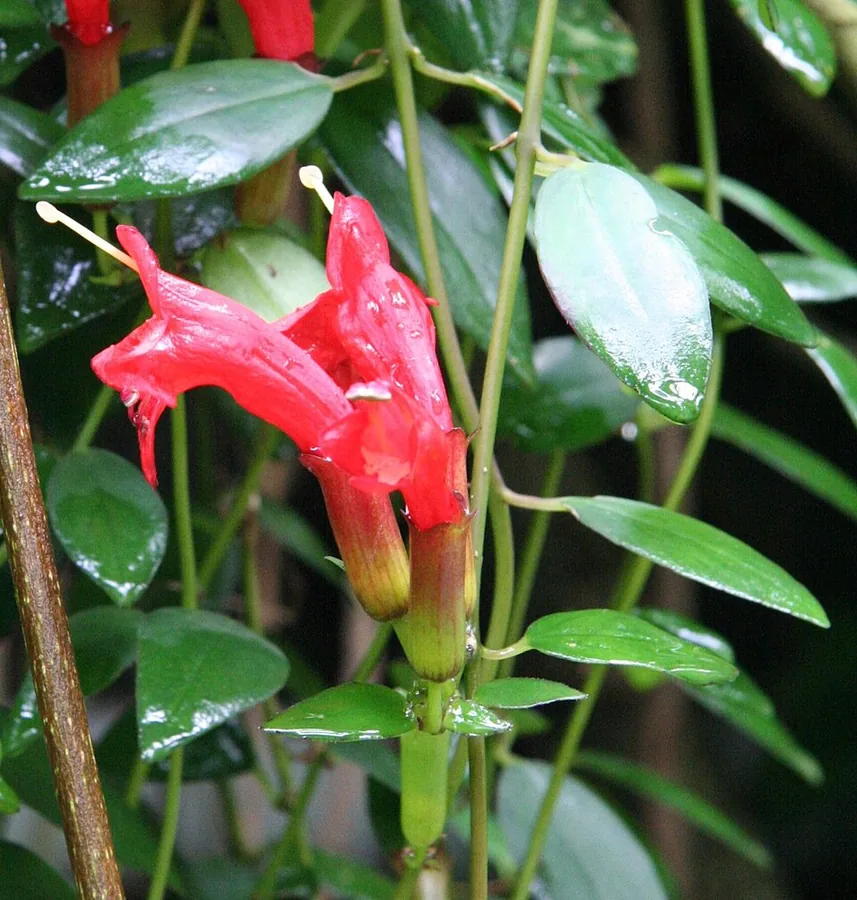
The lipstick plant earns its name from its flowers, which push a bright red bloom out of a dark tube exactly like a lipstick out of its case. It's a trailing tropical from the gesneriad family, the same group that gives us African violets, and in the wild it grows as an epiphyte clinging to trees across Southeast Asia. Indoors it spills out of a hanging basket, with glossy leaves running down stems that reach 12 to 35 inches (30 to 90 cm) long.
Despite the exotic look, it asks for little once you read what it wants. It likes to be warm, it likes humidity, and it flowers best when its roots are a touch crowded in the pot. Get those three right and it blooms on and off from spring well into the cooler months.
It's also a safe choice for a home with animals or small children. The ASPCA lists it as non-toxic, so you can hang it where a curious cat or a toddler might reach without a second thought.
Care
The short version: bright indirect light, warmth above 55°F (13°C), and humid air. Let the top of the mix dry between drinks, ease off the water in winter to set buds, and feed lightly through spring and summer.
Light
Give it bright, indirect light near a window but out of harsh midday sun, which scorches the leaves. It puts up with medium light and partial shade, but the brighter the spot, the more flowers you get.
Water
Let the top inch (3 cm) of mix dry before watering again, roughly every 5 to 10 days, and never let it sit in water. Hanging baskets dry out fast, so check them more often. Cut back in winter, since cooler, drier roots are what trigger the flower buds.
Soil
Plant in a light, fast-draining mix, such as African violet potting soil loosened with sphagnum moss and a little crushed charcoal. It grows naturally on tree bark, so the roots want air far more than they want to stay wet.
Temperature
Keep it between 55°F and 81°F (13°C to 27°C) and away from cold glass. Anything below the mid-50s starts dropping leaves, and a real chill can set it back hard.
Humidity
This plant wants high humidity to look its best. Group it with other plants, set it over a pebble tray, or run a humidifier, but pair the moisture with moving air so mold doesn't take hold.
Feeding
Feed every two weeks through spring and summer with a balanced liquid houseplant fertilizer diluted to half strength. Stop feeding in fall and winter while the plant rests.
Pruning
After a flush of flowers fades, cut the stems back to about 6 inches (15 cm) to push out bushy new growth. Trim any straggly stems back to roughly 2 inches (5 cm) to keep the plant full rather than leggy.
Repotting
Repot only every 2 to 3 years, or when roots crowd the drainage holes. It blooms best slightly pot-bound, so resist the urge to move it into a much bigger pot.
Size & spacing
Stems trail 12 to 35 inches (30 to 90 cm) long with a spread of 12 to 24 inches (30 to 60 cm). A hanging basket or a high shelf gives the stems room to cascade.
Troubleshooting
Most lipstick plant trouble traces back to the air around it, whether that's a cold draft, dry stagnant air, or uneven watering. Read the early signs and you can usually fix the cause before the plant sheds much. Match what you see below, then adjust its spot or its routine.
Leaves falling off, worst near the bottom
A lipstick plant drops leaves when it gets a chill, so check for a cold draft, an open winter window, or an air conditioning vent blowing on it. Watering swings make it worse, whether the mix has gone bone dry or stayed soggy. Move it somewhere warm above 55°F (13°C) and water on a steady rhythm.
Fix:
- Move to a warm spot away from drafts and cold glass
- Keep temperatures above about 13°C (55°F)
- Water consistently so the medium stays evenly moist but not soggy
Gray fuzz or dark spots on the leaves and stems
Gray fuzzy growth points to botrytis blight, while sharp dark patches are leaf spot, and both set in when humid air sits still around the plant. Snip off the affected foliage and get the air moving again. Keep the leaves dry and off the surface of the potting mix so the spores have nowhere to settle.
Fix:
- Remove affected foliage
- Improve air circulation
- Keep leaves dry and off the potting medium
Sticky residue, fine webbing, or tiny insects on the plant
These are the calling cards of aphids, mealybugs, scale, or spider mites. Check the stems and leaf undersides, where they like to hide, then wash or wipe them off. Follow up with insecticidal soap or horticultural oil and keep the plant apart from your others until the pests are gone.
Fix:
- Wipe off or wash off pests
- Treat with insecticidal soap or horticultural oil
- Isolate the plant until controlled
Toxicity
Good news for pet owners and parents: the lipstick plant is safe. The ASPCA lists it as non-toxic to cats, dogs, and horses, and nothing in its leaves or those showy red flowers will poison an animal or a child. Hang it wherever you like.
Safe for
People · Cats · Dogs · Horses · Rabbits · Livestock · Birds
Cats None
The ASPCA lists this plant as non-toxic to cats. A nibble might cause a little mild stomach upset, as any plant can, but there's no poison to worry about.
Dogs None
Safe for dogs on the ASPCA's list. A curious chew shouldn't cause any harm beyond the odd bit of indigestion from the roughage.
Horses None
The ASPCA clears it for horses too. It's an unlikely snack for a horse anyway, and nothing in it is toxic.
Rabbits Safe
Nothing in the lipstick plant is poisonous to rabbits, so a stray bite is no cause for alarm.
Livestock Safe
It poses no toxic risk to grazing animals, though as a tropical houseplant it rarely crosses their path.
Birds Safe
Pet birds can share a room with it safely. The foliage carries no known toxins that would trouble them.
People Safe
Safe around children. It isn't grown to be eaten, but a curious taste won't poison anyone.
Varieties
A few named forms turn up in the houseplant trade, mostly differing in their leaves or their flower color. These are the ones you're likely to find.
'Variegatus' (variegated lipstick plant)
This one trades the usual solid green for leaves brushed with cream to yellow variegation.
Aeschynanthus radicans var. lobbianus
Sold as the red bugle vine, it sets dark red calyces against a red corolla, though modern taxonomy now folds it in under A. pulcher.
How to propagate
The lipstick plant is easy to copy from cuttings, so one healthy basket can become several. Take your cuttings during the warm growing months for the quickest roots.
Stem cuttingsEasy
Spring to summer during active growth · Roots in about two weeks
Take cuttings in spring or summer, while the plant is growing, for the fastest results. Cut a soft stem with three nodes, strip off all but the top 2 to 4 leaves, and dip the cut end in rooting hormone. Pot it into equal parts vermiculite and perlite kept lightly moist, and it should put out roots in about two weeks.
Myths
The lipstick plant is poisonous and unsafe to keep around cats and dogs.
The worry usually comes from its lipstick-red flowers, which look like they should be trouble. They aren't. The ASPCA lists the plant as non-toxic to cats, dogs, and horses, so it's a genuinely pet-safe houseplant you can hang within reach.