Houseplant · Gesneriaceae
Goldfish Plant
Nematanthus gregarius
Give it bright filtered light and steady warmth, and the goldfish plant trails out arching stems hung with little orange blooms.
Bright indirect
50–81°F · 10–27°C
USDA 10–11
4–20 in · 10–50 cm
Overview
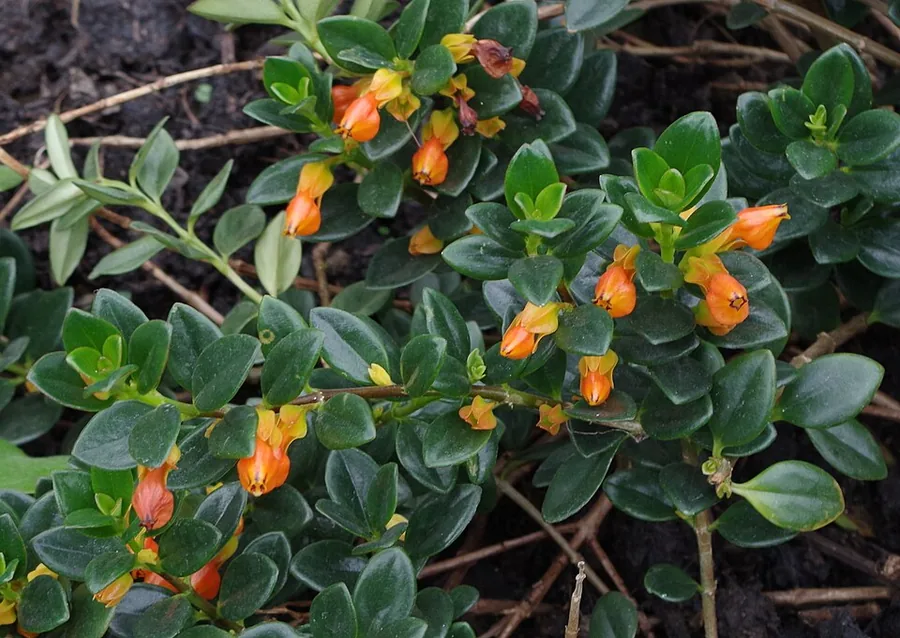
The goldfish plant earns its name from its pouched orange flowers, each one curved and puffed like a tiny fish. It comes from the rainforests of southeast Brazil, where it grows as an evergreen that drapes over branches rather than standing upright. Indoors it makes an easygoing trailing houseplant for a hanging basket or a high shelf.
Glossy dark green leaves line the arching, trailing stems, and the flowers appear through summer against that backdrop. The plant stays small, reaching maybe 4 to 20 inches (10 to 50 cm) tall while spreading wider as the stems lengthen. That trailing habit is the whole point, so give it somewhere its stems can spill over an edge.
It asks for little. Bright indirect light, warmth, and humid air keep it healthy, and a pinch after flowering keeps it full instead of leggy. Pet owners can relax too, since every part of this plant is safe around cats, dogs, and other animals.
Care
The short version: bright filtered light out of harsh sun, warmth, and humid air. Keep the peat-free mix moist but let the surface dry a touch between waterings, feed monthly through the growing season, and pinch the stems back after the flowers fade.
Light
Give it bright, filtered light near a window but out of harsh direct sun, which scorches the leaves. An east- or west-facing spot suits it well, and a south window works behind a sheer curtain. Too little light and the plant trails on but stops blooming.
Water
Keep the mix moist but well drained, letting the top inch or so dry before you water again. Soft water suits it best, since it dislikes the salts in hard tap water. Ease off in winter when growth slows.
Soil
Plant it in a loam or sand-based, peat-free potting mix that holds moisture but drains freely. It is happy across a wide pH band of 5.5 to 7.5, so anything from slightly acidic to neutral works fine.
Temperature
Warmth keeps it growing, ideally between 50°F and 81°F (10°C to 27°C). It cannot take a chill, so keep it well above 50°F (10°C) and away from cold drafts and frosty windowpanes.
Humidity
This is a rainforest plant that wants high humidity. Dry indoor air leaves the foliage tired and the buds reluctant, so group it with other plants, set it on a pebble tray, or run a humidifier nearby.
Feeding
Feed monthly through spring and summer while the plant is in active growth, using a balanced dilute liquid houseplant fertilizer. Stop feeding over the cooler months when growth rests.
Pruning
Pinch the stems back after flowering to keep the plant bushy and stop it going bare and leggy at the base. It is low maintenance otherwise, and the trimmings root easily into new plants.
Repotting
Move it up a pot size every 2 to 3 years or once it outgrows its container. This is a slow to moderate grower that takes about 2 to 5 years to reach full size, so it rarely needs disturbing. Roots circling the drainage holes or soil that dries out fast are your cue.
Size & spacing
Expect a compact plant, 4 to 20 inches (10 to 50 cm) tall, with stems trailing out to a spread of 1.5 to 3 feet (50 to 100 cm). Hang it or set it high so the stems have room to cascade.
Troubleshooting
A goldfish plant rarely gives much trouble. When it does, the signs show up on the leaves or in a shortage of flowers. Match what you see below and adjust before it sets the plant back.
Sticky leaves and tiny insects clustered on new growth
Those soft pear-shaped bugs are aphids, and the sticky film they leave is honeydew. Rinse them off with a stream of water, then treat the plant with insecticidal soap and repeat until they're gone. Keep it apart from your other houseplants until it's clean.
Fix:
- Rinse plant with a stream of water to dislodge aphids
- Apply insecticidal soap to affected areas, repeating as needed
- Isolate the plant from other houseplants until controlled
Plenty of leaves but few or no flowers
A goldfish plant that won't bloom is almost always short on light. Move it to a brighter spot with bright, filtered light near a south, east, or west window, just out of the harsh midday sun. A pinch after each flush of flowers also pushes it toward bushier, more floriferous growth.
Fix:
- Move to a brighter spot with bright, filtered light (e.g., near a south-, east-, or west-facing window out of harsh direct sun)
- Pinch after flowering to encourage bushier, flowering growth
Toxicity
Good news for a home with animals: the goldfish plant is safe. Both the ASPCA and NC State Extension list it as non-toxic, so a curious nibble won't poison a pet. The most that can happen is a bit of mild stomach upset from eating any houseplant, which passes on its own.
Safe for
People · Cats · Dogs · Horses · Rabbits · Livestock · Birds
Cats None
The ASPCA lists this plant as non-toxic to cats, so a curious chew won't poison one. A cat that eats a lot of foliage might get a passing bout of stomach upset, nothing more.
Dogs None
Dogs are in the clear here too, with the goldfish plant rated non-toxic by the ASPCA. The worst a big mouthful tends to cause is some mild, short-lived tummy trouble.
Horses None
NC State Extension lists the plant as non-toxic to horses, so there's nothing to worry about if one grazes a stray leaf.
Rabbits None
No toxins here put a rabbit at risk. As with any new green, introduce it in small amounts so the gut adjusts gently.
Livestock None
This is a tender indoor plant that livestock rarely meet, and it carries no compounds known to harm grazing animals.
Birds None
Pet birds are safe around it, with no toxic parts to fret over if one nibbles a leaf.
People None
The goldfish plant poses no poisoning risk to people. It isn't grown to eat, but a child who tastes a leaf is in no danger.
Varieties
Most goldfish plants sold are the plain species, but a couple of variegated forms turn up for anyone after patterned foliage.
'Golden West' (variegated)
An RHS-recognized variegated selection whose dark leaves carry creamy markings for a two-toned look.
'Variegatus'
Another RHS-listed variegated form, grown for its patterned foliage rather than the plain green of the species.
How to propagate
The goldfish plant is simple to multiply, and stem cuttings give you new trailing plants for the cost of a little patience.
Stem cuttingsEasy
Spring · Several weeks to root; reaches full size in about 2-5 years
Take softwood stem-tip cuttings in spring, the standard method noted by both the RHS and NC State Extension. They take several weeks to root, and from there the young plant fills out slowly, reaching full size in about 2 to 5 years.
Myths
The goldfish plant is poisonous to cats and dogs and has to be kept away from pets.
The ASPCA lists it as non-toxic to cats and dogs, and NC State Extension adds horses to that safe list. It is safe to keep around pets, and the worst a nibble might bring is the mild stomach upset that eating any houseplant can cause.