Tree · Fabaceae
Honey Locust
Gleditsia triacanthos
Tough, fast, and forgiving, the honey locust throws dappled shade over the worst urban ground.
Full sun
Every 7–14 days
USDA 3–9
30–79 ft · 9–24 m
Overview
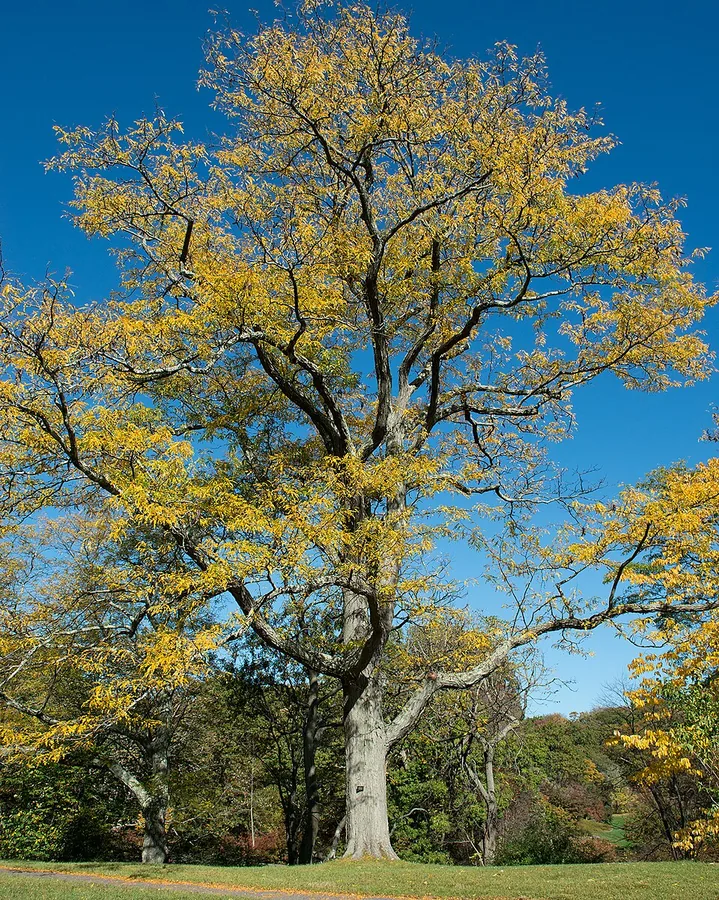
The honey locust is a fast-growing legume tree native to central North America, named for the sweet pulp tucked inside its long, twisting pods. It casts a light, dappled shade that lets grass and flowers grow right up to the trunk, which is part of why it became such a common street and yard tree. Left wild it can reach 30 to 80 feet (9 to 24 m), with a broad, open crown.
Almost nothing fazes it. The tree handles clay, sand, drought, road salt, compacted soil, and alkaline city ground, and it rides out winters down to -40°F (-40°C) and summers up to 100°F (38°C). That range, from zone 3 to zone 9, is why you see it growing where fussier trees give up.
The catch is the wild form, which arms its trunk and branches with long, branched thorns and drops heavy pods. Breeders solved both problems with thornless, seedless cultivars of var. inermis, and those are what nurseries sell. Pick one of those and you get all the toughness without the mess or the spikes.
Care
The short version: full sun and almost any soil will do. Water it well for the first couple of years, then step back, because a settled honey locust is one of the most drought-tolerant shade trees you can plant.
Light
Plant a honey locust in full sun for the densest crown and best growth. It will put up with part shade, but it grows fastest and stays healthiest out in the open with at least six hours of direct light.
Water
Give a young tree a regular soak for its first one to two years while the roots reach out. After that it is very drought tolerant and rarely asks for water at all, so let the top half of the soil dry between drinks.
Soil
Few trees are this easygoing about soil. It thrives in moist, rich loam but tolerates clay, sand, poor ground, compaction, salt, and alkaline city dirt, across a wide pH band of 6.0 to 8.0.
Temperature
This is a cold-hardy tree built for extremes, comfortable from -40°F to 100°F (-40°C to 38°C). That toughness covers USDA zones 3 through 9 and lets it grow where many shade trees can't.
Humidity
Outdoor humidity is never an issue for an established tree, so there's no level to manage. Good air movement through the crown does more good, since it helps foliage dry and keeps mite and disease pressure down.
Feeding
As a legume, the honey locust feeds itself and rarely needs more. Skip the fertilizer unless the soil is genuinely poor, and then give just a single balanced slow-release dose in spring.
Pruning
Prune in late winter to early spring while the tree is dormant. Train it to one strong central leader when young, and cut out any crossing, dead, or damaged wood to keep the structure clean.
Repotting
A honey locust belongs in the ground rather than a pot, so repotting rarely comes up. If you do hold a young tree in a container, move it on once roots circle the inside or push out the drainage holes.
Size & spacing
Give this tree real room, because it can reach 30 to 80 feet (9 to 24 m) tall and spread 25 to 50 feet (8 to 15 m) wide. Set it well clear of buildings, walls, and other trees so the broad crown has space to fill out.
When to plant
The honey locust keeps a simple yearly rhythm. Plant it in spring or fall, watch for small fragrant flowers in late spring, and look for the long brown pods to ripen and drop through early autumn.
Northern hemisphere
Southern hemisphere
Typical months for a temperate climate: start earlier in warm zones, later where spring frosts linger.
- Plant: Spring or fall
- Harvest: Inconspicuous fragrant greenish-yellow flowers in late spring (May to June); flat twisted brown seed pods ripen September to October.
Hardiness
USDA hardiness zones: 3–9
Temperature: down to -40°C
Troubleshooting
A honey locust is hardy, but a few pests and one serious fungus turn up often enough to know on sight. Most of the leaf damage looks alarming and amounts to little. The cankers are the ones to take seriously, so match what you see below before you reach for the pruning saw.
Sunken cankers on the bark with branch dieback
Sunken, discolored lesions that ring branches and the trunk signal Thyronectria or Nectria canker, fungi that exploit trees already weakened by drought, wounds, or crowding. There is no spray cure, so prune well below each canker in dry weather and disinfect your tools between cuts. Take out a badly cankered tree before it spreads, and keep the rest vigorous with steady water and no bark injuries.
Fix:
- Prune out infected branches well below the canker during dry weather and disinfect tools
- Remove and destroy severely cankered trees
- Improve vigor with proper watering and avoid bark wounds
Leaflets bound in silk webbing and skeletonized by midsummer
Silk-spun webbing full of small caterpillars points to the mimosa webworm, which hits golden-leaved cultivars like Sunburst hardest. Prune out the small nests as soon as they appear and treat young caterpillars with Bt. Rake up the debris under the tree where the pupae spend the winter.
Fix:
- Prune out and destroy small webbed nests early
- Apply Bt (Bacillus thuringiensis) while caterpillars are small
- Clean up debris beneath the tree where pupae overwinter
Swollen pod-shaped galls on leaflet tips and early leaf drop
Those swollen, pod-like growths are the work of the honeylocust pod gall midge, whose maggots develop inside deformed leaflets. An established tree shrugs off a light attack and is rarely harmed. If galls take over, spray horticultural oil on the new tips in March or April and cut out the worst shoots.
Fix:
- Tolerate light infestations on established trees, which are rarely killed
- Apply horticultural oil to terminals in March-April to kill eggs
- Prune and destroy heavily galled shoots
Twisted, stunted new growth in spring
Warped or dwarfed spring leaves usually come from the honeylocust plant bug feeding on the soft, expanding foliage, and the damage looks worse than it is. The tree grows out of it, so light early-season feeding is fine to leave alone. Later in summer, fine stippling and webbing means spider mites instead, which a hard spray of water or a dose of insecticidal soap will knock back.
Fix:
- Tolerate minor early-season plant bug damage; trees usually recover
- Hose down foliage to dislodge spider mites
- Use insecticidal soap or horticultural oil for heavy mite outbreaks
Toxicity
Good news for a household with animals: the honey locust is safe. The ASPCA lists it as non-toxic to dogs, cats, and horses, and the sweet pods are eaten by livestock and wildlife every fall. The only real hazard is physical, the long sharp thorns on wild trees, which is exactly why landscape cultivars are bred thornless.
Safe for
People · Cats · Dogs · Horses · Rabbits · Livestock · Birds
Cats None
Nothing to worry about here. A cat that bats at a fallen leaflet or chews a twig won't be poisoned.
Dogs None
Safe for dogs. A pup that gnaws a dropped pod may swallow more roughage than its stomach likes, but the tree itself carries no toxin.
Horses None
Horses can graze around it without harm, and the sweet pods are a treat rather than a threat.
Rabbits Safe
No poison concern for rabbits. The bark and twigs are simply rough browse, not anything dangerous.
Livestock None
Pods are a palatable, nutritious feed eaten without ill effect. Cattle, goats, and sheep have fed on them for generations.
Birds Safe
Birds are fine around it, and wildlife strips the sweet pods every fall without any trouble.
People Safe
The sweet pulp inside the ripe pods has long been eaten by people. The real hazard is the wild form's long, sharp thorns, so handle thorny trunks with care.
The wild species bears large, sharp, branched thorns on the trunk and branches that can cause puncture injuries; landscape cultivars are typically thornless.
Varieties
Nearly every honey locust sold for a yard or street is a named thornless cultivar. These are the ones you'll run into most.
Shademaster
A vigorous, thornless and nearly seedless form with a vase shape and ascending branches that has become a tough, dependable street tree.
Skyline
A thornless, podless cultivar with a pyramidal outline, a strong central leader, and clean golden-yellow color in fall.
Sunburst
A thornless, seedless selection prized for its bright golden new foliage, though it is the one most often hit by mimosa webworm and pod gall midge.
Imperial
A thornless, seedless cultivar that stays compact and rounded with neat horizontal branching.
var. inermis
The naturally thornless botanical form, its name meaning unarmed, from which most landscape cultivars are selected.
How to propagate
You can raise a honey locust from its own seed, but the named cultivars are a different matter and have to be cloned to keep their best traits.
SeedModerate
Spring after collecting ripe pods in fall · 1 to 2 growing seasons to a transplantable seedling
Gather ripe pods in fall and sow in spring, but first break the hard, waterproof seed coat by scarifying it with a file, hot water, or concentrated sulfuric acid, or nothing will sprout. Give the seedling one to two growing seasons to reach transplant size. Keep in mind that the offspring of a thornless tree don't run true, since only about 60 percent come up thornless.
GraftingDemanding
Late winter to spring (grafting) or summer (budding) · 1 to 2 growing seasons
Because the named thornless, seedless cultivars never come true from seed, nurseries graft them in late winter to spring or bud them in summer onto seedling rootstock. That keeps the exact clone intact, and the young tree settles in over one to two growing seasons.
Myths
Honey locust is poisonous to pets and livestock like the other locust trees.
Honey locust gets blamed for the sins of the black locust (Robinia pseudoacacia), a different tree it is often confused with. Honey locust is non-toxic, and its sweet pods are eaten by livestock and wildlife. It is black locust that carries the toxalbumins that poison dogs and horses.
A honey locust planted in the yard will grow vicious thorns and drop messy pods.
The wild tree does carry fierce branched thorns and long pods, but that is not what nurseries sell. Most landscape trees are thornless cultivars of var. inermis, and many of them are seedless and podless on top of that.