Tree · Fabaceae
Black Locust
Robinia pseudoacacia
A tough, fast tree that fixes its own nitrogen and thrives where little else will, thorns, brittle limbs, and all.
Full sun
Every 14–30 days
2190–2920 days
USDA 3–8
Overview
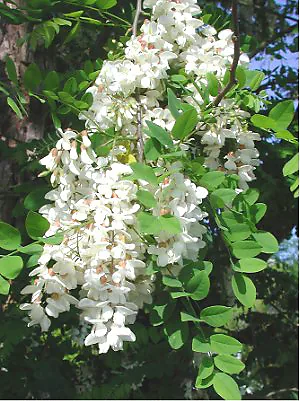
Black locust is a fast-growing North American tree from the pea family, native to the Appalachian and Ozark country and now spread far beyond it. It shrugs off poor, dry, eroded ground that defeats most trees, because it fixes its own nitrogen through its roots. In late spring it hangs heavy with drooping clusters of fragrant white pea-like flowers.
What makes it useful also makes it a handful. It races skyward to 30 to 50 feet (9 to 15 m), throws up root suckers, and seeds itself into dense thickets, which is why it's treated as invasive in many places outside its home range. The wood is famously rot-resistant and hard, yet the standing limbs are brittle and prone to snapping in storms.
There's one more thing to know before you plant it. Nearly every part of the tree, the bark, leaves, seeds, and young sprouts, is poisonous, and horses are hit hardest of all. Only the flowers escape the toxalbumins the rest of the tree carries.
Care
The short version: give it full sun and almost any well-drained soil, even poor and dry, then mostly leave it alone. Water young trees through their first summers, prune the brittle wood while dormant, and stay on top of the root suckers.
Light
Plant it in full sun for the best form and flowering, though it will take some partial shade. Like most legumes it wants light to drive its fast growth, and a crowded, shaded site leaves it thin and leggy.
Water
Once established this is one of the most drought-tolerant trees you can grow, content on dry, sandy, eroded ground. Water young transplants through their first summers, but a mature tree rarely needs any help, watering only every 14 to 30 days at most in a dry spell.
Soil
It handles poor to average, well-drained soil that would starve other trees, including dry, sandy, rocky, and eroded sites, because it fixes its own nitrogen. The pH range is wide, from 4.6 to 8.2, so acidic or alkaline ground both suit it.
Temperature
Black locust is cold-hardy and heat-tough, taking anything from -40°F to 104°F (-40°C to 40°C). That range covers hardiness zones 3 through 8, which is most of the temperate map.
Humidity
Ordinary outdoor humidity is fine, and there's no number worth chasing for a landscape tree. It adapts to dry and humid climates alike across its broad range.
Feeding
As a nitrogen-fixing legume it makes much of its own fertility, so it needs little to no feeding. Skip the high-nitrogen fertilizers in particular, since they push soft, weak growth on a tree that's already brittle.
Pruning
Prune in late winter or early spring while the tree is dormant, taking out dead, crossing, weak, or storm-damaged limbs and raising the crown. Cut back root suckers regularly to slow its spread, and wear gloves, because the young growth bears sharp paired spines.
Repotting
This doesn't apply once the tree is in the ground. Only young container or balled-and-burlapped stock gets transplanted, and that's best done while the tree is dormant.
Size & spacing
Give it real room. A mature black locust reaches 30 to 50 feet (9 to 15 m) tall and spreads 20 to 35 feet (6 to 11 m) wide, so site it well clear of buildings, walkways, and parking where its brittle limbs could fall.
When to plant
Black locust asks little about timing. Sow scarified seed in late winter, or set out young trees in spring after the last frost or in fall while they're dormant. The fragrant white flowers follow in late spring, roughly April through June.
Northern hemisphere
Southern hemisphere
Typical months for a temperate climate: start earlier in warm zones, later where spring frosts linger.
- Sow: Late winter; scarify seed (hot water or acid) before sowing to break hard seed coat.
- Plant: Spring after the last frost, or fall, while dormant.
- Harvest: Fragrant white pea-like flowers in drooping clusters in late spring (April to June).
Hardiness
USDA hardiness zones: 3–8
Temperature: down to -40°C
Troubleshooting
Most black locust trouble is structural or comes from a couple of well-known insects rather than from disease. Learn the borer, the leafminer, and the tree's own brittle wood, and you've covered nearly everything that goes wrong. Match what you see below, then act before a weak limb finds a target.
Holes, sawdust, and swollen knots along the trunk and limbs
This is the locust borer, whose larvae tunnel through the trunk and branches until the wood gives way in a storm. Watch for round exit holes, frass that looks like sawdust, and black-and-yellow beetles on the flowers in late summer. Keep the tree vigorous, prune out badly infested limbs, and take down any hazard tree standing over a target.
Fix:
- Maintain vigorous tree health to resist attack
- Prune out and destroy heavily infested, dead, or hazardous limbs
- Remove severely declining hazard trees near targets
Brittle limbs snapping in wind and ice storms
Black locust has naturally weak, brittle wood that breaks under storm load, and borer tunneling only makes it worse. Look for cracked unions and dead or overextended limbs hanging over anything you care about. Prune out the weak and hazardous wood while the tree is dormant, and plant it well clear of buildings and walkways in the first place.
Fix:
- Prune out weak, dead, and hazardous limbs while dormant
- Reduce long, heavy limbs over walkways or structures
- Remove hazardous trees near high-use areas
Leaves turning brown and skeletonized by late summer
This is the locust leafminer, whose larvae and small orange-and-black beetles mine and skeletonize the leaflets until the whole crown looks scorched. The damage is cosmetic, and the tree leafs out fine the next spring. Rake up heavy litter and keep young trees watered, but there's no need to spray an established tree.
Fix:
- Tolerate damage as it rarely kills established trees
- Rake and remove heavy leaf litter
- Maintain tree vigor with adequate moisture for young trees
Toxicity
Treat this as a toxic tree. Every part but the flowers, the bark, leaves, seeds, and sprouts, holds toxalbumins that block protein synthesis and can poison fatally. Horses are the most vulnerable, and chewed bark alone has killed them, so keep stock, pets, and children well away from the wood and seed pods.
Toxic to
Cats · Dogs · Horses · Rabbits · Livestock · Birds · People
Cats Moderate
A cat that chews the bark, leaves, or seeds can start vomiting and turn dull and off its food. Watch for weakness, labored breathing, and bloody diarrhea, and call a vet if any of it shows up.
Dogs Moderate
Dogs that gnaw the bark or swallow seed pods tend to vomit, lose their appetite, and grow weak and listless. Trouble breathing or blood in the stool means it's time to get to a vet.
Horses Severe
Horses are the most at risk, and even a little chewed bark can be dangerous. Expect depression, no appetite, weakness, colic, and a weak or uneven pulse, and in bad cases the brain is affected and the animal dies.
Rabbits Toxic
The same toxalbumins in the bark, leaves, and seeds hit rabbits hard, bringing on gut upset, weakness, and a refusal to eat. Keep prunings and fallen pods well out of reach.
Livestock Severe
Cattle, goats, and sheep that strip bark, sprouts, or seeds can go down with depression, weakness, and bloody diarrhea, and poisoning has killed them outright. Fence stock away from the trees and any cut wood.
Birds Toxic
The seeds and bark carry the same protein-blocking toxins for birds, so a curious bird that pecks at pods or sprouts can fall ill. Don't leave seed pods where poultry or pet birds forage.
People Caution
Only the fragrant flowers are eaten, and just after cooking; the bark, leaves, seeds, and sprouts are toxic and have poisoned children who chewed them. Teach kids to leave every part but the blossoms alone.
Wear gloves when pruning to avoid the sharp paired thorns, and keep bark, seed pods, prunings, and sprouts away from horses, livestock, pets, and children.
Helpline numbers

United States
ASPCA Animal Poison Control: (888) 426-4435 (fee applies)
Poison Control: (800) 222-1222



Canada
Poison Centres: 1-844-764-7669
Varieties
A few ornamental cultivars are grown for flower color, leaf color, or shape, though most keep the same brittle wood as the wild tree. These are the ones you'll run into.
Purple Robe
Grown for its showy rose-pink to purple flowers and bronzy new growth, though it still carries the species' weak wood.
Frisia
Holds golden-yellow foliage all season, but the wood stays as brittle and break-prone as the wild tree's.
Twisty Baby (Lace Lady)
A dwarf with contorted, twisting branches that rarely flowers and keeps the same brittle wood.
Umbraculifera
Thornless, with a dense, rounded mop-head crown that rarely puts on flowers.
How to propagate
Black locust multiplies almost too easily, by seed, by root suckers, and by graft for the named forms. Each route suits a different goal, from raising a new tree to keeping a cultivar true.
SeedModerate
Spring · 1-2 seasons
Start from seed in spring, but the hard coat won't sprout until you scarify it, either with near-boiling water for about a minute or an acid soak. Once treated, the seed comes up and takes a season or two to settle in, and stored seed still germinates after 10 or more years.
DivisionEasy
Dormant season · 1 growing season
The tree spreads itself by root suckers, so this is the easy way to multiply it during the dormant season. Suckers and dormant root cuttings from a quarter inch to an inch thick root readily and fill in within a single growing season, which is exactly why the tree is so hard to contain.
GraftingDemanding
Dormant season or summer budding · 1-2 seasons
Named cultivars like Purple Robe and Frisia won't come true from seed, so they're budded or grafted onto seedling rootstock instead. Do it in the dormant season or bud in summer, and give the union a season or two to take.
Myths
Black locust is harmless because it is a native legume like edible beans and its flowers are eaten.
The flowers do turn up in some foods and the tree fixes its own nitrogen, but that's where the safety ends. The bark, leaves, seeds, and sprouts all carry toxalbumins that can poison fatally, horses most of all.
Black locust is a tidy, well-behaved shade tree.
It throws up root suckers and seeds itself into dense thickets, and it's invasive well outside its native range. The wood is brittle and hazard-prone, and locust borers only weaken it further.