Houseplant · Apocynaceae
Hindu Rope Hoya
Hoya carnosa 'Compacta'
Give it bright light and a dry-leaning watering hand, and this curly-leaved wax plant rewards you for years.
Bright indirect
50–75°F · 10–24°C
USDA 10–12
2–3 ft · 0.5–1 m
Overview
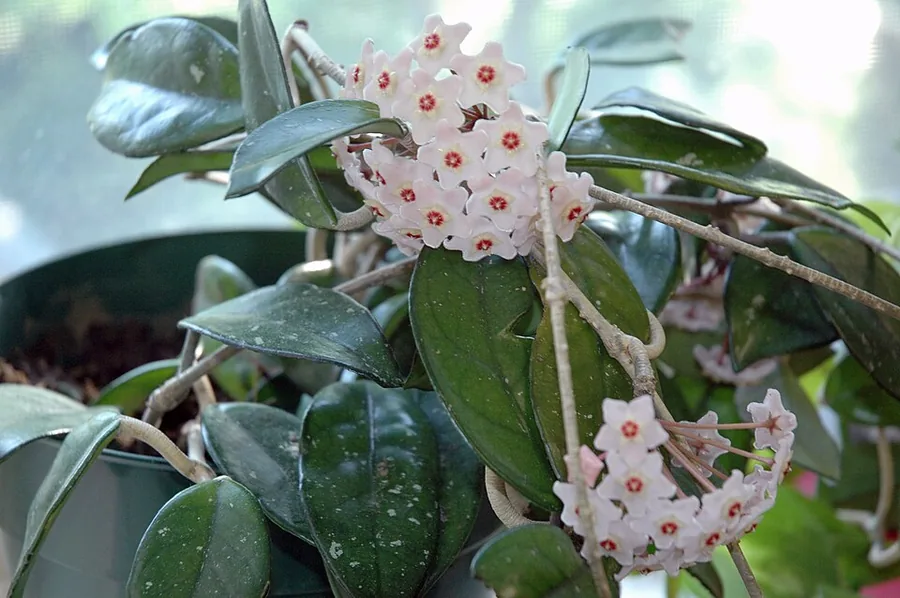
The Hindu rope hoya is a wax plant grown for its odd, beautiful leaves, which curl and fold back on themselves into thick, rope-like trails. It is a naturally occurring mutation of the common Hoya carnosa, so it shares that plant's easy temperament while looking nothing like it. The trailing stems suit a hanging pot or a high shelf where they can spill down.
It is a slow grower, and that patience is the trade for how long it lasts. Plants live for years in the same pot, and old, established specimens reward you with clusters of star-shaped, sweetly scented flowers. Those blooms come from short woody spurs that the plant keeps and reuses, so they return to the same spots season after season.
Care is forgiving once you understand what it wants. The twisted leaves store their own water, which makes the plant tough but rot-prone if you are too generous with the watering can. Bright light, a fast-draining mix, and a hands-off attitude toward repotting cover most of what it needs.
Care
The short version: bright indirect light with a little direct sun, a fast-draining mix, and water only once it has dried out. Feed monthly in the growing season, keep it warm and humid, and leave the old flower spurs alone.
Light
Give it bright indirect light with some direct sun, which is what coaxes out the flowers. It will get by in partial sun or partial shade, but a dim corner means a plant that grows slowly and rarely blooms. Keep it out of harsh midday sun, which can scorch the leaves.
Water
Let the mix dry out between waterings and lean toward too little rather than too much. The dense, water-storing leaves already hold their own reserves, which makes this cultivar especially prone to rot, so cut back further in winter when growth slows.
Soil
Use a loose, fast-draining mix that is loam-based and rich in organic matter, such as potting soil cut with orchid bark and perlite. It is relaxed about pH, happy anywhere from 6.0 to 8.0. What matters most is that water moves through fast.
Temperature
Keep it in the range of 50°F to 75°F (10°C to 24°C), which is comfortable indoor warmth for most homes. It dislikes cold drafts, so move it away from chilly windows and doors in winter.
Humidity
This plant likes high humidity, more than the average home offers. A tray of damp gravel under the pot or a spot in a steamy bathroom helps, and the added moisture also keeps spider mites at bay.
Feeding
Feed monthly from spring through autumn while it is actively growing, using a dilute liquid feed. A formula higher in nitrogen and potassium, such as a 2:1:2 or 3:1:2 NPK, encourages it to flower.
Pruning
It needs almost no pruning and resents being cut back hard, so in late winter or early spring take out only weak or crowded shoots. Whatever you do, never cut off the bare flower spurs after blooming, because new flowers form again on those same old stalks.
Repotting
Repot rarely, because this plant resents the disturbance and is content to stay in the same pot for years. Wait for clear signs it is rootbound, like roots pushing out the drainage holes, growth stalling, or the pot drying out unusually fast after a watering.
Size & spacing
The trailing stems reach 1.5 to 3 feet (50 to 100 cm) long over many years of slow growth, with a spread of 4 to 20 inches (10 to 50 cm). Give it room to dangle from a hanging pot or shelf so the rope-like growth shows off.
Troubleshooting
Most trouble with a Hindu rope comes back to watering or light. The thick leaves are good at hiding both thirst and rot, so read the signs below early and act before a small problem spreads through the plant.
Soft, blackening stems and mushy roots
This is root rot, and on a Hindu rope it sets in fast because the thick, water-storing leaves already hold their own reserves, so a wet mix tips the plant over the edge. Stop watering and let the soil dry, then unpot it, cut away any brown and soft roots, and replant into fresh fast-draining mix. If the rot has gone far, take a few healthy cuttings as insurance.
Fix:
- Stop watering and let the soil dry out
- Unpot, cut away rotted roots, and repot into fresh fast-draining mix
- Take healthy stem cuttings as insurance if rot is advanced
Cottony patches, sticky film, or fine webbing on the plant
The deep folds of the leaves hide mealybugs, scale, and spider mites, so check the undersides and crevices closely. Dab the cottony mealybugs and bumpy scale with a cotton swab dipped in isopropyl alcohol, then treat the whole plant with insecticidal soap or neem oil and repeat until they are gone. Mites hate moisture, so raising the humidity helps keep them off.
Fix:
- Dab mealybugs/scale with a cotton swab dipped in isopropyl alcohol
- Treat with insecticidal soap or neem oil, repeating as needed
- For spider mites, use insecticidal soap/neem and raise humidity
The plant grows but never produces flowers
Most often the cause is too little light, since a Hindu rope needs bright light with some direct sun before it will bloom. The other common reason is that the bare flower spurs were cut off after an earlier bloom, because new flowers form on those same old spurs. Move it somewhere brighter, leave every spur in place, and give a young plant time, as many wait until they are two or three years old to flower.
Fix:
- Move to a brighter spot with bright indirect light plus some direct sun, but avoid scorching midday sun
- Stop removing the bare flower stalks - leave all spurs/peduncles in place
- Be patient with young plants until they mature
Leaves turn shriveled, wrinkled, or limp
When the curled leaves go soft and wrinkled, the mix has usually been bone dry far too long. Give the plant a thorough soak until water runs from the drainage holes, and the leaves plump back up within a day or two. Keep watering steady through the growing season instead of swinging between flooded and parched.
Fix:
- Water thoroughly until it drains, then resume letting the top dry between waterings
- Keep watering consistent through the growing season
Toxicity
Good news for pet owners: the Hindu rope hoya is non-toxic and safe to keep around animals and children. The ASPCA and NC State Extension both clear the wax plant for cats, dogs, and horses, so a stray nibble is no cause for alarm. The milky sap is only a little sticky, so wash your hands after pruning.
Safe for
People · Cats · Dogs · Horses · Rabbits · Livestock · Birds
Cats None
The ASPCA lists this wax plant as non-toxic to cats, so a curious nibble is nothing to worry about. A cat that eats a lot of any houseplant might get a brief upset stomach, but the plant itself carries no real danger.
Dogs None
Dogs are safe around it too, with the ASPCA marking the wax plant non-toxic for them. The most you might see from a big mouthful is some mild, passing stomach upset.
Horses None
NC State Extension tags Hoya carnosa as non-toxic to horses, so there is no poisoning risk if one grazes on it.
Rabbits None
No toxic compounds are reported in this plant, and a rabbit can sample a leaf without harm. As with any rich houseplant, keep tastes small so the gut stays settled.
Livestock None
Grazing animals face no toxicity from the wax plant. The thick, waxy leaves are not appealing forage, and they are safe even if browsed.
Birds None
Pet birds can perch and pick at it without any toxic effect. The plant holds nothing that would harm a bird that takes a bite.
People None
The plant is not poisonous to people, though it is grown for looks rather than eating. The milky sap is a little sticky, so wash your hands after pruning.
Non-toxic, but ingestion of any houseplant can occasionally cause mild GI upset; the sap is mildly sticky/milky
Varieties
The Hindu rope is itself a single named cultivar of the wax plant rather than a group of types, so there is really just one to know.
Hoya carnosa 'Compacta'
This is the Hindu rope plant itself, a naturally occurring mutation of Hoya carnosa whose leaves curl and fold tightly into rope-like strands on a slow-growing vine.
How to propagate
A Hindu rope is easy to copy, and you have two simple paths: root a cutting, or let a trailing stem root itself where it lies.
Stem cuttingsEasy
Spring or early summer · Roots in about 2-3 weeks
Take semi-ripe stem or tip cuttings in spring or early summer, making sure each piece includes a node, and stand them in water or moist mix where they root in about 2 to 3 weeks. The stems also put out roots along their length on their own, so you can pin one down and layer it without ever cutting it free.
Myths
Cut off the bare flower stalks once the blooms have faded.
Those bare stalks, called spurs or peduncles, are exactly where the next round of flowers will form. Leave every spur in place, because cutting them off throws away future blooms.
The Hindu rope plant is its own species called Hoya compacta.
Kew's plant database lists Hoya compacta as a synonym, not an accepted species. The Hindu rope is really the cultivar Hoya carnosa 'Compacta', a naturally occurring mutation of the parent wax plant.