Ornamental · Convolvulaceae
Dichondra
Dichondra
A low mat of coin-shaped leaves that works as a lawn you barely mow or a silver waterfall over a pot.
Full sun
Every 3–7 days
60–120 days
USDA 8–12
Overview
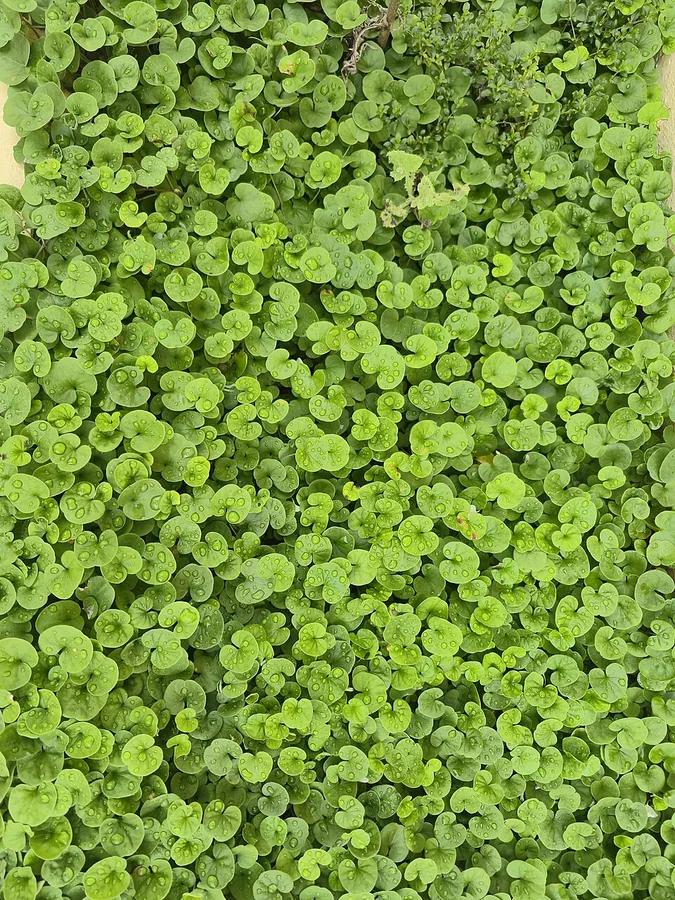
Dichondra is a low, mat-forming groundcover in the morning glory family, named for the small kidney-shaped leaves that give it common names like ponysfoot and kidney-weed. It stays only an inch or two off the ground and spreads sideways by stems that root as they go, so a few plants can knit into a wide carpet. Gardeners reach for it in warm regions where a soft green mat beats a thirsty, high-mow lawn.
The name covers two very different plants. The green lawn types, D. repens and D. micrantha, make a fine low-mow turf substitute that likes steady moisture. The silver-leaved 'Silver Falls' is a drought-tolerant trailer grown for the way its felted stems pour over the edge of a container or basket. There's also a wild relative, D. carolinensis, that shows up uninvited in weak turf.
None of it asks for much beyond sun and good drainage. The plant takes full sun to partial shade and handles a wide swing of temperatures, but it will rot in soggy ground and sulks under heavy foot traffic. Give it a well-drained spot and a little patience while it fills in, and it largely takes care of itself.
Care
The short version: full sun to partial shade in well-drained soil, with steady moisture for the green lawn types and a much drier hand for silver 'Silver Falls', plus good drainage in every case.
Light
Dichondra grows best in full sun but takes partial sun and partial shade without much complaint. The green lawn types stay denser in good light, while 'Silver Falls' keeps its bright silver color best where the sun reaches it.
Water
Here the two kinds part ways. Green lawn dichondra likes steady moisture and has high water needs, while silver 'Silver Falls' is very drought tolerant once established and prefers dry to medium soil. Both insist on good drainage, so water on a roughly 3 to 7 day rhythm and never let the ground stay soggy.
Soil
Plant in well-drained sandy loam or a decent garden loam, since drainage matters most of all for groundcover use. A pH anywhere from 6.0 to 7.5 suits it, so most ordinary garden soil is already in range.
Temperature
Dichondra handles a wide span, from about 30°F to 100°F (-1°C to 38°C), which is why it thrives in warm-climate gardens. Cold is its weak point, and 'Silver Falls' in particular is frost tender and killed off by a freeze.
Humidity
Average outdoor humidity is all it asks, so there's no level to chase. Damp, crowded foliage is the only real risk, since prolonged leaf wetness invites leaf spot.
Feeding
Feed monthly through the spring and summer growing season. Give the green lawn types a higher-nitrogen feed to push dense, even growth, and keep 'Silver Falls' on a much lighter diet so it trails rather than bulks up.
Pruning
Trim the trailing stems to shape the plant and keep its spread in check, which matters since it spreads by rooting at the nodes. The green lawn type is forgiving here, so you can mow it or leave it unmown as you prefer.
Repotting
Container plants want repotting seasonally, especially the fast-growing 'Silver Falls'. Move them up when roots start circling the pot, the rootball dries out fast after watering, or the stems cascade well past the rim with little new growth.
Size & spacing
Each plant stays low, only 1 to 3 inches (2 to 8 cm) tall, but spreads wide, reaching 2 to 4 feet (60 to 120 cm) across. Set plants far enough apart to let the rooting stems close the gaps and knit into a continuous mat.
When to plant
Dichondra is a warm-season grower with little tolerance for hard cold. Start seed indoors in early spring, about 6 to 8 weeks before your last frost, then sow or set plants out from April to May once the soil has warmed. Expect inconspicuous greenish-yellow to white flowers in May and June.
Northern hemisphere
Southern hemisphere
Typical months for a temperate climate: start earlier in warm zones, later where spring frosts linger.
- Sow: early spring, about 6-8 weeks before last frost
- Plant: after last frost when soil has warmed, April to May
- Harvest: inconspicuous greenish-yellow to white flowers May to June
Hardiness
USDA hardiness zones: 8–12
Temperature: down to -12°C
Troubleshooting
Most dichondra problems trace back to the site rather than the plant. Thin spots, rot, and pest damage all tend to follow heavy traffic, poor drainage, or a stand that never filled in. Match what you see below and fix the conditions first.
Yellowing and collapse in cold or waterlogged ground
Soggy, poorly drained soil brings on root and stem rot, while cold finishes off 'Silver Falls', which is frost tender. Improve drainage, ease off the watering, and move container 'Silver Falls' under cover before the first frost. Plants set in well-drained sandy loam can be replanted in spring once the soil warms.
Fix:
- Improve drainage and reduce irrigation frequency
- Move container 'Silver Falls' under cover or indoors before frost
- Plant in well-drained sandy loam
- Replant in spring once soil warms
Bare, thin patches along paths and play areas
Dichondra is slow to establish and never takes kindly to being walked on, so the busiest stretches stay sparse while sheltered corners knit together. Keep it to small, low-traffic spots and stay off the mat until it has filled in. Overseed the thin areas, keep them evenly moist, and feed with nitrogen to push dense growth.
Fix:
- Limit dichondra lawns to small, low-traffic areas
- Keep foot traffic off until the mat is fully established
- Overseed or plug thin areas and keep evenly moist
- Fertilize with nitrogen to encourage dense growth
Chewed leaves and dark spots on the foliage
Flea beetles and cutworms chew the leaves and sever young seedlings, and leaf-spot diseases such as Alternaria mark the foliage in damp weather. A vigorous, dense stand shrugs off most of this on its own. Water early so the leaves dry fast, pull any badly spotted foliage, and ask your local extension about control if the damage spreads.
Fix:
- Maintain vigorous, dense growth to outgrow minor damage
- Reduce leaf wetness by watering early in the day
- Remove and dispose of severely spotted foliage
- Consult local extension for control options
Toxicity
Good news for pet owners and parents: dichondra is not toxic. It doesn't appear on the ASPCA's poison lists, and cats, dogs, and the other animals around the garden can be near it without risk. A pet that wolfs down a lot of foliage might get a brief, mild stomach upset, but that's true of almost any plant.
Safe for
People · Cats · Dogs · Horses · Rabbits · Livestock · Birds
Cats None
A safe plant for cats. A cat that grazes a lot of foliage might have a brief, mild stomach upset, the same as with any greenery, and nothing more.
Dogs None
Dogs can nose around it without any worry. Bolting down a big mouthful of leaves may bring on a passing bout of loose stool, but there's no real toxin at work.
Horses Safe
Horses are in no danger here. The trailing stems and small kidney-shaped leaves carry nothing that harms them, even if a horse grazes the mat.
Rabbits Safe
Rabbits can nibble the tender foliage freely, and many treat a patch like any other leafy green without trouble.
Livestock Safe
Grazing cattle, goats, and sheep have nothing to fear from it. The plant holds no toxin that would harm a browsing animal.
Birds Safe
Backyard and pet birds are fine around dichondra. They can peck at the leaves with no ill effect.
People Safe
Safe to have around children. It isn't grown to be eaten, but a leaf in a curious mouth poses no real hazard.
Not poisonous, but pets that nibble foliage may experience at most mild, self-limiting GI upset, as with any plant.
Varieties
Dichondra isn't one plant but a small group, and the right one depends on whether you want a lawn, a trailer for a pot, or simply to know the weed. These are the three worth telling apart.
Dichondra repens / Dichondra micrantha
The green, coin-shaped kidney leaves spread by rooting stems to form a fine low-mow lawn substitute and groundcover in warm regions.
Dichondra argentea 'Silver Falls'
Silvery, felted leaves spill down fast cascading stems, making a tender, drought-tolerant trailing accent for containers and hanging baskets that's grown as an annual where winters turn cold.
Dichondra carolinensis
This wild Carolina ponysfoot is the creeping lawn weed that turns up in thin, weak turf across the South.
How to propagate
Dichondra is easy to multiply because its stems root wherever they touch the ground. You can start a fresh stand from seed, lift rooted pieces, or take cuttings, depending on which type you're working with.
SeedModerate
Spring, April to May after soil warms · Several weeks to months to form a dense mat
Seed is the usual way to start a green lawn of dichondra. Sow in spring, from April to May once the soil has warmed, and keep the ground evenly moist while it germinates. Be patient, since it takes several weeks to months to knit into a dense mat.
DivisionEasy
Spring to early summer · A few weeks
Because the stems root as they trail across the ground, you can lift rooted sections and move them in spring or early summer. They transplant readily and settle in within a few weeks.
Stem cuttingsEasy
Spring to summer · 2 to 4 weeks
Trailing stems root with ease at the nodes, which makes cuttings the simplest way to multiply 'Silver Falls'. Take them from spring through summer and they put down roots in 2 to 4 weeks.
Myths
Dichondra is just a lawn weed, or else always a desirable lawn.
It is both, depending on which plant you mean. The cultivated lawn types (D. repens/micrantha) and trailing 'Silver Falls' are prized ornamentals, while wild dichondra like D. carolinensis is a creeping weed that invades thin, weak turf in the South. The plant isn't good or bad on its own; the species and the setting decide.