Ornamental · Convolvulaceae
Cypress Vine
Ipomoea quamoclit
Give it full sun and a string to climb, and cypress vine answers with feathery leaves and scarlet stars.
Full sun
Every 3–7 days
59–95°F · 15–35°C
65–90 days
Overview
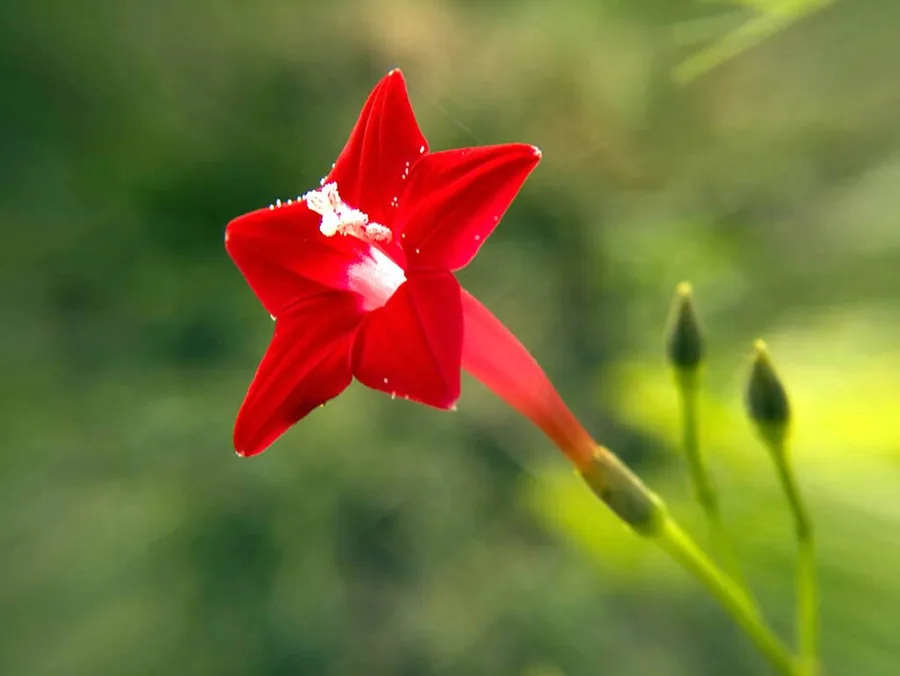
Cypress vine is a fast-growing annual from the morning-glory family, grown for its lacy, thread-fine foliage and small scarlet star-shaped flowers. The leaves are cut so finely they look almost fern-like, and the blooms draw hummingbirds and butterflies from early summer until frost. Left to climb, it twines up to 6 to 20 feet (1.8 to 6 m) in a single season.
It is one of the easier vines to grow, which is both its charm and its catch. Give it a sunny spot and something to climb, and it takes off on its own. It also drops seed freely, so in warm regions it can naturalize and turn up where you didn't plant it.
The hard seed is the part to watch. The seeds carry LSA-type alkaloids and are toxic to pets and people if eaten, so site the vine and store any collected seed out of reach. Grow it for the show, not for the seed pods.
Care
The short version: full sun, lean to average well-drained soil, and steady moisture while it gets going. Skip the fertilizer, give it a trellis or string to climb, and clip the seedpods if you don't want it sowing itself everywhere.
Light
Cypress vine flowers best in full sun, meaning 6 or more hours of direct light a day. It will climb in part shade, but the bloom thins out fast as the light drops.
Water
Keep the soil evenly moist while the vine establishes, then ease off, since it shrugs off some drought once it's rooted in. Water deeply during dry spells rather than giving frequent light sips.
Soil
Plant in average to poor, well-drained soil and resist the urge to enrich it. Rich ground or extra nitrogen pushes leafy growth at the cost of flowers, so leaner is better here. It takes a pH anywhere from 6.0 to 7.5.
Temperature
This is a heat lover that runs through the warm months and dies at frost. It grows across roughly 59°F to 95°F (15°C to 35°C) and won't get going until the soil has warmed.
Humidity
Ordinary outdoor humidity suits it fine, so there's no level to manage. Good airflow does more good than any number, keeping the fine foliage clear of pests and mildew.
Feeding
Feeding is mostly a mistake with this vine. It needs almost none, and high-nitrogen feed gives you a wall of leaves with few flowers, so at most offer a light low-nitrogen feed at planting in truly poor soil.
Pruning
Pinch the young tips to push the vine to branch, and trim stray stems to keep it where you want it. At season's end, clear the spent vines and clip the seedpods to hold back its heavy self-sowing.
Repotting
none
Size & spacing
Given support, the vine climbs 6 to 20 feet (1.8 to 6 m) tall and spreads 3 to 6 feet (91 to 183 cm) wide. Plan for a sturdy trellis, fence, or string, since it covers ground fast once the heat arrives.
When to plant
Cypress vine is a warm-season annual that hates cold soil. Start the seed indoors in late winter or sow it straight outside once frost has passed, and the vine blooms from early summer until the first fall frost cuts it down.
Northern hemisphere
Southern hemisphere
Typical months for a temperate climate: start earlier in warm zones, later where spring frosts linger.
- Sow: 6-8 weeks before the last spring frost; nick and soak the hard seed coat 12-24 hours before sowing.
- Plant: After the last frost when soil has warmed; can be direct-sown at the last frost date.
- Harvest: Early summer through fall frost.
Hardiness
USDA hardiness zones: 11–12
Temperature: down to 4°C
Troubleshooting
Cypress vine rarely gives much trouble, and most of what comes up traces back to too much feeding, too much shade, or a few common pests on the fine leaves. Match what you see below, then fix the cause rather than the symptom.
Volunteer seedlings popping up all over next spring
Cypress vine is a prolific self-seeder and turns weedy in warm regions, dropping seed that comes up in drifts the following year. Pull the volunteers while they are small and easy to lift. To get ahead of it, clip the developing seedpods before they ripen and shed.
Fix:
- Pull volunteer seedlings while young
- Remove seedpods before they ripen and shed seed
Plenty of leaves but almost no flowers
Rich ground and too much nitrogen push a cypress vine to grow leaves instead of buds, so it climbs hard and barely blooms. Shade does the same, since the vine needs at least 6 hours of direct sun to flower well. Stop feeding, move it into full sun, and let it grow in lean, well-drained soil.
Fix:
- Stop nitrogen feeding
- Move or sow in a full-sun site (6+ hours direct sun)
- Grow in average to lean, well-drained soil
Speckled, distorted leaves with webbing or sticky residue
The fine foliage draws aphids, spider mites, and leaf miners, which stipple and yellow the leaves, leave sticky residue, or carve pale winding tunnels. Flip a few leaves and look underneath: soft clustered insects mean aphids, fine webbing means mites, and squiggly trails mean miners. Knock them back early with a hard water rinse and insecticidal soap, and strip off any badly mined leaves.
Fix:
- Rinse foliage with a strong spray of water to dislodge mites and aphids
- Apply insecticidal soap, treating early before populations expand
- Remove and destroy heavily mined or infested leaves
Toxicity
This is not a plant to grow within reach of pets or small children. The seeds contain LSA alkaloids and are toxic if eaten, causing stomach upset and, in larger amounts, hallucinations and other nervous-system effects. The foliage is a milder caution, but the seedpods are the real hazard, so keep them and any saved seed well out of reach.
Toxic to
Cats · Dogs · Horses · Rabbits · Livestock · Birds · People
Cats Mild
A cat that nibbles the foliage may drool or vomit. The real danger is the seeds, which carry LSA alkaloids and can bring on agitation, tremors, disorientation, or hallucinations if a cat eats more than a few.
Dogs Mild
Chewed leaves usually cause vomiting and a bout of stomach upset. Eating a quantity of seeds is the bigger worry, since the alkaloids can trigger restlessness, shaking, and a wobbly, disoriented dog.
Horses Caution
Horses rarely browse the thin foliage, but the same morning-glory seeds are best kept out of reach. A mouthful of seed could upset the gut and, in quantity, affect the nervous system.
Rabbits Caution
This is not rabbit forage. Treat the seedpods as the hazard, since the alkaloid-rich seeds can cause digestive trouble and, in larger amounts, neurologic effects.
Livestock Caution
Grazing animals tend to leave the vine alone, but seed-bearing plants in a pasture warrant caution. Eating the seeds can lead to stomach upset and, with enough, signs of nervous-system distress.
Birds Caution
Wild birds visit the flowers for nectar without harm, yet the seeds are not safe to offer. Keep collected seed away from pet birds, where even a small amount could cause problems.
People Caution
No part of this plant is grown to eat. The seeds are the concern: swallowing them can cause nausea and stomach pain, and a larger dose of the LSA-type alkaloids can bring on hallucinations. Keep seeds and pods well away from children.
Keep seeds and seedpods away from pets; the seeds are the main concern.
Helpline numbers

United States
ASPCA Animal Poison Control: (888) 426-4435 (fee applies)
Poison Control: (800) 222-1222



Canada
Poison Centres: 1-844-764-7669
Varieties
Cypress vine itself is the scarlet-flowered standard, but a couple of close relatives turn up alongside it and are easy to mix up.
'Alba'
A white-flowered form that swaps the usual scarlet stars for clean white ones.
Cardinal Climber (Ipomoea × multifida)
A hybrid of I. coccinea and cypress vine with broader, deeply lobed leaves and red trumpet flowers with pale throats, rather than cypress vine's threadlike foliage.
How to propagate
Cypress vine comes only from seed, and the one trick worth knowing is softening that hard seed coat before you sow.
SeedEasy
Sow indoors 6-8 weeks before last frost, or direct-sow after the last frost when soil is warm. · Germinates in about 1-3 weeks after scarifying; establishes and climbs quickly through the warm season.
Cypress vine grows from seed with almost no fuss, but the hard coat needs a little help first. Nick or scarify each seed and soak it for 12 to 24 hours before sowing, then start indoors 6 to 8 weeks before your last frost or sow straight into warm ground after it. The seed sprouts in 1 to 3 weeks and the vine climbs fast once the heat sets in.
Myths
Cypress vine and cardinal climber are the same plant.
They are two different vines. Cypress vine carries very fine, feathery, thread-like leaves cut almost to the midrib, while cardinal climber, its hybrid offspring from a cross of I. coccinea and I. quamoclit, has broader, deeply lobed palmate leaves. The foliage is the giveaway.