Ornamental · Asteraceae
African Daisy
Osteospermum ecklonis
Give it full sun, sharp drainage, and cool weather, and the African daisy covers itself in blooms.
Full sun
Every 3–7 days
50–75°F · 10–24°C
USDA 10–11
Overview
The African daisy belongs to the sunflower family and hails from southern Africa, where it earned the names Cape daisy and Cape marguerite. In the garden it grows as an outdoor flowering annual across most of the country, mounding or trailing into a low cushion of gray-green leaves topped with daisy-like flowers. Each bloom rides on a slim stem and opens to a bright ring of rays around a contrasting center disk.
One quirk sets it apart from a true daisy. The flowers close at night and in low light, then reopen when the sun returns, so a bed that looked bare at dawn fills back in by mid-morning. The plant is a tender perennial that only survives the winter in zones 10 and 11; everywhere colder, gardeners plant it fresh each spring and let it run as an annual.
It carries an easy reputation for good reason. Give it sun and soil that drains, keep the spent blooms picked off, and it flowers from late spring well into fall. The one thing it dislikes is a hot, muggy summer, which can stall the bloom until cooler weather brings it back.
Care
The short version: full sun and loose, well-drained soil are the two things that matter most. Keep the soil evenly moist without letting it stay soggy, feed it sparingly, and pinch off the faded flowers to keep new ones coming.
Light
African daisies want full sun, at least 6 hours of direct light a day, to bloom their best. They'll take partial sun, but shade trades flowers for floppy, stretched-out growth. More sun also keeps the foliage dry, which holds mildew at bay.
Water
Keep the soil evenly moist but never soggy, since standing water rots the roots fast. An established plant shrugs off a short dry spell, yet it flowers far better with steady moisture. Let the top of the soil dry a touch between waterings, roughly every 3 to 7 days depending on heat.
Soil
Plant in loose, well-drained soil with a little organic matter worked in; sharp drainage is what keeps this daisy healthy. It's easygoing about acidity and grows across a pH of 5.5 to 7.5. Heavy, wet clay is the one thing to fix before planting.
Temperature
This is a cool-season plant that does its best work between 50°F and 75°F (10°C to 24°C). Bloom slows once a hot, humid summer sets in, and it picks back up as the weather cools. Frost ends the plant in most regions.
Humidity
Ordinary outdoor humidity suits it fine, so there's no number to chase. Airflow matters more than the moisture in the air, since crowded, still conditions are how powdery mildew gets a foothold.
Feeding
Feed with a light hand. A balanced slow-release fertilizer or a little compost through the growing season is plenty, applied seasonally. Go heavy and you grow lush leaves with few flowers, since too much nitrogen pushes foliage over bloom.
Pruning
Deadhead the spent flowers as they fade and the plant keeps pushing new ones. Pinch the growing tips early for a fuller, bushier shape. Cut back any sprawling, leggy branches from late summer into autumn to tidy the mound.
Size & spacing
A mature plant stands 12 to 35 inches (30 to 90 cm) tall and spreads 9 to 24 inches (23 to 61 cm) wide. Give each one room to reach its full spread so air moves through and the leaves stay dry.
When to plant
The African daisy is an outdoor plant that wants warm soil but cool air. Start seed indoors 6 to 8 weeks before the last frost, set the plants out once the frost has passed and the ground has warmed, and enjoy blooms from late spring into fall, heaviest while the weather stays cool.
Northern hemisphere
Southern hemisphere
Typical months for a temperate climate: start earlier in warm zones, later where spring frosts linger.
- Sow: 6 to 8 weeks before the last spring frost
- Plant: after the last spring frost when soil has warmed
- Harvest: late spring through fall, blooming most heavily in cool weather
Hardiness
USDA hardiness zones: 10–11
Temperature: down to -1°C
Troubleshooting
Most trouble with African daisies traces back to two things: soggy roots or summer heat. Catch the early signs on the flowers and lower leaves and you can step in before a small problem spreads. Match what you see below, then act while it still helps.
Wilting and yellowing that starts at the base
The usual cause is root rot from soggy, poorly drained soil that suffocates the roots and turns them brown and mushy. Verticillium wilt can bring on the same droop and yellowing. Let the soil dry between waterings, pull any plant that's collapsed, and keep new daisies out of soil that's stayed infected.
Fix:
- Improve drainage and let soil dry between waterings
- Remove and discard severely affected plants
- Avoid replanting susceptible species in infected soil
Curled new growth with a sticky film
Small soft-bodied aphids gather on the shoot tips and the undersides of leaves, where they suck sap and leave a sticky residue behind. A strong jet of water knocks most of them loose. Follow up with insecticidal soap if the cluster keeps coming back, and a few resident ladybugs will keep the rest in check.
Fix:
- Spray off with a strong jet of water
- Apply insecticidal soap if populations persist
Few flowers once summer turns hot
The African daisy is a cool-season bloomer, and many cultivars slow right down through the hot, humid part of summer. Too much nitrogen feeds the leaves at the cost of the flowers and makes the slump worse. Ease off the fertilizer, keep deadheading, and the blooms come back as the weather cools.
Fix:
- Site in a spot with cooler conditions and good air flow
- Reduce fertilizer and avoid high-nitrogen feeds
- Deadhead regularly to promote rebloom when cool weather returns
A dusty white film on the leaves
Those dusty patches are powdery mildew, a fungus that settles in when the air is humid and barely moving around crowded plants. It spreads across the leaf surface over time. Open up the spacing for better airflow, water at the base rather than over the top, and strip off the worst leaves.
Fix:
- Improve air circulation and spacing
- Avoid overhead watering
- Remove affected foliage
Toxicity
Good news for pet owners and parents. The African daisy is non-toxic, and approved sources clear it for cats, dogs, and horses alike. A curious nibble from a pet or a toddler won't do any harm, so this is a safe daisy to plant where animals and children roam.
Safe for
People · Cats · Dogs · Horses · Rabbits · Livestock · Birds
Cats Safe
Listed as non-toxic to cats, so a curious nibble on the foliage causes no harm.
Dogs Safe
Dogs can share a bed or border with this daisy, and a stray chew won't poison them.
Horses Safe
Approved sources clear it for horses, with no toxic compounds to worry about.
Rabbits Safe
Safe for rabbits, though any leafy green should stay a small part of their daily diet.
Livestock Safe
Cattle, goats, and sheep face no poisoning risk from grazing near it.
Birds Safe
Pet birds and backyard hens can forage around the plant without trouble.
People Safe
Non-toxic and fine to grow where toddlers and small children play.
Varieties
The name African daisy covers several plants, but the garden Osteospermum comes down to the species and a handful of named selections. These are the ones worth knowing by name.
Osteospermum ecklonis
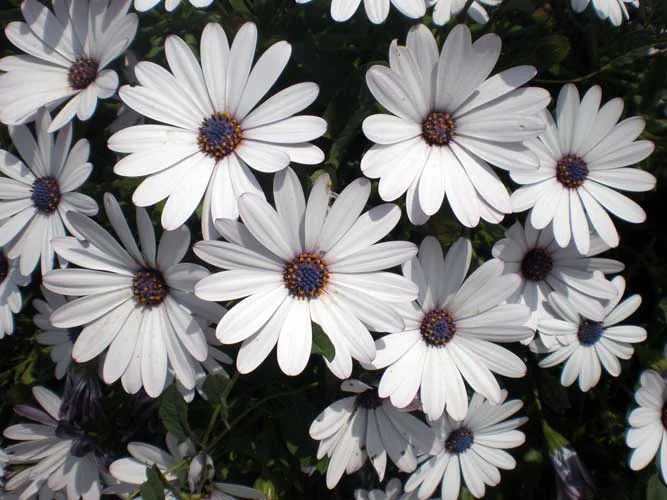
This is the parent species behind most hybrids, a mounding to trailing plant with a woody base, white daisy rays, and a blue-purple center disk.
Bright Lights series
A compact hybrid series proven in university trial gardens, picked for its bold flower colors and a long stretch of cool-season bloom.
Wildside
A named selection noted in plant-finder records for its unusual flower coloring.
How to propagate
African daisies start either from cuttings or from seed, and the choice often comes down to which variety you have. Most named hybrids copy true only from cuttings.
Stem cuttingsModerate
During active growth in the growing season · Roots typically form in about 4 to 5 weeks under mist or a humidity tent
Most named hybrids are grown from tip cuttings rather than seed, since cuttings copy the parent. Take them during the growing season, dip the cut end in rooting hormone, and stand them in a moist soilless mix. Under mist or a humidity tent the roots come in over about 4 to 5 weeks.
SeedModerate
Sow indoors 6 to 8 weeks before the last spring frost · Several weeks to transplant size before moving outdoors after frost
Some cultivars do grow from seed, though most garden hybrids still come from cuttings. Sow indoors 6 to 8 weeks before the last spring frost, and the seedlings need several weeks to reach transplant size before they head outdoors once the cold has passed.
Myths
African daisies bloom best in the heat of summer.
It works the other way around. Osteospermum flowers hardest in cool weather, and a lot of cultivars all but stop in a hot, humid summer. Treat it as a cool-season plant and the show lasts far longer.
Every plant called African daisy is the same one, and it is toxic.
Several unrelated plants share that common name, which is where the worry starts. This one is Osteospermum in the Asteraceae family, and approved sources list it as non-toxic to cats and dogs.