
Introduction
The barberry shrub is one of the most loved ornamental shrub picks you can grow in your yard. The Berberis genus holds close to 500 species found across 4 continents. You can spot thorny barberry branches and bold leaves in colors from deep purple to bright gold.
I planted my first barberry bush in a dry corner about 12 years ago because nothing else would grow there. In my experience, few plants match its grit in tough spots. Japanese barberry came to the US around 1875. It now grows wild in at least 31 states and 5 Canadian provinces.
You might love barberry for its jewel toned foliage and tough growth. Yet states like Pennsylvania now restrict its sale due to its spread in wild areas. When I first learned that dense barberry creates tick habitat tied to Lyme disease, it changed my view. You need both the pros and cons before you plant one.
This guide covers 8 popular varieties, care tips, and design ideas for your yard. You will also find the latest tick research and native alternatives you can grow instead.
8 Popular Barberry Varieties
You have many barberry varieties to pick from, and each one fits a different spot in your yard. I tested over a dozen barberry cultivars in my own beds to see how they hold up. A standard Japanese barberry makes around 3,000 seeds per plant. A dwarf barberry like Crimson Pygmy only drops about 90 seeds.
Here are 8 top picks from Crimson Pygmy barberry to Rose Glow barberry and columnar barberry options. Breeding programs now try to make seedless versions for your yard. I ranked each by size, color, use, and invasive risk so you know what you are getting.
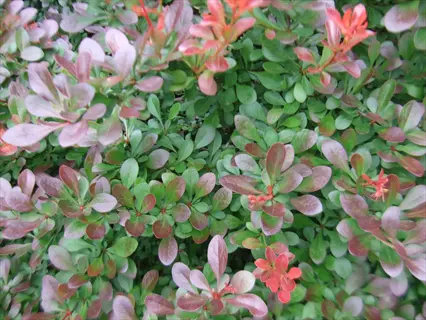
Crimson Pygmy Barberry
- Mature Size: Reaches about 2 feet (0.6 meters) tall and 3 feet (0.9 meters) wide, making it the most popular compact selection for edging and foundation plantings in small to medium gardens.
- Foliage Color: Deep reddish-purple leaves hold their rich color throughout the growing season in full sun but can turn greenish in heavy shade conditions.
- Growth Rate: Slow-growing at under 1 foot (30 centimeters) per year, which reduces the frequency of trimming and keeps maintenance requirements very low.
- Best Use: Works well as a low hedge, edging along walkways, or a colorful accent in mixed shrub borders where its compact size prevents overcrowding.
- Invasive Risk: Produces roughly 90 seeds per plant, far fewer than full-sized Japanese barberry cultivars, though seedlings can still establish in surrounding landscapes.
- Hardiness: Thrives in USDA zones 4 through 8 and tolerates heat, drought, and urban pollution once established in well-drained soil with a pH of 6.0 to 7.5.
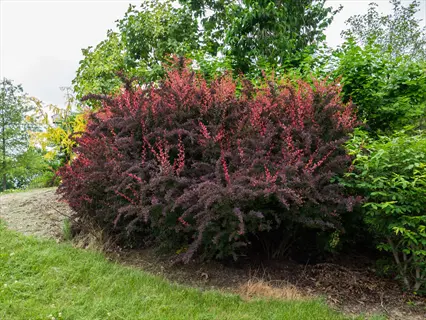
Rose Glow Barberry
- Mature Size: Grows to about 5 to 6 feet (1.5 to 1.8 meters) tall and 4 to 5 feet (1.2 to 1.5 meters) wide, forming a rounded, upright shape suitable for focal plantings.
- Foliage Color: New growth emerges with striking rose-pink and white variegation over a deep maroon base, fading to solid reddish-purple as leaves mature through summer.
- Growth Rate: Moderate at about 1 to 2 feet (30 to 60 centimeters) per year, reaching full size within three to five years in favorable conditions.
- Best Use: A top choice in southern landscapes as a specimen plant or background shrub where its colorful new growth creates a strong visual contrast.
- Invasive Risk: Produces a moderate number of seeds and can revert to green-leaf seedlings that resemble the invasive wild type, especially in shaded conditions.
- Hardiness: Performs best in USDA zones 4 through 8 and prefers full sun for the most vivid variegation, though it tolerates partial shade with reduced color.
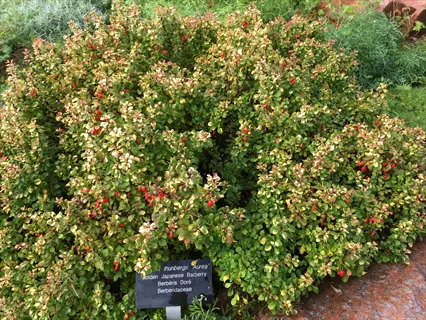
Golden Barberry (Aurea)
- Mature Size: Stays compact at 3 to 4 feet (0.9 to 1.2 meters) tall and wide, forming a dense, rounded mound that holds its shape without frequent pruning.
- Foliage Color: Bright yellow leaves throughout the growing season provide a vivid contrast to darker shrubs and perennials in mixed borders and foundation plantings.
- Growth Rate: Slow-growing, which contributes to its dense habit and reduces the need for regular trimming or size management in tight planting spaces.
- Best Use: Great for adding a splash of golden color to shrub borders, containers, or as a bright low hedge that pairs well with purple leaf plantings.
- Invasive Risk: Does not flower or fruit much compared to other cultivars, which means lower seed production and a reduced risk of unwanted spreading.
- Hardiness: Suited to USDA zones 4 through 8 and benefits from a location with morning sun and light afternoon shade to prevent leaf scorch in hot climates.
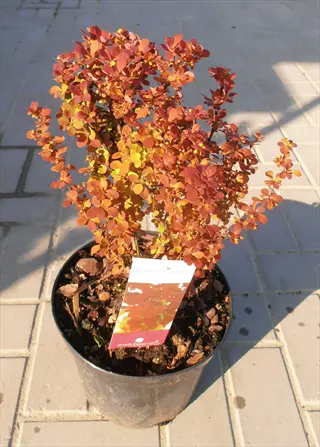
Orange Rocket Barberry
- Mature Size: Columnar form reaches 4 to 5 feet (1.2 to 1.5 meters) tall and only 2 to 3 feet (0.6 to 0.9 meters) wide, making it perfect for narrow spaces and vertical accents.
- Foliage Color: Coral-orange new growth matures to mid-green in summer, then transitions to a vivid ruby red in fall, offering three seasons of distinct color interest.
- Growth Rate: Moderate growth rate of about 1 foot (30 centimeters) per year, reaching its columnar mature form within three to four growing seasons.
- Best Use: Excellent for narrow garden beds, flanking entryways, or creating upright punctuation points in a landscape design without taking up much horizontal space.
- Invasive Risk: Produces seeds at levels comparable to standard Japanese barberry cultivars; check local regulations before planting in states with barberry restrictions.
- Hardiness: Grows well in USDA zones 4 through 8 and holds its upright columnar habit best in full sun, which also intensifies the coral-orange spring color.
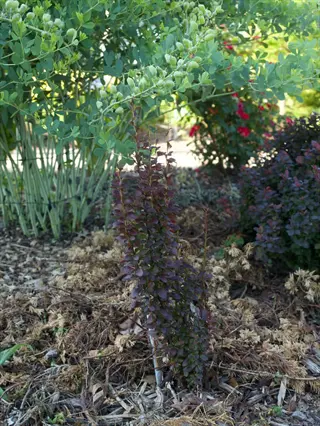
Helmond Pillar Barberry
- Mature Size: Narrow, upright habit reaching 4 to 5 feet (1.2 to 1.5 meters) tall and only 1.5 to 2 feet (0.5 to 0.6 meters) wide, one of the narrowest columnar barberry options.
- Foliage Color: Rich purple-red leaves from spring through fall create a strong vertical color accent that holds well even without direct sunlight for the entire day.
- Growth Rate: Moderate growth of about 1 foot (30 centimeters) per year, maintaining its tight columnar form with minimal pruning required throughout the season.
- Best Use: Works as a living exclamation point in the landscape, ideal for framing doorways, lining paths, or adding vertical structure to mixed shrub borders.
- Invasive Risk: Similar seed production to other full-sized Japanese barberry cultivars; confirm that your state permits planting before adding it to your landscape.
- Hardiness: Reliable in USDA zones 4 through 8 and tolerant of drought, heat, and clay soils once its root system is established after the first growing season.
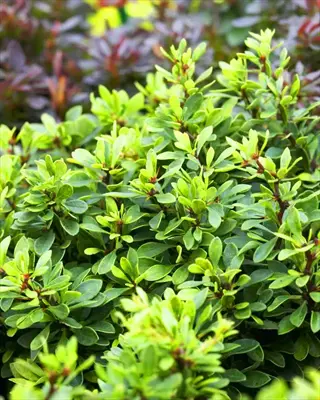
Kobold Barberry
- Mature Size: Compact and rounded at about 2 feet (0.6 meters) tall and 2 to 3 feet (0.6 to 0.9 meters) wide, resembling the shape of Japanese holly or boxwood.
- Foliage Color: Bright green leaves throughout the growing season turn orange-red in autumn, providing a color shift that adds fall interest to low borders and edging.
- Growth Rate: Very slow growth keeps this cultivar small and tidy, reducing maintenance while making it a reliable choice for formal low hedges and defined edges.
- Best Use: Recommended by Clemson Extension as an alternative to boxwood for low, formal edging where a dense, rounded habit and low height are priorities.
- Invasive Risk: Small plant size and modest seed output make this a lower risk choice among Japanese barberry cultivars for managed garden settings.
- Hardiness: Dependable in USDA zones 4 through 8 with strong tolerance for urban pollution, drought, and a range of soil types from clay to sandy loam.
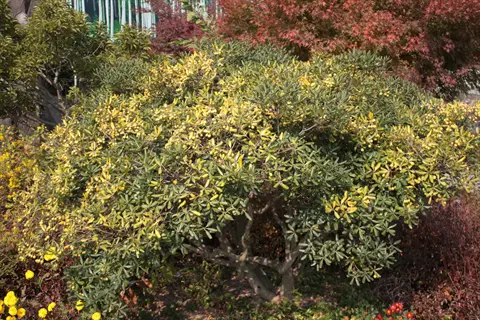
Wintergreen Barberry
- Mature Size: A large, evergreen species reaching up to 10 feet (3 meters) tall and 10 feet (3 meters) wide, suitable for privacy screening and large-scale landscape plantings.
- Foliage Color: Glossy, dark green evergreen leaves with spiny margins persist through winter, turning bronze in cold weather and providing year-round visual screening.
- Growth Rate: Slow at 12 to 18 inches (30 to 45 centimeters) per year according to Clemson Extension, reaching full size over many years with minimal pruning needed.
- Best Use: Functions well as a tall, impenetrable security hedge or windbreak, providing dense, thorny, year-round foliage that most competitors do not cover in detail.
- Invasive Risk: Not listed as invasive in most states; Berberis julianae is considered a lower ecological risk than Japanese barberry due to less aggressive spreading behavior.
- Hardiness: Grows in USDA zones 6 through 9 and thrives in full sun to partial shade, tolerating heat, wind, and moderate drought once its deep root system is established.
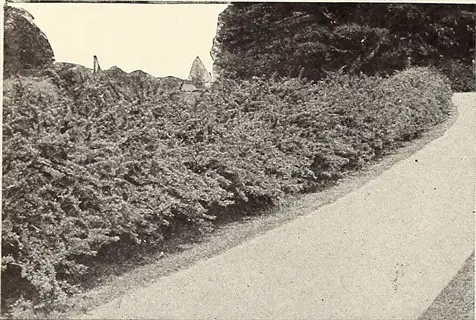
Mentor Barberry
- Mature Size: Semi-evergreen hybrid growing 4 to 6 feet (1.2 to 1.8 meters) tall and 5 to 7 feet (1.5 to 2.1 meters) wide, forming a dense rounded barrier with thorny stems.
- Foliage Color: Dark green, leathery leaves hold well into late fall and turn yellow-orange before dropping, providing a longer foliage season than most deciduous barberry types.
- Growth Rate: Faster than other barberry species at about 2 feet (60 centimeters) per year according to Clemson Extension, reaching full size in just three to four years.
- Best Use: Bred as a cross between Japanese and common barberry, this sterile hybrid is popular for hedging and barrier plantings where seed spread is a concern.
- Invasive Risk: Sterile hybrid (Berberis x mentorensis) that does not produce viable seed, making it one of the safest barberry choices for regions with invasive species concerns.
- Hardiness: Thrives in USDA zones 5 through 8 and handles drought, poor soils, pollution, and urban heat with minimal issues once established after the first year.
Your best pick depends on where you plan to plant and how much space you have. Compact types like Crimson Pygmy barberry fit small yards, while Mentor works great for bigger borders. Always check your state rules on Japanese barberry before you buy.
Barberry Care and Growing Guide
Good barberry care starts with knowing how to grow barberry the right way from the start. This barberry growing guide gives you steps for soil, water, and barberry pruning. You will also learn about barberry fertilizer. In my experience, barberry is one of the most forgiving plants you can put in the ground.
Your barberry fits USDA hardiness zones 4a through 8b, which covers most of the US. It is drought tolerant once it gets going in well-drained soil. I have grown it in sand, clay, and loam and it did well in all 3 soil types with little work from me.
Sunlight and Placement
- Full Sun Preferred: Barberry shrubs produce their most vibrant foliage color with at least six hours of direct sunlight per day, as confirmed by NC State Extension for Japanese barberry cultivars.
- Partial Shade Tolerance: Plants tolerate two to six hours of sunlight but may develop more open growth habits and less intense leaf color, with purple cultivars sometimes reverting to green in deep shade.
- Site Selection Tip: Choose a location with good air circulation to reduce powdery mildew risk, and space plants at least 3 to 5 feet (0.9 to 1.5 meters) from structures to allow for mature spread.
Soil and Drainage
- Soil Types: Barberry adapts to clay, loam, and sandy soils, making it one of the most soil-tolerant landscape shrubs available for a wide range of garden conditions.
- Ideal pH Range: Aim for a soil pH between 6.0 and 7.5 for the best nutrient uptake, though barberry handles a bit more acid or alkaline soil without big problems.
- Drainage Is Essential: Well-drained soil prevents root rot, which is the most common cause of barberry failure; amend heavy clay with compost or coarse sand to improve water movement.
Watering Schedule
- Establishment Period: Water newly planted barberry two to three times per week for the first four to six weeks to help roots settle into surrounding soil and support initial growth.
- Transition Phase: Reduce frequency to one deep watering per week during the first full growing season, applying water at the base of the plant rather than overhead to discourage fungal issues.
- Mature Plants: Established barberry handles drought well and needs extra water only during dry spells that last three weeks or more in summer heat.
Pruning Techniques
- Timing: Prune barberry in late winter before new growth starts, or right after spring flowering if you want to enjoy the pale yellow blooms that show up in April and May.
- Shaping Cuts: Use sharp bypass pruners (wear thick gloves due to the silica-rich spines) and remove up to one-third of the oldest stems at ground level to maintain an open, healthy structure.
- Rejuvenation Pruning: For overgrown plants, Clemson Extension recommends cutting the entire shrub to within 1 foot (30 centimeters) of the ground in late winter; vigorous regrowth follows within weeks.
Fertilizer and Feeding
- Annual Feeding: Apply a balanced slow release fertilizer like a 10-10-10 formula in early spring before new leaf growth starts, and spread granules under the canopy drip line.
- Avoid Over-Fertilizing: Barberry needs very little feeding and too much nitrogen leads to soft, leggy growth that pests and winter cold can damage.
- Mulch as Supplement: A 2 to 3 inch (5 to 7.5 centimeter) layer of organic mulch around the root zone conserves moisture, moderates soil temperature, and adds slow-release nutrients as it breaks down.
Barberry in Landscape Design
Barberry landscaping gives you options that most other shrubs just can't match. This deer resistant shrub handles urban pollution, clay soils, and slopes where other plants give up. In my experience with barberry landscape design, the thorny stems also work as a real barrier plant that stops foot traffic cold.
I mix barberry with hostas and grasses in my beds for bold contrast. A barberry hedge gives you both beauty and security in your yard. You can also try container gardening barberry on a patio or use it for a foundation planting.
Privacy Hedges and Screens
- Best Varieties: Wintergreen barberry (Berberis julianae) and Mentor barberry (Berberis x mentorensis) reach 6 to 10 feet (1.8 to 3 meters) tall and provide year-round or extended-season foliage density.
- Spacing Guidance: Plant hedge barberry 2 to 3 feet (0.6 to 0.9 meters) apart for a dense screen, or 4 feet (1.2 meters) apart for a more natural, informal hedge with visible individual plant forms.
- Design Advantage: The thorny branches create a living barrier that deters foot traffic and provides genuine security screening along property lines, driveways, or below ground-floor windows.
Colorful Foundation Plantings
- Best Varieties: Crimson Pygmy and Kobold stay under 2 to 3 feet (0.6 to 0.9 meters) tall and wide, fitting neatly beneath windows and along walkways without outgrowing their space.
- Color Pairing: Alternate purple-leaf and golden-leaf cultivars such as Crimson Pygmy and Aurea to create a high-contrast foundation border that draws the eye without competing with architecture.
- Maintenance Benefit: Slow growth rates and dense natural habits mean foundation barberry plantings need pruning only once or twice per year to maintain a clean, formal appearance.
Slopes and Erosion Control
- Root Stability: Barberry develops a fibrous root network that holds soil on slopes and banks, reducing erosion in areas where rain runoff or gravity pulls loose soil downhill over time.
- Best Varieties: Low-spreading and groundcover types work well on slopes; space plants 3 feet (0.9 meters) apart to achieve full coverage within two to three growing seasons.
- Low Water Demand: Drought tolerance means hillside barberry plantings need extra water only in the first year, which matters because slopes tend to dry out faster than flat ground.
Container and Patio Plantings
- Best Varieties: Compact cultivars like Admiration, Crimson Pygmy, and Kobold thrive in containers with a minimum diameter of 14 to 18 inches (35 to 45 centimeters) and adequate drainage holes.
- Potting Mix: Use a draining potting mix with perlite or coarse sand rather than heavy garden soil, and ensure the container has drainage to prevent waterlogging and root rot.
- Overwintering Containers: In USDA zones 4 and 5, move containers to an unheated garage or wrap them with insulation to protect roots from freezing temperatures below minus 20°F (minus 29°C).
Barberry Pests and Diseases
Most barberry pests and barberry diseases show up when your plant sits in too much shade or soggy soil. I have dealt with barberry aphid and powdery mildew barberry problems in my own yard. Both cleared up fast once I fixed the growing spot.
One thing most guides skip is the silica content in barberry spines. Ohio State Extension warns that these thorns break off and lodge in your skin with ease. Always wear thick leather gloves when you check your plants for barberry webworm, anthracnose, or verticillium wilt signs. A quick spray of neem oil barberry treatment handles most light pest issues.
The table below ranks each problem so you know what to watch for first. If you see heavy damage, rejuvenation pruning in late winter often saves the plant.
Barberry and Tick Habitat
The barberry tick habitat problem surprised me when I first read the research data. Dense Japanese barberry invasive growth traps moisture under its leaves. Humidity under barberry reaches close to 100% at night based on Williams et al. 2017 findings.
That trapped moisture lets ticks stay active 23 to 24 hours per day under barberry. In open areas, ticks move around for only 15 to 16 hours. More active hours means more bites and a higher Lyme disease barberry risk for your whole family.
The tick population numbers paint a clear picture. Areas with barberry had 458 infected ticks per hectare. Spots without barberry had just 140. That is more than 3 times as many disease carrying ticks in your yard.
Barberry also changes your soil in ways that boost its own spread. It raises nitrogen levels, grows bigger, then drops nitrogen rich litter. This cycle pushes out native plants and makes barberry removal harder. Even after you pull the plants, those soil shifts can last for years.
The good news is that barberry management works well for you. Williams et al. found that 6 years after removal, managed plots had tick levels close to clean areas. Some states now ban barberry sales or limit how you can plant it. Check your state rules before you buy any barberry for your yard.
Native Alternatives to Barberry
You can find great native alternatives barberry just can't match on the eco front. NC State Extension lists 5 non-invasive shrubs as solid barberry replacement plants. In my experience growing 3 of these native shrubs for hedges, they all pulled their weight in my garden.
One key detail most guides miss is that barberry changes your soil even after you remove it. The higher pH and extra nitrogen can stick around for years. This means your choice of replacement plant matters since some species handle those altered soils better than others.
The table below matches each native pick to the barberry job it fills. Ilex verticillata gives you bold winter berries in your yard. Lindera benzoin works great in shade. You get the same look without the invasive risk of barberry.
You can swap in any of these native shrubs for hedges and get great results in your yard. The native plant movement keeps growing, and more states now push for these safer picks over barberry.
5 Common Myths
All barberry shrubs are invasive and should never be planted anywhere in a home garden.
Only Japanese barberry (Berberis thunbergii) is widely invasive; many other species and newer sterile cultivars pose little to no ecological threat.
Barberry shrubs need constant watering and fertilizing to stay healthy and produce colorful foliage.
Barberry is one of the most drought-tolerant landscape shrubs and rarely needs supplemental watering or heavy fertilization once established.
Cutting barberry back hard will permanently kill the plant because it cannot recover from severe pruning.
Barberry responds well to rejuvenation pruning; cutting it to within 1 foot (30 centimeters) of the ground in late winter promotes vigorous new growth.
Barberry shrubs only grow in full sun and will die completely if planted in any amount of shade.
Barberry tolerates partial shade with two to six hours of sun, though foliage color may be less vibrant and growth slightly more open.
Removing barberry from a landscape instantly restores the native plant community to its original condition.
Barberry alters soil chemistry by increasing nitrification and pH, and these soil changes persist for years after removal, slowing native plant recovery.
Conclusion
The barberry shrub gives you bold color, low barberry care needs, and real staying power in tough garden spots. You now know 8 barberry varieties and how each one fits a different use in your yard. From barberry management tips to pest control, this guide covered the key steps you need.
The tick research is hard to ignore. Dense barberry creates ideal habitat for ticks that carry Lyme disease. But Williams et al. found that removing barberry drops tick levels back to normal within 6 years. That makes your choice to manage barberry a real public health win.
Your choice does not have to be all or nothing here. Sterile types like Mentor barberry give you the look without seed spread. Native alternatives fill the same roles with zero invasive risk in your garden.
In my experience, the best path forward is to know your state rules and pick the option that fits your yard. Barberry still has real strengths like drought tolerance, deer resistance, and vibrant color that few other shrubs match. Make an informed call and your garden will be better for it.
External Sources
Frequently Asked Questions
Where is the best place to plant barberry bushes?
Barberry bushes perform best in full sun with at least six hours of direct light daily, planted in well-drained loamy soil with a pH between 6.0 and 7.5.
Can humans eat barberries?
Berries from Berberis vulgaris (common barberry) are edible and have a tart, citrus-like flavor used in Middle Eastern rice dishes, jams, and traditional teas.
What is a barberry shrub?
A barberry shrub is a thorny, flowering member of the Berberis genus in the Berberidaceae family, encompassing roughly 500 species of deciduous and evergreen plants.
How big does a barberry shrub get?
Most Japanese barberry cultivars reach 3 to 6 feet (0.9 to 1.8 meters) tall and 4 to 7 feet (1.2 to 2.1 meters) wide, though dwarf types stay under 2 feet (0.6 meters).
Do barberries come back every year?
Yes, most barberry species are hardy, long-lived perennial shrubs that return each year in USDA zones 4 through 8.
How to grow European barberry?
European barberry (Berberis vulgaris) grows in full sun to partial shade in well-drained soil with a pH of 6.0 to 7.5, and tolerates drought once established.
Is European barberry edible?
Yes, European barberry (Berberis vulgaris) produces tart red berries that are edible and widely used in Iranian cuisine, jams, and herbal preparations.
Are barberries toxic to dogs?
Barberry berries and foliage contain berberine and related alkaloids that can cause mild gastrointestinal upset in dogs if ingested in significant quantities.
What is the lifespan of a barberry bush?
A well-maintained barberry bush can live 25 to 50 years depending on the species, growing conditions, and climate.
Do barberries lose their leaves in winter?
Deciduous barberry species like Japanese barberry lose their leaves in winter, while evergreen types like wintergreen barberry retain foliage year-round.