Ornamental · Begoniaceae
Wax Begonia
Begonia semperflorens
Give it moist soil, dappled light, and room to breathe, and the wax begonia blooms nonstop from spring to frost.
Partial shade
Every 2–4 days
50–75°F · 10–24°C
USDA 9–11
Overview
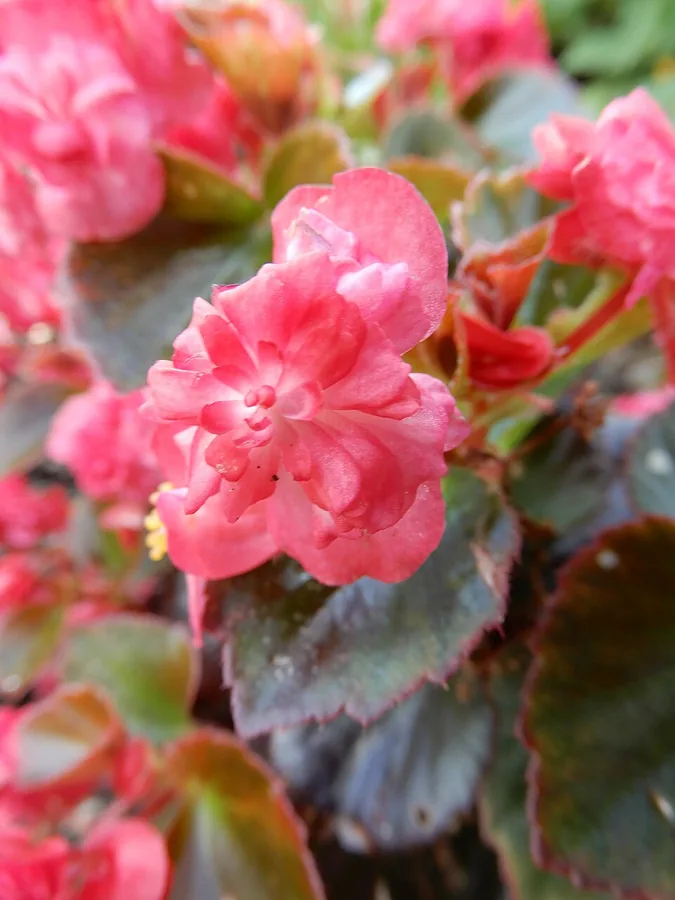
The wax begonia earns its name from thick, glossy leaves that feel almost polished, in green or deep bronze. It is one of the easiest flowering plants to grow, which is why it fills so many summer beds, borders, and window boxes. Small pink, red, or white flowers keep coming from spring right through to the first hard frost.
Most gardeners treat it as a warm-season annual. It is a tender perennial at heart and lives year-round only in the mildest zones, so almost everywhere else it gets planted fresh each spring and pulled at frost. The plants stay neat and low, rarely topping a foot, and look as good massed in a bed as they do tucked into a pot.
Where it really shines is the shady spot most flowers refuse. Bronze-leaved kinds take more sun, green-leaved kinds want afternoon shade, and both bloom without the fuss of deadheading. Keep the soil evenly moist and well drained and the plant mostly takes care of the rest.
Care
The short version: dappled light or morning sun with afternoon shade, soil kept evenly moist but never soggy, a monthly feed through the season, and 6 to 12 inches of space between plants so air can move.
Light
Wax begonias do best in partial shade or morning sun with afternoon shade, though they tolerate a wide range. The bronze-leaved types take full sun the best, while green-leaved ones scorch in it and want the shade through the hot part of the day.
Water
Keep the soil evenly moist but well drained, watering every 2 to 4 days as it starts to dry. Water at the base early in the morning, since foliage left wet under hot sun can scorch and damp leaves invite fungal disease. The thick waxy leaves let the plant ride out a brief dry spell.
Soil
Plant in moist, well-drained soil rich in organic matter. A slightly acidic pH of 5.5 to 6.5 suits it, and good drainage matters more than anything, since soggy ground is what rots the roots.
Temperature
These plants like it mild, between 50°F and 75°F (10°C to 24°C). They sulk in heat and die back at the first frost, which is why most gardeners grow them as annuals.
Humidity
Ordinary outdoor humidity is plenty, so there is no number to hit. Airflow counts for far more, because crowded, humid plantings are exactly where mildew and gray mold take hold.
Feeding
Feed monthly through the growing season with a balanced fertilizer made for flowering bedding plants. That steady, light feeding keeps the flowers coming without pushing soft, floppy growth.
Pruning
Pinch or shear back any leggy stems to keep the plant compact and bushy and to push out new branches. The flowers are self-cleaning, so you can skip the deadheading most annuals demand.
Size & spacing
Plants stay small, reaching 6 to 12 inches (15 to 30 cm) tall and about as wide. Set them 6 to 12 inches (15 to 30 cm) apart so air moves freely between them and disease has less of a foothold.
When to plant
Wax begonias are tender and have no tolerance for frost. Start the dust-fine seed indoors in late winter, set the young plants out only after the last frost and once nights hold above 50°F (10°C), and they bloom without a break from early summer until frost shuts them down.
Northern hemisphere
Southern hemisphere
Typical months for a temperate climate: start earlier in warm zones, later where spring frosts linger.
- Sow: About 8 to 12 weeks before the last spring frost; do not cover the tiny seed.
- Plant: After all danger of frost has passed and night temperatures stay above 50°F.
- Harvest: Blooms continuously from spring or early summer until frost.
Hardiness
USDA hardiness zones: 9–11
Temperature: down to -7°C
Troubleshooting
Almost every wax begonia problem traces back to too much moisture sitting on the leaves or around the roots. Catch the early signs and you can usually turn it around with better spacing and smarter watering. Match what you see below, then act before it spreads.
Wilting plants with mushy, blackened stems at the soil line
When a plant flops over even though the soil is wet, suspect stem or Pythium root rot from soil that never drains. The crown and roots go soft, dark, and decayed, and there is no saving them. Pull the worst plants, fix the drainage, and ease off the watering before the rot spreads.
Fix:
- Remove severely affected plants
- Improve soil drainage
- Reduce watering frequency
White powdery dust across the leaves and stems
That dusty film is powdery mildew, a fungus that moves in when the air is humid and stagnant. It rubs off at first but soon spreads through crowded plantings. Space the plants 6 to 12 inches apart, pull the worst leaves, and water at the base in the morning so the foliage stays dry.
Fix:
- Improve spacing and air circulation
- Remove affected foliage
- Water at the base in the morning rather than overhead
Gray fuzz on flowers that rot and collapse
This is botrytis blight, also called gray mold, and it sets in during cool, damp, still weather. The tissue turns tan to brown and ends up coated in gray spores. Cut away the infected parts, open the planting up for better airflow, and keep water off the leaves.
Fix:
- Remove and discard infected plant parts
- Increase air circulation
- Avoid overhead watering
Cottony clumps or tiny insects with stippled, distorted growth
Cottony white masses point to mealybugs, while slender crawling specks are usually thrips, and both feed on the stems and leaf undersides. Thrips do the most lasting harm, since they can carry viruses such as INSV and TSWV. Hose off light infestations, treat what remains with insecticidal soap, and cut out any heavily infested growth.
Fix:
- Spray off light infestations with water
- Treat with insecticidal soap
- Remove heavily infested plant parts
Toxicity
This is not a plant to let pets chew. Every part holds calcium oxalate crystals, with the most packed into the roots, and a bite leaves the mouth burning, drooling, and sore. Keep it away from cats, dogs, horses, and grazing animals, and know that no part is safe for people to eat either.
Toxic to
Cats · Dogs · Horses · Rabbits · Livestock · Birds · People
Cats Toxic
A cat that chews the leaves or roots gets a mouthful of sharp oxalate crystals, so look for hard drooling, pawing at the mouth, and vomiting. The roots hold the most and cause the worst burning.
Dogs Toxic
Dogs that dig up and gnaw the tubers suffer the most. Expect intense mouth burning, heavy salivation, repeated vomiting, and obvious trouble swallowing soon after a bite.
Horses Toxic
The same oxalate crystals irritate a horse's mouth and gut, bringing on drooling, mouth pain, and colic-like discomfort. A grazing animal that eats a large amount faces the steepest risk.
Rabbits Toxic
The oxalate crystals burn a rabbit's mouth and digestive tract just as they do other animals, so keep the plant well out of reach rather than offering any as forage.
Livestock Toxic
Cattle, goats, and sheep that graze on begonia can take in enough oxalate to trigger mouth irritation, drooling, and digestive upset, and a big helping is the real danger.
Birds Caution
Specific bird data is thin, but the crystals that burn other animals would irritate a curious bird's mouth too, so treat the plant as off limits to be safe.
People Caution
No part of the wax begonia is meant to be eaten. A bite leaves the mouth burning, and handling the sap can irritate sensitive skin, so wash up after pruning and keep it away from small children.
Toxicity is oral and gastrointestinal irritation rather than systemic in pets; grazing animals eating large amounts are at greater risk.
Helpline numbers

United States
ASPCA Animal Poison Control: (888) 426-4435 (fee applies)
Poison Control: (800) 222-1222



Canada
Poison Centres: 1-844-764-7669
Varieties
Wax begonias are sold mostly in named series rather than single cultivars, grouped by leaf color and how much sun they take. These are the ones you will run into most.
Cocktail Series
Compact bronze-leaved plants, with selections like 'Whiskey', 'Vodka', and 'Gin', that take full sun better than most wax begonias.
Ambassador Series
Green-leaved and bred for heat, these do best in morning sun with shade through the hot afternoon.
Doublet Series
Carries full, double, rose-like blooms instead of the plain single flowers most wax begonias produce.
How to propagate
Stem cuttingsEasy
Spring or fall, including from overwintered plants · Roots typically form in about 2 to 4 weeks
Cuttings are the easy route, and you can take them in spring or fall, even from a plant you carried through winter indoors. Snip a healthy stem, or pull a single leaf, and set it in a moist, well-drained medium. Roots form in about 2 to 4 weeks into a plant that matches its parent.
SeedModerate
Indoors about 8 to 12 weeks before the last frost · Several weeks from sowing to transplant size
Seed asks for more patience. Start it indoors 8 to 12 weeks before your last frost, scatter the dust-fine seed on the surface without covering it, and give it gentle bottom heat. It takes several weeks to reach transplant size, and it never goes straight into the garden.
Myths
Wax begonias need full shade and cannot take any sun.
Once they settle in, these plants handle a wide range of light. Bronze-leaved cultivars grow and flower happily in full sun, while the green-leaved types do want some afternoon shade.
Begonias are harmless if a pet takes a nibble.
Every part holds calcium oxalate crystals, and the roots hold the most. A bite burns the mouth and brings on drooling and vomiting in cats, dogs, and horses, so keep curious pets away from the plant.