Ornamental · Acoraceae
Sweet Flag
Acorus gramineus
Give it constantly wet ground and a bit of sun, and sweet flag holds a clean grassy fan all season.
Full sun
Every 1–3 days
USDA 5–11
0–4 ft · 0.2–1.2 m
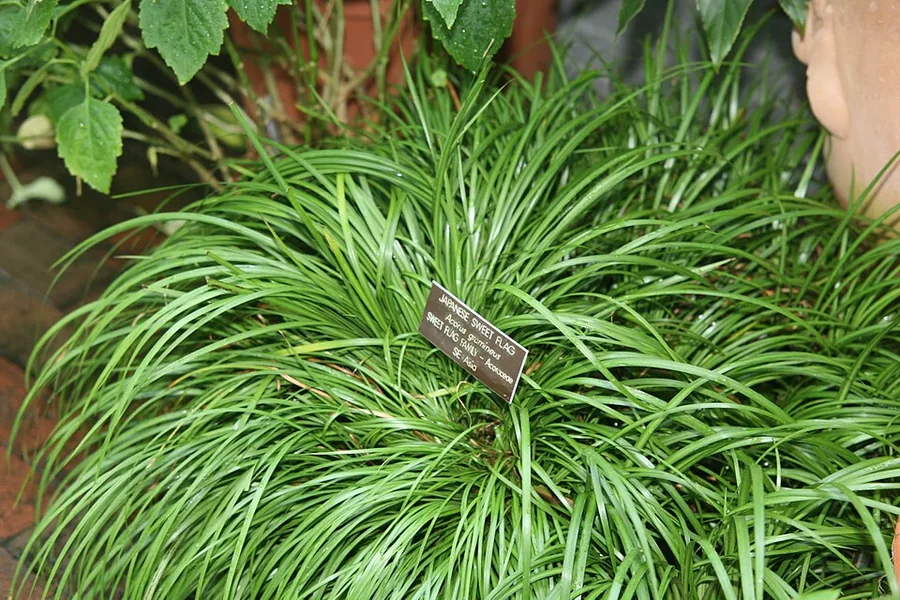
Overview
Sweet flag is an aromatic, grass-like perennial grown for its upright fans of foliage rather than its flowers. It belongs to Acorus, a genus old enough to sit in its own family, Acoraceae, with neither true grasses nor irises as close kin. Crush a leaf and it gives off a warm, spicy scent, which is where the plant earned its name.
Two plants share the name. The dwarf Acorus gramineus stays low at 6 to 12 inches and brings the gold and cream cultivars, while the larger common sweet flag, Acorus calamus, reaches a couple of feet with broad iris-like blades. Both want their feet wet, which makes them naturals for a pond edge, a bog, a rain garden, or a container left standing in a saucer of water.
What sweet flag asks for is steady moisture and a little patience. It creeps outward slowly by rhizomes and rarely needs much from you beyond water. Let the soil dry out, though, and the leaf tips scorch and brown faster than almost anything you'll fix.
Care
The short version: full sun to part shade in soil that stays constantly moist to wet, or even in shallow standing water. Never let it dry out, feed it lightly in spring, and shear off tatty foliage in late winter.
Light
Sweet flag does best in full sun but takes partial sun and partial shade in stride. The gold and variegated forms hold their color best with more light, though a touch of afternoon shade keeps them from scorching where summers run hot.
Water
This is a marginal bog plant, so keep the soil constantly moist to wet at all times, or grow it in a few inches of standing water at a pond or stream edge. Acorus calamus will take deeper water than the dwarf gramineus. Drying out is the number-one cause of failure, browning the foliage in a hurry.
Soil
It grows in rich, consistently moist to wet soil and isn't fussy about texture, taking clay, loam, sand, or silt and tolerating frequent standing water. Aim for a pH between 5.5 and 7.5, comfortably on the mild side of acidic to neutral.
Temperature
Sweet flag is tough across a wide range, hardy roughly from -20°F to 95°F (-29°C to 35°C). That cold-hardiness is what carries it through winter in zone 5.
Humidity
Ordinary outdoor humidity is plenty, so there's no number to chase here. What the plant truly cares about is wet roots, not damp air.
Feeding
This is a low-feed plant that gets by on little in rich, moist ground. A light dose of balanced slow-release fertilizer in spring is all it asks for, and even that is optional.
Pruning
Sweet flag is very low maintenance and needs no routine pruning. Shear or trim away tatty, scorched, or winter-damaged leaves in late winter or early spring, and the clump refreshes itself.
Repotting
Container plants want dividing or potting on every 2 to 3 years. Lift and split when you see roots crowding the pot, the crown rising above the soil, or the center of the clump thinning out.
Size & spacing
Plants range from 6 to 47 inches (15 to 120 cm) tall depending on which sweet flag you grow, from tiny gramineus dwarfs to full-size calamus. Set them 6 to 24 inches (15 to 60 cm) apart, closer for quicker groundcover.
When to plant
Sweet flag is hardy from zone 5 to 11 and asks for no fuss over timing. Set divisions out in spring once frost has passed, into ground that stays wet, and the greenish flower spikes follow in May and June. It's grown for foliage, so those blooms are easy to miss.
Northern hemisphere
Southern hemisphere
Typical months for a temperate climate: start earlier in warm zones, later where spring frosts linger.
- Sow: not typically grown from seed; propagate by division instead
- Plant: spring after frost, into constantly moist or wet ground or shallow water
- Harvest: spring to early summer (May-June); flowers are inconspicuous greenish-yellow spadixes and the plant is grown for foliage, not bloom
Hardiness
USDA hardiness zones: 5–11
Temperature: down to -29°C
Troubleshooting
Nearly every problem with sweet flag traces back to one thing: water. Keep it wet and the plant mostly looks after itself, but let it dry and the leaves tell you fast. Match what you see below before the whole clump suffers.
Leaf tips browning and the clump scorching out
Sweet flag is a bog and waterside plant, so dry soil is almost always the reason a clump browns and withers. The gold 'Ogon' and variegated forms scorch fastest in a hot, exposed spot. Move it somewhere the ground stays wet, or stand the pot in a saucer of water, and trim off the worst leaves so fresh growth can come back.
Fix:
- Move the plant to constantly moist or wet ground, a bog, pond/stream edge, or stand the container in a saucer of water so the soil never dries
- Water deeply and keep the soil saturated; mulch to retain moisture
- Trim off badly scorched foliage; new growth recovers once moisture is restored
- In hot climates give gold and variegated forms some afternoon shade or filtered sun to reduce scorch
A plant that stays small and fills in slowly
This is usually just the plant's slow nature rather than anything wrong. Sweet flag creeps outward by rhizomes over several seasons, and the dwarf gold cultivars are the slowest of all. Keep the soil wet and the light bright to push what growth it has, and set divisions about 8 to 12 inches apart if you want quicker cover.
Fix:
- Be patient: allow clumps to expand over several seasons
- Keep soil consistently wet and provide adequate light to maximize growth
- Plant closer together (about 8-12 in apart) for faster groundcover coverage
Creeping rhizomes spreading into wet ground nearby
In constantly wet soil the larger common sweet flag (Acorus calamus) creeps outward and can form big colonies. The dwarf Acorus gramineus stays far more polite. Lift and divide the edges in spring to hold the clump in bounds, or grow the vigorous calamus in a submerged pot so its rhizomes can't run.
Fix:
- Divide and lift edges in spring to keep the clump in bounds
- Grow in a submerged container or pot to contain the rhizomes, particularly for Acorus calamus
- Install an edging barrier in bog or pond plantings
Toxicity
Sweet flag is safe to grow and handle around pets and people, and it isn't listed as a toxic plant. The one real caution is the rhizome, which carries beta-asarone, a mild toxin and possible carcinogen. The leaves are no great worry, but the roots are best left in the ground rather than eaten by anyone.
Toxic to
Cats · Dogs · Horses · Rabbits · Livestock · Birds · People
Cats Mild
The foliage isn't a real worry, but the aromatic rhizome carries beta-asarone and a cat that chews into it may drool or have a brief stomach upset. Keep the roots out of reach to be safe.
Dogs Mild
A dog nosing the leaves is fine, though gnawing the pungent rhizome can bring on mild drooling or loose stools. There's no concern with the foliage itself.
Horses Mild
Grazing the leaves poses little risk, but the beta-asarone in the rhizome makes the roots worth fencing off from a curious horse.
Rabbits Mild
Rabbits can nibble the grassy foliage, yet the aromatic rhizome holds beta-asarone and is best kept away from them.
Livestock Mild
Cattle, sheep, and goats tend to leave the bitter, aromatic plant alone, and the only real caution is the rhizome rather than the leaves.
Birds Mild
Birds rarely bother with sweet flag, but the beta-asarone in the roots means the rhizome shouldn't be on the menu.
People Caution
The plant is safe to grow and handle, but do not eat the rhizome. Despite its old use as calamus flavoring, it contains beta-asarone, which the US FDA bans from food as a possible carcinogen.
Safe as an ornamental around pets. Note, however, that the rhizome of the larger common/Eurasian sweet flag (Acorus calamus), especially diploid/triploid forms, contains beta-asarone, a compound the US FDA has banned as a food or flavoring additive (21 CFR 189.110) because of potential carcinogenicity. Although the rhizome was used historically as a medicine and flavoring (calamus), it should NOT be eaten or used as a calamus herbal remedy. This does not affect the plant's safety as a non-toxic ornamental for pets.
Helpline numbers

United States
ASPCA Animal Poison Control: (888) 426-4435 (fee applies)
Poison Control: (800) 222-1222



Canada
Poison Centres: 1-844-764-7669
Varieties
The Acorus you'll meet are mostly dwarf cultivars chosen for foliage color, plus the larger common sweet flag. These are the ones worth knowing by name.
Acorus gramineus 'Ogon'
A dwarf Japanese sweet flag with bright gold, yellow-and-green striped fans about 6 to 12 inches tall, showing its best color in more sun but glad of some afternoon shade where summers run hot.
Acorus gramineus 'Variegatus'
A dwarf form striped cream and green, prized as a fine-textured groundcover and a pond-edge or container accent.
Acorus gramineus 'Minimus Aureus'
A tiny golden dwarf only a few inches tall, made for small containers and miniature or fairy plantings.
Acorus calamus 'Variegatus'
The large common sweet flag, around 2 to 2.5 feet tall, with broad iris-like leaves boldly striped cream and green on a sterile triploid plant.
How to propagate
Sweet flag is multiplied by dividing the clump, the only reliable way to keep the named color forms true.
DivisionEasy
Spring (or early summer) · A few weeks to a season
Division is the standard, dependable way to make more sweet flag, and it's an easy job. Lift the rhizomatous clumps in spring or early summer, pull them apart, and keep the pieces constantly moist or in shallow water while they settle in over the next few weeks to a season. Named forms like 'Ogon' and 'Variegatus' have to be divided rather than grown from seed to come back true.
Myths
Sweet flag is a true grass or a kind of iris.
It is neither. Sweet flag is Acorus, set apart in its own family Acoraceae, and grown for its aromatic, sword-like fans of foliage. The grassy, iris-like look is just resemblance, not kinship.