Shrub · Ranunculaceae
Sweet Autumn Clematis
Clematis terniflora
A wall of fragrant white bloom every late summer, on a vine that needs a firm hand to keep it in bounds.
Full sun
Every 5–10 days
USDA 4–9
15–30 ft · 4.6–9.1 m
Overview
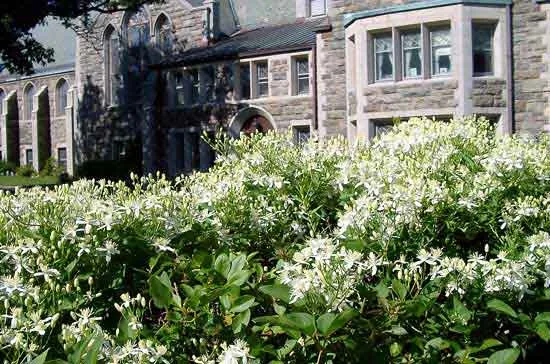
Sweet autumn clematis is a fast, twining vine that smothers a fence or arbor in tiny, sweet-scented white flowers from August into September, just as most of the garden winds down. It belongs to the buttercup family and hails from East Asia, and it climbs hard, reaching 15 to 30 feet (4.5 to 9 m) in a season once it settles in. The bloom is the draw, a froth of cross-shaped flowers thick enough to hide the leaves.
It asks for very little. Full sun overhead, cool shaded roots below, and ordinary well-drained soil are about all it wants, and it shrugs off cold all the way down to -29°F (-34°C). That same toughness is the catch. The plant self-seeds with abandon, and across the eastern and central US it has jumped the garden fence and crowded out native plants, which has landed it on invasive lists in many states.
Grow it with your eyes open. Cut the spent flowers before they set seed, keep it well away from woodlands, and it earns its place on a trellis. If that upkeep sounds like more than you want, the native Clematis virginiana gives you the same fragrant white show without the spread.
Care
The short version: plant it in full sun with its roots shaded and mulched, give it average well-drained soil and even moisture, cut it back hard each late winter, and deadhead before it sets seed to keep its spread in check.
Light
Give it full sun for the heaviest bloom, though it still flowers in partial shade. The classic clematis trick applies here: let the top bask in sun while you keep the roots cool below with mulch or a low plant at its feet.
Water
Aim for average, even moisture, watering roughly every 5 to 10 days while it gets going. Once established it turns tough and adaptable and rides out dry spells, but a cool, mulched root zone keeps it happiest.
Soil
It takes almost any well-drained ground, whether loam, clay, or sand. A pH anywhere from 5.5 to 7.5 suits it, so soil chemistry is rarely the thing that holds it back.
Temperature
This is a cold-hardy vine that handles winters down to -29°F (-34°C) and summer heat up to 100°F (38°C). That wide range is part of why it spreads so easily across the country.
Humidity
Ordinary outdoor humidity is plenty, so there's no level to manage. Airflow is what counts here, since still, damp air late in the season is what invites mildew onto the leaves.
Feeding
A single feed of balanced general-purpose fertilizer in spring is all it needs. This is a vigorous grower already, so there's no reason to push it harder.
Pruning
Because it flowers on new wood, cut the whole vine back to about 1 foot (30 cm) in late winter or early spring before growth starts. Just as important, deadhead the spent flowers before they set seed to rein in its heavy self-sowing.
Repotting
This is a ground-grown vine that rarely needs potting up. If you do keep one in a container, repot only when roots circle the pot, water runs straight through, or growth starts to stall.
Size & spacing
Expect a big vine, 15 to 30 feet (4.5 to 9 m) tall and just as wide, so give it a sturdy support and plenty of elbow room. Set plants far enough apart that air moves freely between them to keep late-season mildew down.
When to plant
This vine blooms on new wood, so the year revolves around a hard spring cutback. Set plants out in spring or fall, cut the whole thing down to about a foot in late winter, and the fresh growth carries the flowers from August into September. Snip those flowers off before the seed ripens, or you'll be pulling seedlings for years.
Northern hemisphere
Southern hemisphere
Typical months for a temperate climate: start earlier in warm zones, later where spring frosts linger.
- Plant: spring or fall
- Harvest: August to September
Hardiness
USDA hardiness zones: 4–9
Temperature: down to -34°C
Troubleshooting
Most of what goes wrong with sweet autumn clematis is the plant doing exactly what it does best, which is grow and spread. Watch for runaway seeding, the odd stem that wilts overnight, and a dusting of mildew late in the year. Match what you see below, then step in before it gets ahead of you.
Seedlings popping up everywhere and vines climbing over everything
This is the plant's invasive habit at work. After bloom it sets clouds of feathery, wind-borne seed that sprouts freely well beyond the bed, and its fast twining growth sprawls over whatever it reaches. Cut off the spent flowers before the seed heads ripen, pull volunteer seedlings while they are small, and keep it away from woodlands. The native Clematis virginiana is a fragrant stand-in worth choosing instead.
Fix:
- Deadhead and remove seed heads before seeds mature and disperse
- Pull or dig out seedlings and unwanted runners promptly
- Cut back hard and bag spent flowering/seeding growth
- Do not plant near woodlands or natural areas; consider the native Clematis virginiana instead
A stem suddenly wilts, blackens, and collapses
This is clematis wilt, a fungus that strikes a stem from the top down while the roots stay alive underneath. Stem injury or a dry spell at the base can bring on the same sudden collapse. Cut the affected growth back to healthy tissue or right to the ground, bin the prunings, and keep the roots cool and mulched so the plant pushes fresh shoots from the base. This species shrugs off wilt better than most clematis.
Fix:
- Cut affected stems back to healthy tissue or to ground level
- Remove and dispose of infected material
- Keep roots cool, moist and mulched to support regrowth from the base
A dusty white film or spots on the leaves
Late in the season the foliage can pick up powdery mildew or leaf spot, both of which take hold when air sits still around the plant. Thin crowded growth and space things out so air can move, strip off the worst leaves, and water at the base rather than over the top. A spot in full sun with good airflow keeps it from coming back.
Fix:
- Improve air circulation by thinning and proper spacing
- Remove badly affected foliage
- Avoid overhead watering
Toxicity
Treat this whole plant as off-limits to mouths and bare hands. Every part holds ranunculin, which turns into the irritant protoanemonin the moment a leaf or stem is chewed or crushed, and the ASPCA lists clematis as toxic to cats, dogs, and horses. The bitter, acrid taste usually stops an animal before it swallows much, so severe poisoning is rare, but the sap can still blister skin, so wear gloves when you prune.
Toxic to
Cats · Dogs · Horses · Rabbits · Livestock · Birds · People
Cats Mild
A cat that chews the leaves or stems drools, paws at its mouth, and often vomits or has loose stools. The harsh, bitter taste usually stops them before they eat enough to do real harm.
Dogs Mild
Expect drooling, a sore mouth, and an upset stomach with vomiting or diarrhea after a dog gnaws on the vine. Most spit it out fast once the acrid sap hits.
Horses Mild
Grazing the foliage leaves a horse salivating with a raw, irritated mouth, and it can bring on colic-like belly upset and loose droppings.
Rabbits Mild
The same protoanemonin that troubles cats and dogs blisters a rabbit's mouth and gut, so keep the vine and its trimmings out of reach. Stick to greens you know are safe.
Livestock Mild
Cattle, goats, and sheep that nibble the plant get mouth irritation and digestive upset, though the bitter sap means they rarely take more than a taste.
Birds Caution
There is little record of birds eating it, but the irritant sap is reason enough to keep poultry and pet birds away from the foliage and fresh prunings.
People Caution
No part of this plant is meant to be eaten, and the sap can blister bare skin on contact. Wear gloves when you prune and wash up afterward, and keep children from chewing on the stems.
Sap can irritate skin; wear gloves when pruning and wash hands after handling.
Helpline numbers

United States
ASPCA Animal Poison Control: (888) 426-4435 (fee applies)
Poison Control: (800) 222-1222



Canada
Poison Centres: 1-844-764-7669
Varieties
There aren't named garden cultivars to choose between here so much as a tangle of names to sort out. Two things are worth knowing before you buy.
Clematis terniflora (species)
The non-native species carries compound leaves with smooth, untoothed leaflet edges, which is the quickest way to tell it from the toothed-leaf native Clematis virginiana.
'Clematis paniculata' (name confusion)
It often shows up at nurseries under the wrong names C. paniculata, C. maximowicziana, or C. dioscoreifolia, but the true C. paniculata is a separate species from New Zealand.
How to propagate
This vine is so eager to reproduce that the real skill is making more of it without flooding the garden with seedlings. Cuttings and layering both copy a plant cleanly, while seed is best left controlled.
SeedEasy
After seed ripens in fall · 1-2 seasons
This vine seeds itself far too freely already, so sowing it on purpose is rarely worth doing. If you do let seed ripen in fall, expect a plant to take 1 to 2 seasons to settle in, but controlling the seed is the smarter move.
Stem cuttingsModerate
Late spring to summer · 1-2 seasons
Taking cuttings is the clean way to make more plants without scattering seed. Snip softwood or semi-ripe stems from late spring through summer, and a rooted cutting needs about 1 to 2 seasons to fill out.
LayeringEasy
Spring to summer · 1 season
The easiest route is layering, since the stems root on their own wherever they rest on the soil. Pin a stem down in spring or summer and it usually establishes within a single season.
Myths
Sweet autumn clematis and the native virgin's bower are the same plant.
They are two different species that only look alike. The native Clematis virginiana has toothed leaflet edges and stays in bounds, while the non-native Clematis terniflora has smooth edges and self-seeds hard enough to take over. If you want the fragrance without the invasion, plant the native virgin's bower instead.