Ornamental · Ranunculaceae
Meadow Rue
Thalictrum rochebruneanum
Airy clouds of flower on tall, slender stems, meadow rue brings soft height and motion to a part-shade border.
Partial shade
Every 5–10 days
USDA 4–7
4–6 ft · 1.2–1.8 m
Overview
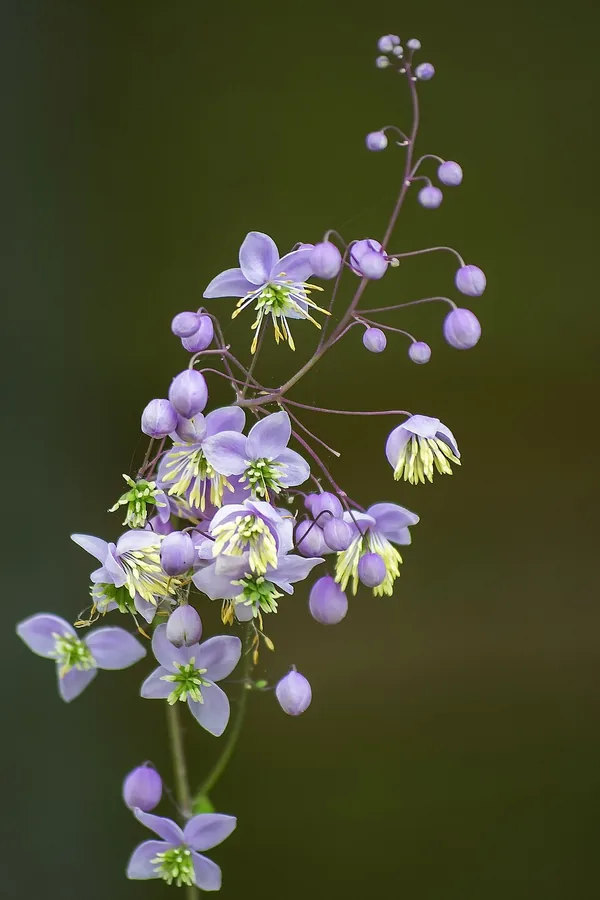
Meadow rue is a clump-forming perennial in the buttercup family, grown for the haze of tiny flowers it holds high above lacy, columbine-like foliage. The stems climb well over head height on some types, yet the whole plant reads as light and see-through rather than heavy. It earns its place at the back of a border, where you can look through it to whatever grows behind.
This is an easy plant once it's in the right spot. It wants part shade and steady moisture, and it sulks in dry, baking sun, so it suits the cooler, damper corners of a garden in zones 4 through 7. Give it those conditions and it asks for almost nothing else.
One thing to know before you plant it: meadow rue is in the same family as the buttercups, and its sap is an irritant. It isn't a herb and no part of it is food, despite the misleading common name. Treat it as an ornamental to look at, not to touch with bare hands.
Care
The short version: part shade, rich and reliably moist soil, and afternoon shade where summers run hot. Stake the tall types early, cut it to the ground in late fall, and divide the clump only when it starts to crowd itself.
Light
Meadow rue does best in part shade, and it will take full sun only where the soil stays moist and the summers stay mild. In hot regions, give it afternoon shade, since harsh midday sun scorches the foliage.
Water
Keep the soil consistently moist but never waterlogged, watering roughly every 5 to 10 days and more in a dry spell. Plants in full sun drink more than those in shade, and a thirsty plant in heat is the first to scorch.
Soil
Give it rich, humusy, well-drained loam that holds moisture without turning soggy. It isn't fussy about pH and grows happily in acid, neutral, or alkaline ground, so the texture matters far more than the chemistry.
Temperature
Meadow rue is fully hardy, shrugging off winter cold down to about -29°F (-34°C) and tolerating summer warmth up to around 86°F (30°C). It struggles most not in the cold but in hot, humid weather, when afternoon shade becomes essential.
Humidity
Ordinary outdoor humidity suits it fine, so there's no figure to aim for. What counts is air movement, since still, muggy air around crowded leaves is what invites powdery mildew and rust.
Feeding
Work some compost or a balanced feed into the soil as growth starts in spring, and that's usually all it needs for the year. Rich, humusy ground does most of the feeding, so heavy fertilizer is wasted on this plant.
Pruning
Cut the spent flower stems back after bloom to keep things tidy, then cut the whole plant to the ground in late fall or early spring. The tall species often need staking, while the sturdy-stemmed types usually stand on their own.
Repotting
Meadow rue prefers to stay put and resents disturbance. Divide the clump only every 3 to 4 years, in spring while it's dormant, and only when crowded, declining growth or smaller leaves tell you it needs rejuvenating.
Size & spacing
Plants stand 4 to 6 feet (122 to 183 cm) tall in flower, rising on slim stems from a much lower mound of leaves. Give each clump about 2 to 3 feet (61 to 91 cm) of room so air moves freely and the foliage stays dry.
When to plant
Meadow rue follows the seasons of a cold-winter garden. Sow fresh seed in fall or start it indoors in late winter, set young plants out after the spring frost has passed, and the airy flowers open from midsummer into early autumn.
Northern hemisphere
Southern hemisphere
Typical months for a temperate climate: start earlier in warm zones, later where spring frosts linger.
- Sow: Late winter to early spring; fresh seed germinates best, so fall sowing of fresh seed is also effective.
- Plant: Spring after frost, or fall.
- Harvest: July to September
Hardiness
USDA hardiness zones: 4–7
Temperature: down to -34°C
Troubleshooting
Meadow rue is a healthy plant, and most of its trouble comes from stale air or summer heat rather than anything serious. Read the early signs on the leaves and stems, then act before a fungus or a hot spell takes hold.
Crisped, drooping leaves through the heat of summer
Meadow rue dislikes hot, humid weather and burns in full afternoon sun, especially when the soil runs dry. Give it afternoon shade where summers turn fierce and keep the ground evenly moist. A layer of mulch holds that moisture and keeps the roots cool.
Fix:
- Provide afternoon shade in hot climates
- Keep soil evenly moist
- Mulch to conserve moisture
A dusty white film spreading across the leaves
This is powdery mildew, a fungus that settles in when the air sits still and damp. Thin and space the plants so air can move through them, and keep water off the foliage. Strip away the worst leaves and bin them rather than composting.
Fix:
- Improve air circulation by thinning and spacing plants
- Avoid overhead watering
- Remove and discard affected foliage
Orange-brown bumps on the underside of the leaves
Those raised pustules are rust, another fungus that thrives on wet, crowded foliage. Pick off the spotted leaves and destroy them, then open the clump up so the leaves dry faster after rain. Water at the base, never over the top.
Fix:
- Remove and destroy infected leaves
- Improve air circulation
- Avoid overhead irrigation
Tall stems bending or leaning under their own flowers
Top-heavy growth is the usual cause, and it gets worse on older plants or those grown in too much shade or wind. Slide a support in early, before the stems start to lean, since once they lodge they rarely straighten. More light builds sturdier stems, and the toughest types stand on their own.
Fix:
- Stake or provide support for tall stems
- Site in adequate light to promote sturdier stems
Toxicity
Handle meadow rue with a little care. Like the rest of the buttercup family, its sap holds protoanemonin, an irritant that can redden skin and upset the stomach if any part is chewed. Nothing on the plant is edible, so keep the leaves and cut stems away from pets, livestock, and children, and wear gloves when you prune.
Toxic to
Cats · Dogs · Horses · Rabbits · Livestock · Birds · People
Cats Mild
A cat that chews the leaves may drool and paw at its mouth, with maybe some vomiting or loose stool. The bitter, peppery sap usually puts them off before they eat much.
Dogs Mild
Watch for drooling, a sore mouth, and a brief bout of vomiting or diarrhea if a dog bites into a stem. The harsh taste tends to stop most dogs after the first nibble.
Horses Mild
The irritant sap can leave a horse with a raw mouth and mild colic if grazed, though the sharp flavor means horses rarely take more than a taste.
Rabbits Mild
A curious rabbit that samples the foliage may end up with mouth irritation and a touch of soft stool. Most leave it well alone once they taste the acrid sap.
Livestock Mild
Cattle, goats, and sheep can get a sore mouth and a queasy gut from the protoanemonin in the leaves, but the bitterness keeps grazing to a minimum.
Birds Caution
There's little firm guidance on birds, so treat the plant as a caution and keep cut stems and trimmings out of their reach.
People Caution
No part of meadow rue is food. The fresh sap can redden or irritate skin and sting the mouth, so wear gloves when cutting stems and keep the plant away from small children.
Wear gloves when cutting or handling cut stems to avoid sap contact with skin; wash hands after handling and keep cut foliage away from pets and small children.
Helpline numbers

United States
ASPCA Animal Poison Control: (888) 426-4435 (fee applies)
Poison Control: (800) 222-1222



Canada
Poison Centres: 1-844-764-7669
Varieties
Several meadow rues turn up in gardens, from sturdy giants to fluffy-flowered species. These are the ones worth knowing by name.
Thalictrum rochebruneanum Lavender Mist
This selection floats a haze of lavender-purple flowers and yellow stamens on tall, sturdy stems that hold themselves up without staking.
Thalictrum aquilegiifolium
Known as columbine meadowrue, it reaches 2 to 3 feet (60 to 90 cm) with fluffy powder-puff heads of pink, purple, or white over columbine-like leaves.
Thalictrum delavayi Hewitt's Double
It carries long-lasting fully double lavender flowers that hold their color far longer because they have no stamens to shed.
How to propagate
You can make more meadow rue by splitting an established clump or by raising it from seed, though neither route is quick and both reward a patient gardener.
DivisionModerate
Spring while dormant, roughly every 3-4 years. · Divisions may be slow to establish, often a season or more.
Lift the clump in spring while it's still dormant and split the crown, doing this only every 3 to 4 years when a plant starts to crowd itself. Keep the new divisions evenly moist and give them time, since they often take a season or more to settle in and look established.
SeedModerate
Sow fresh seed in fall, or start indoors in late winter to early spring. · One to several years to reach flowering size from seed.
Sow fresh seed in fall, or start it indoors in late winter to early spring, since fresh seed germinates far better than seed that has sat. Set the seedlings into rich, moist, humusy soil and be patient, because a plant raised from seed can take anywhere from one to several years to reach flowering size.
Myths
Meadow rue is a true rue and works the same way in herbal recipes.
The shared name is misleading. Meadow rue is a Thalictrum in the buttercup family, while true rue is Ruta graveolens, a citrus-family herb it isn't related to. Meadow rue is not a cooking or medicinal herb, and its sap is an irritant, so don't treat the two as interchangeable.
Buttercup-family ornamentals like meadow rue are completely harmless to handle.
Plants in this family carry ranunculin, which turns into the irritant protoanemonin the moment the tissue is crushed or chewed. Fresh sap can redden the skin and upset the stomach if swallowed, so glove up when you cut the stems.