Shrub · Ranunculaceae
Clematis
Clematis
Give it sun on its head and shade on its feet, and clematis climbs into a wall of bloom.
Full sun
Every 5–7 days
USDA 4–9
8–12 ft · 2.4–3.7 m
Overview
Clematis has earned its nickname as the queen of the climbers. It belongs to the buttercup family, Ranunculaceae, and ranges from vigorous wild species to the large-flowered hybrids that drape a trellis or arbor in saucer-sized blooms. Across USDA zones 4 to 9 it returns year after year as a hardy perennial vine.
The flowers arrive on a long timeline depending on the type. Many open in late spring to early summer and then circle back for a second show in late summer to early fall. The plant climbs by twisting its leaf stalks around thin supports, so it wants wires, netting, or a slim frame to grab rather than a solid post.
Clematis rewards patience more than fuss. Plant it deep, keep its roots cool and moist while its top basks in sun, and prune it to match its bloom group. Get those few things right and a young vine settles in to give you decades of bloom.
Care
The short version: full sun on the top with cool, shaded, evenly moist roots below, rich well-drained soil, and pruning matched to the plant's bloom group.
Light
Clematis flowers best in full sun, ideally 6 or more hours a day, though it takes partial sun or light shade. The old rule holds true: keep its head in the sun and its feet in the shade, since hot, bare roots cut the bloom.
Water
Give clematis at least 1 inch (2.5 cm) of water a week, more in dry spells, and never let the root zone bake. Mulch heavily to hold that moisture and keep the roots cool while the top sits in sun. Even watering every 5 to 7 days keeps it growing strong.
Soil
Plant in rich, fertile, well-drained loam, though clematis tolerates clay or sandy ground once it's amended. It handles a wide pH band from 6.0 to 8.0, so most garden soils suit it after digging in compost.
Temperature
Clematis is tough, riding out winters down to -29°F (-34°C) and summers up to 95°F (35°C). That cold hardiness is why it thrives as a perennial across zones 4 to 9.
Humidity
Ordinary outdoor humidity is fine, so there's no number to chase. Good air movement matters far more, since still, crowded growth invites powdery mildew and stem rot.
Feeding
Feed a balanced fertilizer in spring as growth starts, then through the season. Hold off while the plant is in flower, and go light on nitrogen, which pushes soft growth that wilt finds easy to attack.
Pruning
Prune by bloom group, because cutting the wrong type at the wrong time costs you flowers. Group 1 old-wood bloomers get only a light trim right after flowering, Group 2 large-flowered hybrids take a light prune to the topmost plump buds in late winter, and Group 3 new-wood types are cut hard to 2 to 3 feet in late winter.
Repotting
Clematis rarely needs repotting and resents having its roots disturbed. Move it only when roots circle or push out of the pot, growth stalls, or the soil dries out far too fast.
Size & spacing
A mature vine climbs 8 to 12 feet (2.4 to 3.7 m) tall and spreads 2 to 6 feet (61 to 183 cm) wide. Give it that room and a support to twine through so air can move around the leaves.
When to plant
Clematis goes in the ground in spring or early fall, while the soil is workable and the weather is mild. Plant it deep, with the crown an inch or two below the surface, and it settles its roots before the heat or cold sets in. Expect the first flowers in late spring to early summer, often with a second flush later in the season.
Northern hemisphere
Southern hemisphere
Typical months for a temperate climate: start earlier in warm zones, later where spring frosts linger.
- Plant: spring or early fall
- Harvest: late spring to early summer, often reblooming in late summer to early fall
Hardiness
USDA hardiness zones: 4–9
Temperature: down to -34°C
Troubleshooting
Most clematis trouble shows up on the stems and leaves, from a shoot that collapses overnight to a dusty film on the foliage. Catch these early and you can cut out the problem before it spreads. Match what you see below, then act while it still helps.
A shoot wilts and blackens right as buds open
This is clematis wilt, a fungal stem rot that strikes just as the buds or flowers form, dropping a whole shoot while the rest of the plant stays green. Look low on the stem near the soil line for dark lesions. Cut every affected stem back to healthy tissue or below ground, disinfect your pruners between cuts, and keep watering. A plant set with its crown a couple inches deep usually resprouts from below the following season.
Fix:
- Cut out and destroy all affected stems back to healthy tissue or below soil level
- Disinfect pruners between cuts
- Keep the plant watered; plants set with the crown a couple inches deep usually resprout from below ground the following season
Ragged holes in young shoots with slime trails
Chewed young shoots and ragged holes on newly planted vines usually mean slugs and snails, betrayed by the silvery slime trails they leave behind. If there are no trails, check after dark for earwigs tucked into the flowers and crevices. Scatter iron phosphate bait around young plants, clear away debris and hiding spots, and trap earwigs with rolled cardboard until the shoots harden off.
Fix:
- Apply iron phosphate slug bait around young plants
- Remove hiding places and garden debris
- Trap earwigs with rolled cardboard or shallow traps
White powdery film on the leaves with curled, stunted growth
A dusty white coating on the upper leaf surface, paired with dwarfed and distorted foliage, points to powdery mildew taking hold in still, crowded air. Wipe a leaf to tell it apart from clean dust, since the film clings and the leaf is misshapen. Strip the affected leaves, thin the vine for better airflow, and keep water off the foliage. A labeled fungicide early in the infection helps if it spreads.
Fix:
- Remove affected leaves
- Improve airflow by thinning and proper spacing
- Avoid overhead watering
- Apply a labeled fungicide early in infection if needed
Sticky new growth crowded with small soft insects
Clusters of soft green or dark insects on the shoot tips, along with sticky honeydew and maybe sooty mold or ants, mean aphids are feeding on the tender new growth. Check the undersides of young leaves to confirm. Hose off a light run with plain water, or spray insecticidal soap every 5 to 7 days for about 3 rounds. Save a systemic insecticide for heavy, stubborn infestations.
Fix:
- Spray with insecticidal soap, repeating every 5 to 7 days for about 3 applications
- Hose off light infestations with water
- Use a systemic insecticide only for heavy, persistent infestations
Toxicity
Clematis is not a plant to eat or to leave within easy reach of pets. Every part holds protoanemonin, an irritant that forms when the leaves or stems are chewed or crushed, and the ASPCA lists the vine as toxic to cats, dogs, and horses. The bitter taste keeps most animals from eating much, but the sap can still sting skin and mouths, so handle it with care.
Toxic to
Cats · Dogs · Horses · Rabbits · Livestock · Birds · People
Cats Mild
Chewing the leaves or stems brings on drooling, vomiting, and diarrhea, with a sore, irritated mouth. The bitter, acrid taste usually stops a cat before it eats enough to do real harm.
Dogs Mild
A dog that gnaws the foliage tends to drool, gag, and develop an upset stomach with mouth irritation. The sharp taste keeps most from swallowing much, so serious poisoning is uncommon.
Horses Mild
Grazing the plant can leave a horse salivating heavily, off its feed, and with oral blistering and colicky discomfort. Horses normally avoid the bitter foliage when better forage is on hand.
Rabbits Caution
The same protoanemonin that troubles cats and dogs will irritate a rabbit's mouth and gut, so treat the vine as off-limits and fence it from runs and hutches.
Livestock Caution
Cattle, goats, and sheep can suffer mouth and digestive irritation if they browse clematis, though the acrid taste keeps most away unless pasture runs short. Keep the vine out of reach of grazing stock.
Birds Caution
The irritant sap makes clematis a poor choice around pet birds and poultry, so keep curious beaks from pecking the foliage and stems.
People Caution
No part of the plant is meant to be eaten, and the sap can redden and blister skin or sting the mouth on contact. Wear gloves when you prune and wash up afterward, and keep small children from chewing the leaves.
Sap can irritate skin; wear gloves when pruning and wash hands afterward.
Helpline numbers

United States
ASPCA Animal Poison Control: (888) 426-4435 (fee applies)
Poison Control: (800) 222-1222



Canada
Poison Centres: 1-844-764-7669
Varieties
Clematis runs to hundreds of species and cultivars, but a few turn up again and again in gardens. These are the ones worth knowing by name, and the bloom group each one falls into.
Jackmanii
This classic hybrid carries large, deep velvety-purple flowers and belongs to Group 3, blooming on new wood and taking a hard cutback each late winter.
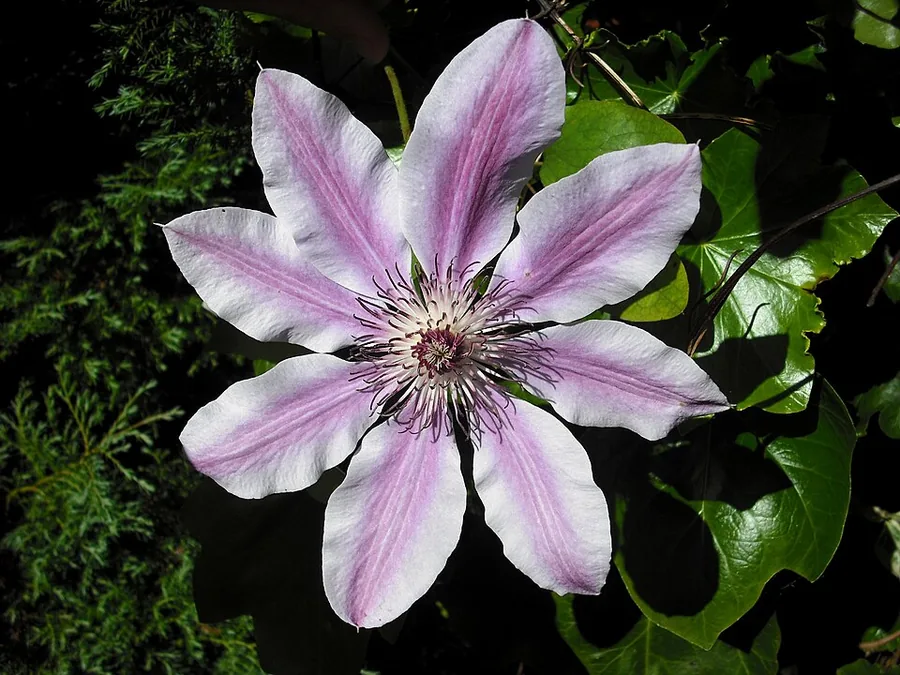
Nelly Moser
A Group 2 large-flowered hybrid, it shows pale pink petals each marked with a darker carmine bar, and since strong sun fades those colors it does best with some shade.
Henryi
This vigorous Group 2 large-flowered hybrid opens big creamy-white flowers set off by dark anthers.
Sweet autumn clematis (Clematis terniflora)
It smothers itself in small fragrant white flowers late in the season, but it self-seeds so aggressively and has turned so invasive across parts of the eastern US that it is not recommended for gardens.
Clematis montana
A vigorous early species that blooms in spring with masses of small flowers, this Group 1 type is pruned only lightly and only after it finishes flowering.
How to propagate
Clematis is slow to multiply but not hard, and the easiest routes copy a plant you already have rather than starting from seed.
LayeringEasy
Spring to summer · A few months to a year
The most reliable way to make more clematis is layering. Pin a low, flexible stem against the soil from spring through summer and let it root where it touches, then sever the new plant once it takes hold over the next few months to a year.
Stem cuttingsModerate
Late spring to early summer · Several weeks to months
From late spring into early summer, take semi-ripe internodal cuttings from the current season's growth. They root over several weeks to a few months, though this takes more care than layering.
DivisionModerate
Early spring · A season
Lift and split established crowns in early spring, working gently because clematis resents heavy root disturbance. Give the divisions a full season to settle in before they hit their stride.
Myths
Clematis is harmless to pets because it is just a flowering garden vine.
It sits in the buttercup family and holds protoanemonin, an irritant the ASPCA lists as toxic to cats, dogs, and horses. Chewing it can bring on drooling, vomiting, diarrhea, and a sore mouth. The bitter taste usually limits how much an animal eats, but the vine is far from harmless.
All clematis should be pruned hard every late winter.
How you prune depends entirely on the bloom group. Group 1 flowers on old wood and only wants a light trim after it blooms, the Group 2 large-flowered hybrids take a light prune, and only the new-wood Group 3 gets cut back hard. Cut an old-wood type to the ground and you remove that year's flowers.