Houseplant · Asteraceae
String of Bananas
Curio radicans
Give it bright light, gritty soil, and a dry rest between drinks, and string of bananas spills over the pot in no time.
Bright indirect
50–77°F · 10–25°C
USDA 10–11
12–35 in · 30–90 cm
Overview
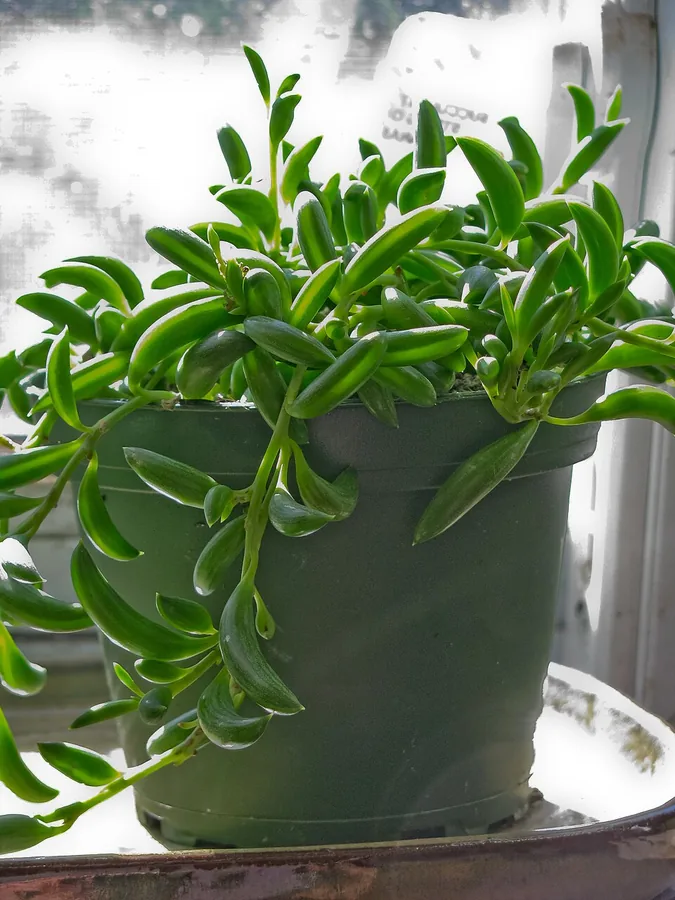
String of bananas is a trailing succulent named for its plump, banana-shaped leaves that hang down the side of a pot in long, leafy ropes. It comes from southern Africa and belongs to the daisy family, the same group as its cousins string of pearls and string of fishhooks. Indoors it grows fast and forgiving, which is a big part of why people love it.
Each curved leaf works as a little water tank, and a faint stripe down the side acts as a window that lets light reach the inside. That built-in storage is why the plant shrugs off a missed watering and why soggy soil is its one real enemy. Treat it like the desert plant it is and it asks for very little.
Hang it in a bright window or set it on a high shelf and the stems can reach a few feet long. The same trailing habit that makes it a striking houseplant also keeps the leaves up out of easy reach, which matters because every part is toxic to pets and people if eaten.
Care
The short version: bright indirect light, a gritty cactus mix that drains fast, and water only once the top half of the soil has dried out. Go light in winter, and never let the pot sit in water.
Light
Give it bright, indirect light, the kind a few feet back from a sunny window. It puts up with some direct morning sun and a bit of shade, but harsh afternoon rays scorch the leaves brown.
Water
Water only when the top half of the soil has dried out, then soak it until the excess drains away. This is a drought-tolerant succulent that rots if it stays wet, so in winter hold off almost entirely and water just enough to keep the leaves from shriveling.
Soil
Use a gritty, fast-draining cactus or succulent mix so water runs straight through. The plant is easy about acidity and takes anything from pH 6.0 to 8.0, but it will not forgive a heavy mix that holds water around the roots.
Temperature
Normal room warmth suits it, ideally 50°F to 77°F (10°C to 25°C). Keep it above freezing and away from cold drafts, since it has no tolerance for frost.
Humidity
This is a low-humidity plant that's right at home in dry indoor air. There's no need to mist it or fuss over a number, and damp, stuffy air does more harm than good.
Feeding
Feed lightly from spring through summer while it's actively growing, about once a month. Use a diluted balanced or cactus fertilizer, and stop over winter when growth slows.
Pruning
Trim back any leggy or bare stems to push fuller growth, and pinch the tips to shape it. Don't throw the cuttings away, since each piece roots into a new plant.
Repotting
Repot only every 2 to 3 years, or once it's clearly crowded, because it flowers and grows happily when a little snug. Signs it's ready include roots poking through the drainage holes and soil that dries out almost as soon as you water.
Size & spacing
The trailing stems reach 12 to 35 inches (30 to 90 cm) long and spill the same distance over the pot. Give it room to hang free from a shelf or basket so the strands don't tangle or mat.
Troubleshooting
Most string of bananas trouble traces back to water, either too little or far too much. The leaves tell you which one fast, so learn to read them. Match what you see below and fix it before a wrinkle becomes rot.
Mushy, blackening stems that collapse at the base
This is root rot, the one problem most likely to kill the plant, and it comes from too much water sitting around the roots. Stop watering and let the mix dry right out, then unpot and cut away anything brown and soft. Salvage a few firm stem cuttings and restart them in fresh gritty mix before the rot spreads.
Fix:
- Stop watering and let the mix dry out
- Unpot and cut away rotted roots and stems
- Take healthy stem cuttings and restart in fresh gritty mix
- Repot into fast-draining cactus medium in a pot with drainage
Shriveled, wrinkled leaves that have lost their plump shape
This is plain thirst. The leaves act as water tanks, and when the soil runs bone dry they wrinkle and deflate. Water the plant deeply until it drains from the bottom, and the beads usually firm back up within a day or two.
Fix:
- Water thoroughly until it drains from the bottom
- Resume watering whenever the top half of the soil is dry
- Ensure the pot has drainage and the mix is not hydrophobic
Leaves turning brown or reddish on the sunny side
This is sunburn from too much harsh light. The beads facing the window scorch first under intense or hot afternoon sun. Move the plant into bright indirect light and shade it from the strongest midday rays, then build its light tolerance back up slowly.
Fix:
- Move to bright indirect light
- Shade from intense afternoon summer sun
- Acclimate gradually before increasing light
Toxicity
Keep this plant away from animals and out of reach of children. Every part carries pyrrolizidine alkaloids and a milky sap that irritates skin, so it is toxic to cats and dogs and a hazard to other animals and people if eaten. Hang it high, and wash your hands after you trim it.
Toxic to
Cats · Dogs · Horses · Rabbits · Livestock · Birds · People
Cats Toxic
A cat that chews the stems usually drools, throws up, and turns off its food. Diarrhea and a flat, sleepy mood often follow, and a big mouthful can strain the liver.
Dogs Toxic
Dogs react much the same way. Watch for vomiting, loose stools, drooling, and a tired, off-color dog after it has been nibbling the trailing stems.
Horses Toxic
The same pyrrolizidine alkaloids run through the genus, so a grazing horse can suffer stomach trouble, and repeated browsing carries a real risk of liver damage over time.
Rabbits Caution
There's no specific data for rabbits, but the toxin works across mammals, so treat it as off limits. A nibbling rabbit could end up with an upset gut and low energy.
Livestock Toxic
Cattle and other grazers are listed as at risk. The alkaloids build up with steady browsing and can scar the liver, on top of the nausea and dullness a single feed brings on.
Birds Caution
Birds haven't been studied directly here, so keep them away to be safe. The irritant sap and alkaloids give no reason to think a curious bird would tolerate a bite.
People Caution
No part of this plant is food. Swallowing it can leave you nauseous with an upset stomach, and the milky sap may redden or irritate skin, so wash your hands after pruning.
Wear gloves or wash hands after handling, as the irritant sap can cause contact dermatitis.
Helpline numbers

United States
ASPCA Animal Poison Control: (888) 426-4435 (fee applies)
Poison Control: (800) 222-1222



Canada
Poison Centres: 1-844-764-7669
Varieties
There isn't a long list of named forms, but one selection turns up often enough to know by name.
Curio radicans 'Fish Hooks'
A selection grown for its sharply curved, hook-shaped leaves, which is where the nickname string of fishhooks comes from.
How to propagate
String of bananas multiplies almost on its own, and the trimmings you take to keep it tidy are exactly what you root into new plants.
Stem cuttingsEasy
Spring through summer during active growth · About 2 to 4 weeks to root
This is the fast, easy way nearly everyone uses. Take cuttings in spring or summer while the plant is growing, let the cut ends dry and callus for a day, then lay or tuck the stems onto gritty, fast-draining mix. Keep it lightly moist and the pieces root in about 2 to 4 weeks.
SeedModerate
Spring · Several weeks to months
Seed works but it's slow and rarely worth the wait next to cuttings. Sow in spring on a fast-draining mix, keep it warm, and expect several weeks to months before you have plants worth potting on.
Myths
The correct botanical name is Senecio radicans.
Kew's Plants of the World Online now treats Curio radicans as the accepted name, and lists Senecio radicans as an old synonym. You'll still see it sold under the Senecio label everywhere, but Curio radicans is the up-to-date name.